Co-Living Compliance Tracking Software: Rental Protection
June 7, 2026
You usually notice compliance when something goes wrong.
A city inspector asks for occupancy records. An HOA sends a violation notice about parking, trash bins, or quiet hours. A resident disputes a fee and says the house rules were changed after move-in. Your maintenance lead swears the smoke detector check was done, but nobody can find proof. If you run co-living or room-by-room rentals, that kind of scramble is familiar.
Most operators don't fail because they ignore compliance. They fail because they manage it in too many places at once. A lease addendum sits in email. A permit renewal lives on one manager's calendar. House rules are saved as three different PDFs with similar file names. The access log is trapped in a smart lock app. When a dispute or inspection hits, the problem isn't just the rule itself. It's the missing record.
The Hidden Risks of Co-Living Compliance
Co-living creates a different compliance burden than a standard single-family rental.
You aren't just managing a property. You're managing shared kitchens, room-by-room contracts, frequent turnover, occupancy limits, parking policies, noise complaints, guest rules, safety checks, and often a mix of city rules, state landlord law, insurance requirements, and HOA restrictions. A duplex rented to one family has one lease file. A co-living house may have multiple resident agreements, separate notices, shared-space policies, and recurring tasks that need proof.
Where operators get exposed
The biggest legal headaches usually start with small misses:
- Occupancy drift: A house starts compliant, then one extra person moves in, a temporary guest stays too long, or a converted room no longer fits local use rules.
- House rule confusion: Staff enforce one version of quiet hours, residents signed another, and no one can show which version was active on the dispute date.
- Safety records gaps: GFCI tests, smoke alarm checks, extinguisher service, or egress issues get handled informally with no clean audit trail.
- Licensing uncertainty: A host expands into a new city and assumes the same operating model applies, even though property management licensing requirements can change by market and business structure.
That last point trips up more operators than it should. Co-living businesses often grow one house at a time, which makes legal complexity feel manageable until it suddenly isn't.
Practical rule: If you can't show who approved something, when it happened, and what document applied at that moment, you don't have a defensible process. You have a memory problem.
Why spreadsheets stop working
Spreadsheets can track tasks. Shared drives can store files. Calendar reminders can warn you about deadlines.
None of those tools, on their own, create a reliable compliance system.
They don't connect a resident complaint to the signed agreement, the maintenance follow-up, the inspection evidence, and the final resolution. They also break down fast when more than one person touches the process. In co-living, that's common. Leasing, maintenance, cleaning, operations, and ownership all affect compliance.
Compliance Tracking Software becomes useful not as corporate jargon, but as a way to turn scattered records into one operating system for obligations, evidence, reminders, and accountability.
What Is Compliance Tracking Software Really
The simplest way to think about compliance tracking software is this: it's a living digital binder.
A normal binder stores documents after the fact. Compliance tracking software stores the documents, but it also watches dates, tracks tasks, logs activity, and helps you prove that a policy or action occurred. For a co-living operator, that means one place to manage leases, addenda, permits, inspection records, house rules, resident notices, and recurring compliance tasks.
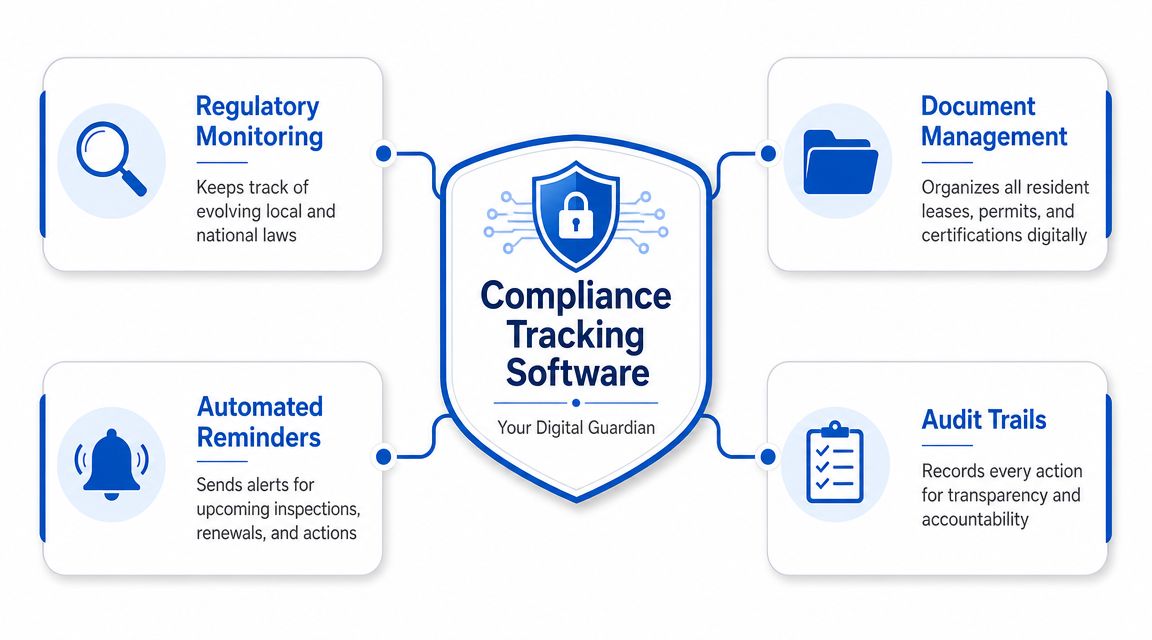
It is not just cloud storage
Dropbox, Google Drive, and shared folders are useful. They are not compliance systems.
A storage folder answers one question: "Where is the file?" Compliance tracking software answers harder questions:
- What obligation applies here
- Who owns it
- When is it due
- What evidence proves it was completed
- What changed since the last review
- Can I show a clean record to an inspector, owner, or attorney
That's the difference. Storage is passive. Compliance software is operational.
What modern tools do differently
The category has shifted in a big way. By 2026, 57% of compliance programs were described as either “managing” or “optimizing,” the two highest maturity levels, with AI-powered automated monitoring replacing manual tracking as the industry standard, according to Secureframe's 2026 compliance statistics roundup.
For non-technical operators, that matters because the software is no longer just a digital filing cabinet. It has become a system that can reduce follow-up work, flag gaps earlier, and keep evidence organized without depending on someone's memory.
If you're also comparing it to broader operations tools, it helps to understand what property management software covers versus where dedicated compliance workflows add structure. The overlap is real, but the purpose is different. Property management software runs the property. Compliance tracking software proves the property was run correctly.
A co-living example
Say your city requires life-safety inspections, your HOA restricts parking and exterior storage, and your resident agreement includes guest limits and quiet hours.
A basic setup might look like this:
| Need | Manual method | Compliance software method |
|---|---|---|
| House rules | PDF in email thread | Version-controlled policy with acknowledgement record |
| Inspection deadline | Calendar note | Assigned task with reminders and completion evidence |
| Resident dispute | Search inbox and texts | Linked communication log and audit trail |
| Permit renewal | Spreadsheet row | Centralized obligation with due date and owner |
Good compliance software doesn't just help you remember. It helps you reconstruct the story later, when someone questions what happened.
That reconstruction is what saves operators in real disputes.
Core Features Every Co-Living Operator Needs
Most feature lists for compliance software are written for large corporate teams. Co-living operators need a more practical filter. Ask one question: "Will this feature help me prove compliance at the property level, with real residents, real tasks, and real disputes?"
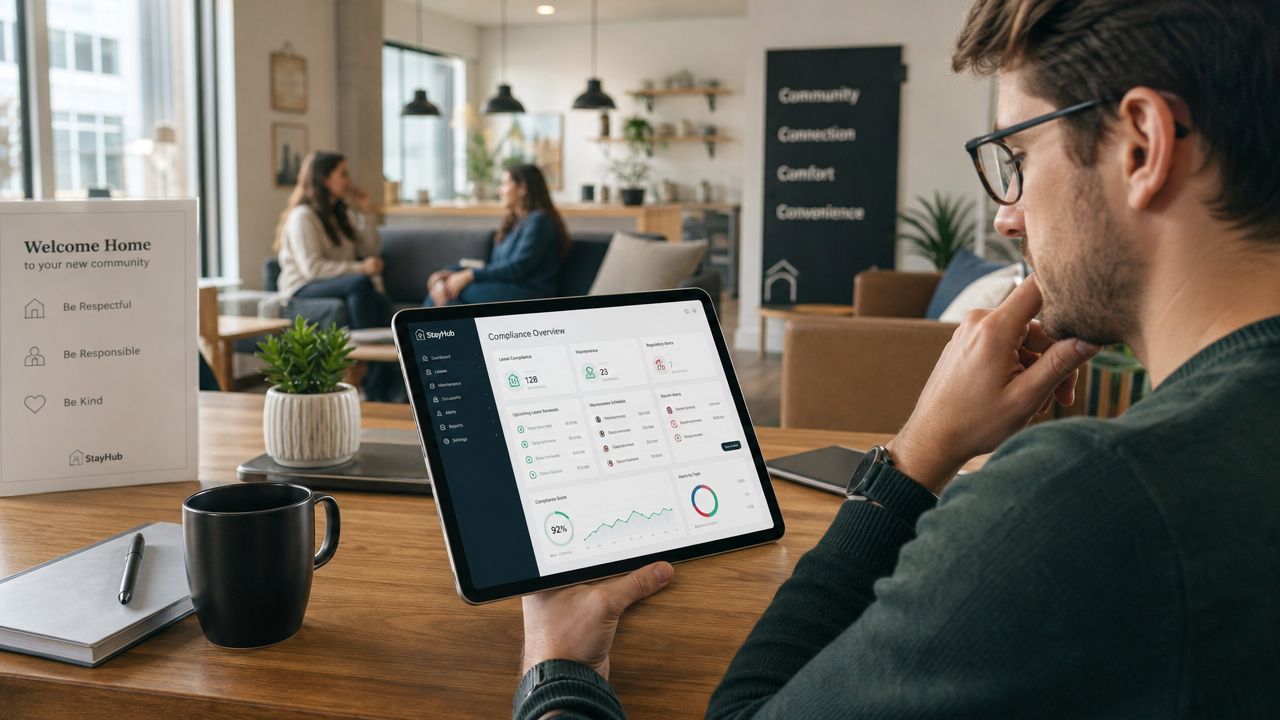
Modern compliance tools now center on continuous monitoring and automated evidence collection, including automatically mapping controls to regulations and continuously pulling and timestamping audit evidence from connected systems, as described in Usercentrics' overview of compliance tracking software. In plain terms, the best systems don't wait for audit week. They collect proof as work happens.
Audit trails that hold up in disputes
An audit trail is your event history. It should show who uploaded a file, changed a rule, assigned a task, completed an inspection item, or acknowledged a document.
In co-living, this matters most when a resident says:
- they never received a notice
- the house rules changed unexpectedly
- staff entered without proper communication
- a fee or warning was applied inconsistently
A timestamped record won't solve every conflict, but it gives you a starting point based on evidence instead of staff recollection.
Document management with version control
Operators often think they need storage. What they need is controlled storage.
That means:
- Current versus archived versions: Your team should know which resident handbook is active and which one is outdated.
- Signed documents attached to the right resident or room: Not buried in a generic folder.
- Searchable categories: Lease, addendum, inspection, permit, insurance, HOA notice, maintenance certification.
- Expiration awareness: Some documents aren't just for reference. They trigger future action.
If you can't tell which rule set a resident agreed to on move-in day, you have an enforcement problem.
Automated reminders that are tied to obligations
Reminders only work when they connect to a real responsibility.
A useful system should remind the right person about:
- recurring safety checks
- permit or registration renewals
- lease document follow-up
- HOA response deadlines
- corrective actions after an inspection or complaint
A weak system sends generic alerts that everyone ignores. A strong one ties the reminder to the property, the task owner, the due date, and the proof required to close it.
The reminder isn't the value. The closed-loop task is the value.
Role-based access for lean teams
Co-living operations usually involve overlapping responsibilities. Leasing staff need lease and resident records. Maintenance teams need work orders, safety checklists, and entry documentation. Owners want summary visibility, not editing access to everything.
Role-based access helps you avoid two common mistakes:
- Everyone can edit everything.
- Only one admin knows where anything is.
Both setups create risk. Permissions should be simple enough to manage but strict enough to protect records.
Reporting that answers operational questions
Reporting sounds boring until you need it.
For co-living, the best reports are usually not enterprise dashboards with dozens of charts. They're simple views that answer practical questions fast:
- Which properties have overdue safety tasks?
- Which lease files are incomplete?
- Which notices are still awaiting acknowledgement?
- Which inspections generated corrective actions that remain open?
- Which rooms or homes create recurring complaint patterns?
The feature set that actually matters
If you're evaluating tools, keep this shortlist:
- Audit trail capability: You need action history, not just uploads.
- Document control: Files should be organized, searchable, and versioned.
- Task automation: Deadlines must turn into assigned work.
- Permissions: Teams should see what they need and no more.
- Reporting: Managers need fast visibility across houses and tasks.
Many operators get distracted by flashy dashboards. The boring features are usually the ones that protect the business.
Real-World Compliance Risks and Software Solutions
The best way to judge compliance tracking software is to test it against messy, property-level problems. Co-living has plenty of them.
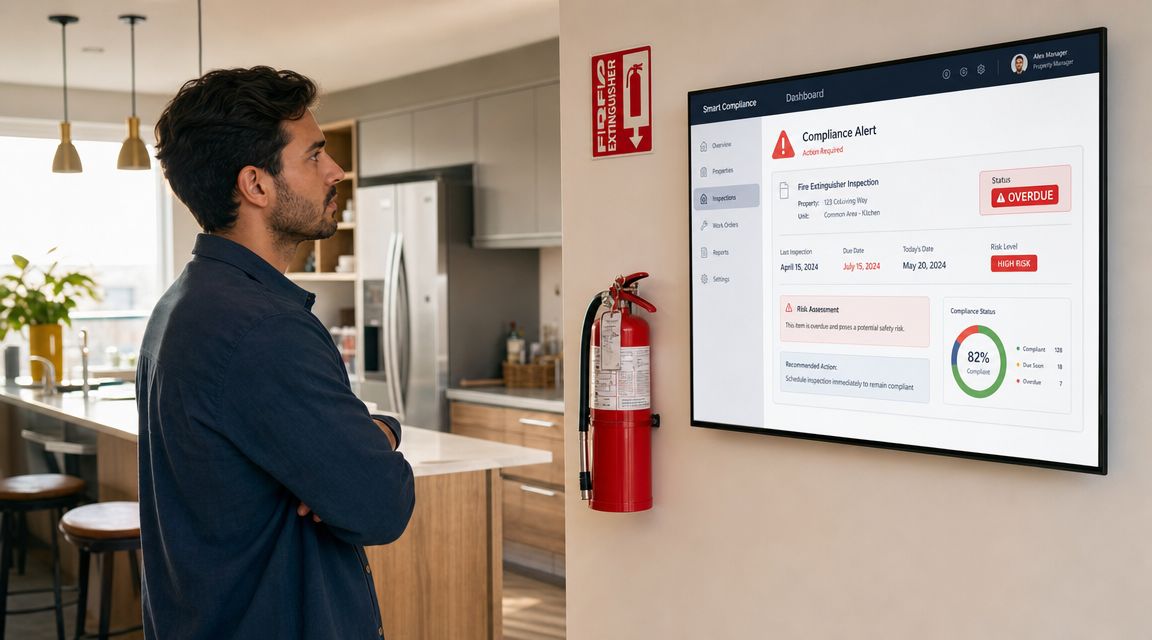
Effective compliance software works best when it replaces point-in-time spreadsheet review with continuous monitoring, automatically documenting obligations and collecting evidence to reduce manual oversight and regulatory exposure, as described in Sirion's guide to compliance tracking software. For co-living, that difference shows up in four areas.
Occupancy and zoning pressure
A standard rental rarely gets questioned for how many unrelated adults live there. Co-living does.
The risk isn't only over-occupancy. It's also room configuration, egress, parking ratios, neighborhood complaints, and whether a property is operating within local definitions for shared housing.
A manual approach usually looks like this: one spreadsheet for room assignments, another for lease dates, and a separate notes thread for exceptions. That setup falls apart when an inspector or neighbor complaint forces a quick response.
A better system links:
- room count and resident roster
- signed agreements
- move-in and move-out dates
- local occupancy notes
- internal approvals for exceptions
- evidence of notices or corrective action
If a house gets reviewed, you want one clean chain of records.
HOA rules and resident agreements
HOA restrictions are easy to underestimate because they often look operational rather than legal. Parking placement, trash can timing, exterior furniture, guest behavior, noise, and use of common areas can all trigger conflict.
The usual failure point is inconsistency. The HOA says one thing, your house rules say another, and the resident signed an older document version.
Software helps by creating a single source of truth for:
| Risk area | What goes wrong manually | What better software does |
|---|---|---|
| Parking | Verbal warnings with no record | Logs notice history and acknowledgement |
| Quiet hours | Different managers enforce differently | Ties enforcement to current policy version |
| Shared spaces | Cleaning rules live in chat threads | Stores policy and incident records together |
| Guest limits | Exceptions aren't documented | Records approvals and related resident communication |
One overlooked benefit is fairness. Clear records make enforcement more consistent, which reduces resident resentment and owner exposure.
Tenant communications and dispute handling
In co-living, a lot of legal friction starts as informal communication. A resident texts about mold. Another says a roommate is threatening them. Someone complains that staff entered without warning. If those conversations stay in personal phones, inboxes, or scattered apps, you've lost the timeline.
This kind of workflow demo helps show why integrated records matter:
What works better is a centralized communication log tied to the resident, room, and property. Then you can attach notices, maintenance follow-up, photos, and outcomes in the same record.
When a dispute escalates, the winner is often the side with the cleaner timeline.
That doesn't mean every message needs a legal review. It means the business needs a consistent place to capture what matters.
Safety tasks and defensible maintenance records
Operators often think they're compliant because the work was done.
But inspectors, insurers, attorneys, and sometimes residents care about something more specific: can you prove it was done, when, by whom, and whether any follow-up was required?
For co-living houses, the list often includes:
- Smoke and CO checks: Not just completion, but date and unit location.
- Fire extinguisher servicing: Along with replacement or deficiency notes.
- Habitability repairs: Especially items affecting bathrooms, kitchens, HVAC, locks, leaks, and electrical outlets.
- Common-area hazards: Trip risks, broken handrails, blocked exits, overloaded outlets, damaged appliances.
A strong software setup creates a trail from report to task to completion evidence. If your smart locks, messaging, and maintenance records are integrated, access events and resident communications become easier to document as part of that record instead of living in separate tools.
How to Choose and Implement Your Compliance System
Most operators don't need the biggest platform. They need the one their team will use consistently.
That usually means choosing software that fits residential operations, handles repeatable tasks well, and doesn't force a co-living business into an enterprise compliance template built for a bank or hospital.
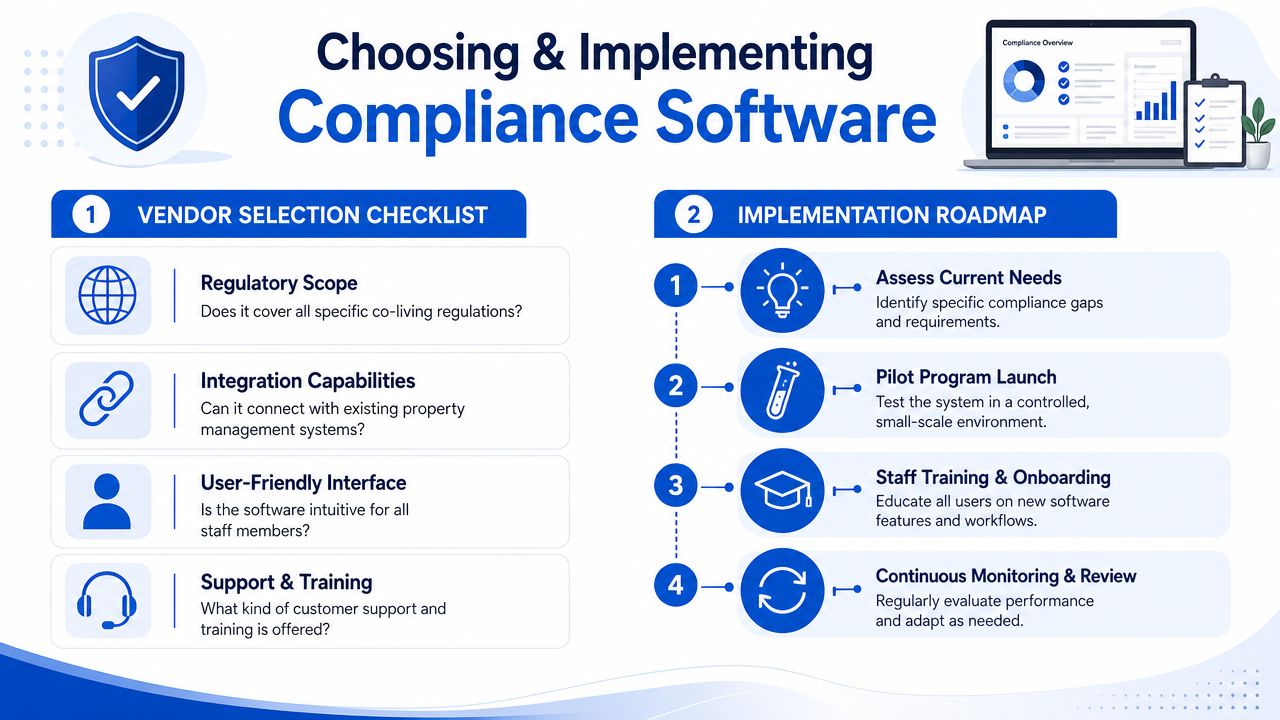
Vendor selection checklist
For operators working across more than one city, multi-framework control mapping is especially valuable because one control library can satisfy several regulatory regimes at once, reducing duplicated effort, as explained in Comply's guide to features in compliance software. In co-living terms, that means one internal checklist or policy set can support multiple local requirements without rebuilding everything from scratch.
Use that principle when screening vendors.
- Regulatory fit: Ask whether the system can handle local housing rules, internal policies, HOA documents, safety tasks, and resident acknowledgements. If it's built only for cybersecurity audits, your team may spend too much time adapting it.
- Property-level structure: Make sure records can be organized by property, room, resident, and task. Generic compliance software sometimes stops at department or project level, which isn't enough for shared housing.
- Integration options: If you use smart locks, e-signature tools, maintenance systems, or resident messaging, ask what can be connected. If your document-heavy workflows are still manual, improving them with automated document workflow tools can reduce duplicate entry and missing records.
- Permissions model: You want clear role-based access for leasing, maintenance, field managers, regional leads, and ownership.
- Evidence handling: Ask how photos, signed PDFs, checklists, and notes are attached to tasks. If proof collection is clunky, your team won't keep records current.
- Reporting usability: Have the vendor show you overdue tasks, open corrective actions, incomplete lease files, and property-level status views. Don't accept abstract demos.
- Residential pricing logic: Co-living operators should pay attention to whether pricing scales by user, property, unit, or another model. The wrong pricing structure can punish growth.
Questions worth asking in a demo
Don't ask only what the product can do. Ask how it behaves when something goes wrong.
Try questions like:
- How do we show which version of a resident policy was active on a specific date?
- Can we assign recurring safety checks by property and attach photo proof?
- What happens if a due date is missed?
- Can we restrict maintenance users from editing lease documents?
- Can one issue be linked to resident messages, work orders, and final resolution notes?
Those answers reveal whether the tool is operational or just presentational.
Buy for exception handling, not for the polished happy path. Normal days are easy. Disputes are where software earns its keep.
A simple implementation roadmap
Once you've picked a tool, keep rollout narrow and practical.
Step 1: Audit your obligations
List the things you must track, not the things you wish you tracked.
Start with:
- leases and addenda
- permits and registrations
- safety inspections
- HOA obligations
- resident notices
- maintenance items with legal significance
- internal operating rules such as guest limits and quiet hours
Step 2: Centralize your records
Move active documents into one structure. Standardize names, categories, and ownership.
Don't migrate junk blindly. Archive outdated files, identify the current policy set, and fix missing signature records before importing.
Step 3: Build automations around recurring risk
Set reminders and workflows for deadlines that repeat or trigger headaches.
Good first candidates include:
- inspection cycles
- expiring permits
- missing lease items
- unresolved corrective actions
- acknowledgement tracking for updated house rules
Step 4: Train by scenario, not by menu
Don't teach staff every button. Teach them what to do when a resident complains, when a safety task is completed, when a notice must be sent, and when an inspector requests records.
That training style sticks because it mirrors actual work.
Pilot one property or one region first if your portfolio is messy. A controlled rollout usually beats a full-portfolio launch with weak data.
The True ROI of Proactive Compliance
Operators often treat compliance tracking software as overhead until they compare it to the cost of chaos.
The return isn't just about avoiding a fine. It's about reducing the operational drag that comes from scattered documents, unclear ownership, missed deadlines, and weak dispute records. In co-living, those failures can create vacancies, owner friction, resident churn, and management time sinks that spread across the whole portfolio.
What good ROI looks like
You don't need a complicated formula. Track outcomes like:
- Fewer missing records: Staff can produce lease files, notices, and inspection proof without a scavenger hunt.
- Faster issue resolution: Resident disputes move quicker when timelines and acknowledgements are easy to find.
- Cleaner inspections and reviews: Teams spend less time preparing because the evidence already exists.
- More consistent enforcement: House rules and HOA policies are applied from the same record set, not from memory.
The biggest payoff is often managerial focus. When compliance is organized, your team can spend more time on leasing, retention, turns, and property condition instead of reconstructing the past.
Why this matters for scale
A single co-living house can survive on heroic effort. A growing portfolio can't.
Once you manage multiple homes, different cities, or several team members, informal systems start producing expensive mistakes. Proactive compliance is what lets a room-by-room rental business grow without turning every complaint, inspection, or resident dispute into a fire drill.
Treat compliance tracking software as part of rental protection. Not because it appears advanced, but because it creates proof, consistency, and control where co-living operators need it most.
If you're building a room-by-room rental business and want software designed around the realities of co-living operations, PadPulse is worth watching. It's an in-development platform for PadSplit hosts and co-living operators, with planned features around messaging, smart-home integrations, pricing, reporting, and operational visibility. You can join the interest list now for updates, limited beta access, and early access opportunities before launch.