Competitive Pricing Intelligence: Maximize Occupancy & NOI
August 21, 2026
A vacant bedroom creates a deceptively difficult decision. You open Zillow, compare a few nearby listings, adjust the number based on the room's condition, then wonder whether you've priced too high and extended the vacancy, or priced too low and given away income. Many room-by-room operators still make that choice from memory and instinct.
Competitive pricing intelligence replaces that guesswork with a repeatable operating process. It combines current competitor listings, room-level features, demand signals, concessions, and your own leasing results so each bedroom gets a price that reflects its actual position in the market. The objective isn't to copy the cheapest listing. It's to make a defensible decision that supports occupancy, revenue, and long-term NOI.
Why Room-by-Room Operators Need Competitive Pricing Intelligence
A co-living house can have several different products under one roof. Each bedroom has its own mix of privacy, light, bathroom access, furnishings, lease terms, and position within the property.
A primary bedroom with a private bathroom, strong natural light, and a quiet upstairs location should command a different price from a smaller interior room beside a shared bathroom. A furnished room with flexible terms competes differently from an unfurnished room requiring a longer commitment. Even similarly sized bedrooms can attract different renters because one offers more privacy or better access to common areas.
That makes a single “house comp” an unreliable pricing reference. Whole-unit rents provide context, yet they do not establish what a comparable bedroom can earn. The useful comparison matches room size, bathroom arrangement, furnishing status, lease structure, and location within the same practical rental area.
Practical rule: Compare like rooms before comparing like addresses.
A pricing error affects more than the advertised rent. A $25 monthly misprice across 10 rooms creates $3,000 in annual NOI difference, before vacancy. A two-week vacancy gap can cost even more, depending on the room's rent. The larger operational lesson is straightforward: a small mistake repeated across several houses becomes a recurring drag on performance.
Systematic market data gives operators a consistent way to review pricing across properties. It can reveal whether a room is overpriced, poorly marketed, missing a valued amenity, or competing with listings that include aggressive concessions. It also creates a record for explaining why a price changed, which matters when owners, leasing staff, or residents question the decision.
Occasional searches usually produce a slower response. Operators may cut rent or add incentives only after vacancy has become expensive, while a disciplined process surfaces weak positioning earlier.
Competitive pricing intelligence is a core operating discipline for shared housing. The workflow should connect the listed price with the room's features, current alternatives, vacancy cost, required contribution margin, and the legal and ethical limits on how market information is collected and used. That guardrail keeps pricing decisions defensible while still allowing operators to respond to real market conditions.
Core Concepts Behind Competitive Pricing Intelligence
In plain language, competitive pricing intelligence is the ongoing process of gathering, checking, and interpreting comparable room prices and leasing activity. Think of it as a stock ticker for bedroom rents. It doesn't predict the future perfectly, but it shows how supply, demand, and competitor positioning are changing in your submarket.
A useful system tracks more than the headline rent:
- Average and median room rent: Use both. The average can be pulled upward by premium suites, while the median better reflects the middle of the market.
- Rent per square foot: Calculate this for private bedroom space where reliable measurements are available. It helps distinguish a high rent supported by size from one supported only by presentation.
- Days on market: A listed room that has remained available for a long time may be overpriced, poorly marketed, or materially different from your comp.
- Nearby occupancy: Occupancy signals help you understand whether competitors have limited availability or are struggling to lease rooms.
- Concessions: Record waived fees, reduced deposits, free periods, and other incentives. A listed rent isn't the full economic offer.
The most important distinction is between asking rent and effective rent. Asking rent is the number displayed in the listing. Effective rent is what the operator collects after concessions and discounts. If one competitor advertises a higher rent but routinely waives fees, its effective position may be cheaper than the listing suggests.
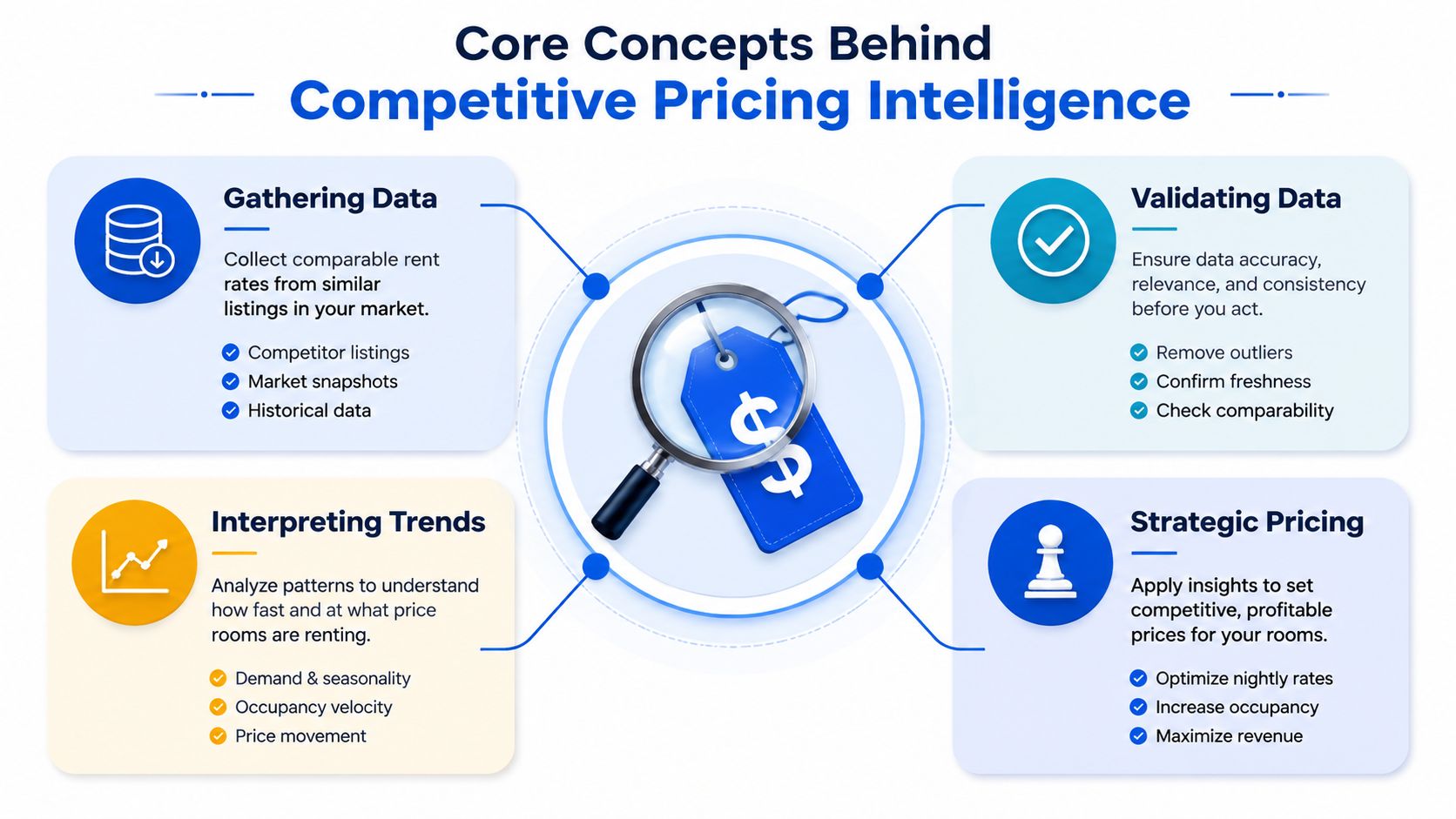
A weekly review turns the data into a feedback loop. You compare current competitors, note changes, review your own inquiries and leases, then decide whether the next move should affect price, promotion, positioning, or follow-up. A dynamic pricing strategy for rental operators works best when the recommendation is explainable and tied to a measurable operating condition, not when software changes prices without context.
Where to Find Reliable Market Rent Data
Room-level rent intelligence usually starts with public listings, but no single source provides a complete answer. Zillow, Apartments.com, Facebook Marketplace, and Roomster can reveal asking rents, listing language, furnishing details, and apparent availability. Their weakness is consistency. You'll need to filter out whole apartments, duplicate listings, stale posts, and rooms with materially different terms.
MLS data and local Realtor feeds can add stronger property history and neighborhood context. They're often less useful for direct room comparisons because room-specific inventory may be sparse or classified inconsistently. Treat them as a market anchor rather than a replacement for live room listings.
Specialized co-living platforms and public PadSplit listings can offer more direct competitor signals. These sources may show the kinds of rooms renters encounter in shared-housing searches, including utility structures, furnished options, shared-bath arrangements, and flexible leasing language. A broader explanation of market rent is available in this guide to what market rent means for rental operators.
Government and Census-derived datasets serve a different purpose. HUD Fair Market Rents and Census American Community Survey data can help frame affordability and neighborhood conditions, but they're macro-level references. They shouldn't be treated as precise substitutes for current room-level listings.
Automation tools can reduce manual work. RentCast, Zillow API access, and Apify-based workflows may help collect listings, but operators need to evaluate subscription costs, rate limits, data quality, and each platform's terms of service. Automation is useful only when the resulting dataset remains relevant and legally usable.
Compare sources by decision value
| Data Source | Granularity | Recency | Cost | Best Use Case |
|---|---|---|---|---|
| Zillow, Apartments.com, Facebook Marketplace, Roomster | Mixed, often room and unit level | Frequently changing | Usually accessible, with manual labor | Live asking rents and listing language |
| MLS and Realtor feeds | Primarily property or unit level | Depends on feed | May require professional access | Neighborhood and property context |
| Co-living platforms and public PadSplit listings | Often closer to room level | Frequently changing | Varies by platform | Direct shared-housing comparisons |
| HUD FMR and Census ACS | Market or household level | Published periodically | Public | Affordability and macro benchmarks |
| RentCast, Zillow API, and Apify workflows | Depends on configuration | Automated collection | Paid or usage-dependent | Repeatable monitoring at scale |
Use four quality checks before adjusting a price:
- Recency: Prefer data less than 30 days old, since stale listings can distort current positioning.
- Granularity: Prioritize true room-level comparisons over whole-unit rents.
- Geographic precision: Start with the same ZIP code or sub-neighborhood before expanding outward.
- Sample quality: Aim for at least 5 to 8 genuine comps, not just 5 to 8 search results.
Triangulate at least two channels. A rent appearing on one platform may be duplicated, outdated, or supported by an unusual concession.
A Practical Workflow for Pricing Individual Rooms
Good pricing decisions follow a sequence. The workflow below keeps the operator in control while making each adjustment easier to defend.
1. Establish a baseline
Start with current comparable rooms within a defined radius. Capture the asking rent, room size, bathroom access, furnishing status, utilities, deposit terms, lease length, listing date, and visible concessions.
Then remove weak comparisons. A luxury private suite shouldn't anchor a basic room, and a furnished weekly arrangement shouldn't set the price for an unfurnished annual lease. Adjust the baseline for amenities only when renters can recognize and value the difference.
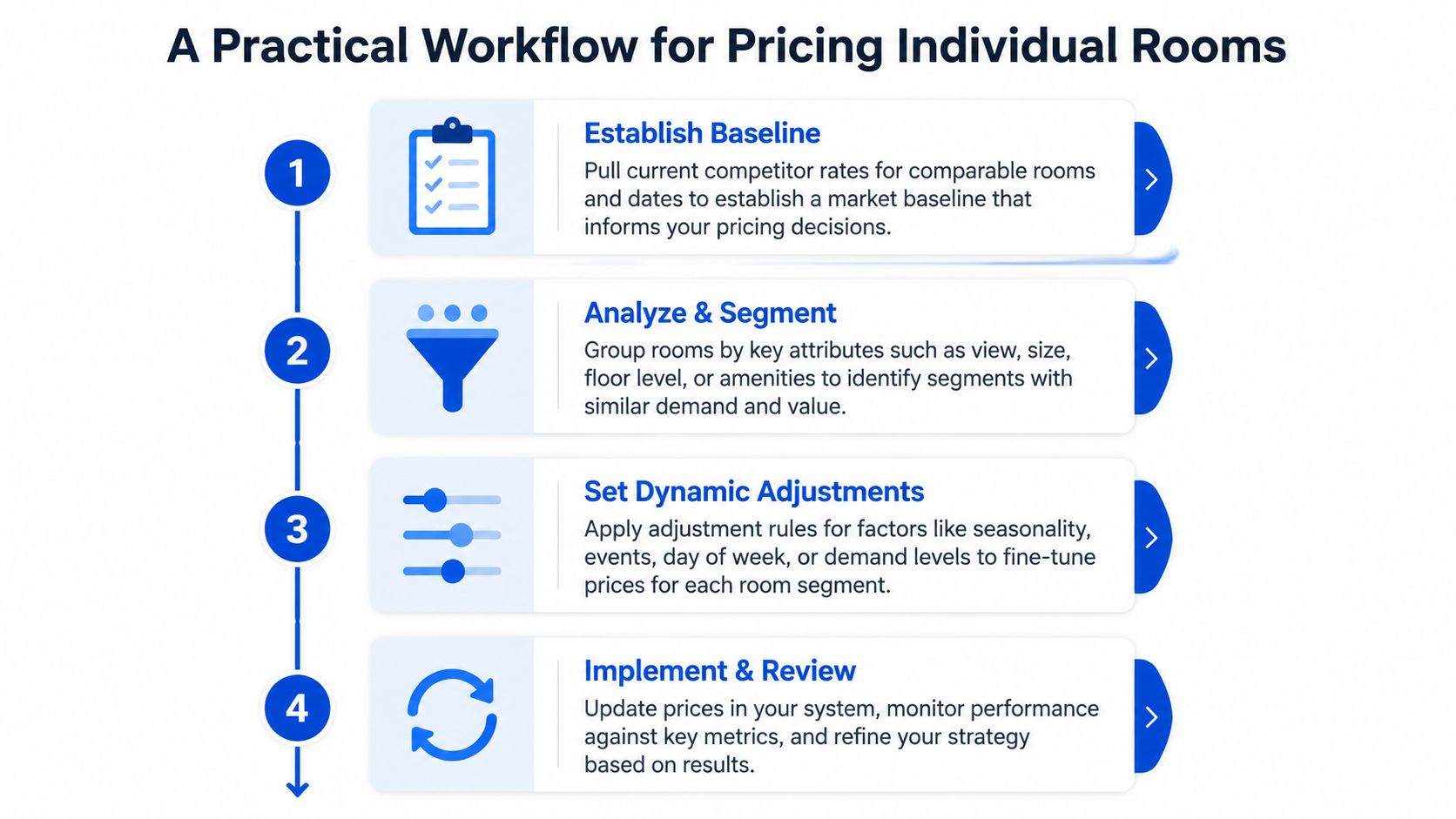
2. Segment the house
Price rooms by product type instead of applying one housewide rule. A practical segmentation might include:
- Premium rooms: Larger bedrooms, private bathrooms, balconies, or unusually strong light and privacy.
- Standard rooms: Comparable bedrooms with shared-bath access and ordinary positioning.
- Value rooms: Smaller rooms, less desirable floor positions, limited storage, or other clear trade-offs.
- Shared configurations: Rooms where privacy, occupancy, and lease structure create a different buying decision.
Your historical data matters here. If one category consistently leases faster, that may support a higher price. If another category generates inquiries but rarely converts, the issue may be price, photos, screening friction, or unclear terms.
3. Set adjustment rules
Choose a review cadence based on local velocity. A fast-moving submarket may justify weekly reviews, while a slower environment may benefit from monthly analysis. The point isn't to change every price frequently. It's to check conditions often enough that a stale assumption doesn't control the outcome.
Tie adjustments to vacancy thresholds and evidence. For example, define what happens when a room reaches your internal target for days vacant, when inquiries decline, or when a comparable set begins offering concessions. A price change should have a reason recorded beside it.
4. Implement and review
Update the listing, syndication channels, and prospect messaging together. A lower price with outdated copy or weak photos may not produce the intended response. Track views, inquiries, tours, applications, leases, concessions, and days vacant after each decision.
Keep a simple decision log with the date, old price, new price, comparable set, reason for the change, and result. Don't judge a move only by whether the room leased. Review the effective rent, vacancy avoided, tenant quality, and operational burden created by the decision.
Decision standard: Every price change should answer three questions. What changed in the market, what changed in your inventory, and what outcome are you trying to improve?
Legal and Ethical Guardrails for Algorithmic Rent Pricing
Automated pricing isn't automatically safe. In housing, the data used, the relationships among operators, and the way a recommendation is applied can create legal and reputational exposure.
A 2025 law review article describes challenges by landlords and the U.S. Department of Justice involving revenue-management software that allegedly uses non-public, competitively sensitive information to coordinate prices across housing markets. Legal and academic coverage summarized by Impact Analytics also describes San Francisco's ban on algorithmic pricing in rental housing and the focus on collusion risk rather than pricing efficiency alone.
The practical implication for room-by-room operators is clear. A tool that recommends a rent isn't a substitute for independent judgment, local legal review, or an audit trail. Fair-housing obligations, antitrust concerns, privacy requirements, and local rent-stabilization rules can all affect how pricing intelligence should be collected and used.
Build a defensible operating policy
- Preserve independent decision-making: Use public, lawful market information and set your own pricing objectives. Don't agree with nearby operators to exchange sensitive future pricing plans.
- Document human review: Record why you accepted, modified, or rejected a recommendation. Note room features, vacancy conditions, and the relevant comparison set.
- Avoid protected-class proxies: Don't use demographic characteristics, names, photographs, neighborhood stereotypes, or other variables that could produce discriminatory outcomes.
- Explain the offer clearly: Prospects should understand rent, utilities, deposits, fees, concessions, and lease terms without having to decode an automated adjustment.
- Audit outputs regularly: Review recommendations by room type and property. Look for unexplained disparities, unstable price movements, and decisions that conflict with written policy.
Transparency also protects trust. Tenants may accept changing prices more readily when the operator explains the legitimate business factors behind the rate and applies them consistently. They're less likely to trust a system that appears opaque, targets individual applicants, or changes terms without notice.
Human oversight doesn't eliminate risk, but it creates a record showing that the operator didn't blindly outsource a housing decision to software.
Connecting Pricing Intelligence to Operations and NOI
Pricing data only creates value when it changes an operating decision. A rent recommendation should influence how you market the room, how quickly you respond to prospects, which amenities you emphasize, and whether an incentive is necessary.
Listing syndication is the first connection. If comparable rooms include utilities, furnished furniture, or flexible terms, your listing needs to present your offer in a way renters can compare. Dynamic messaging can emphasize the specific value of a private bath, smart access, lower move-in friction, or a quieter location, but the claim must match the actual room.
Smart-home systems add useful operational context. Keyless locks can simplify access management, while smart thermostats may help control shared utility costs. Submetering, where available and legally appropriate, can clarify usage patterns. These systems don't automatically justify a premium, but they can help you understand whether a room's operating structure supports a different lease offer.
At the portfolio level, compare rooms by effective rent, vacancy, inquiry quality, leasing speed, and contribution margin. That view helps you identify whether a weak property needs a pricing adjustment, better marketing, improved maintenance, or a different allocation of advertising spend. NOI is the right financial frame for this work, and this explanation of net operating income for rental properties provides the basic context.
| Operational Area | Pricing Intelligence Input | NOI Impact |
|---|---|---|
| Listing syndication | Competitor rent, included utilities, and concessions | Positions the offer clearly and reduces avoidable pricing friction |
| Prospect messaging | Room features and competitor value differences | Improves the relevance of inquiries and tours |
| Smart-home operations | Access, HVAC, and usage information | Helps control operating costs and support consistent service |
| Portfolio analytics | Effective rent, vacancy, and leasing outcomes | Shows where capital and marketing attention are most needed |
| Renewals | Current market position and tenant history | Supports fair, evidence-based renewal offers |
| Incentives | Competitor concessions and vacancy urgency | Prevents unnecessary discounts and targets incentives where needed |
Retention deserves equal attention. A lower move-in price can fill a room quickly but create renewal tension if the next offer feels arbitrary. Use the same documented logic for renewals, and distinguish a temporary lease-up incentive from the ongoing value of the room.
First Steps to Build Your Pricing Intelligence System
Start manually. Expensive software won't fix unclear comparisons, inconsistent room categories, or missing vacancy records.
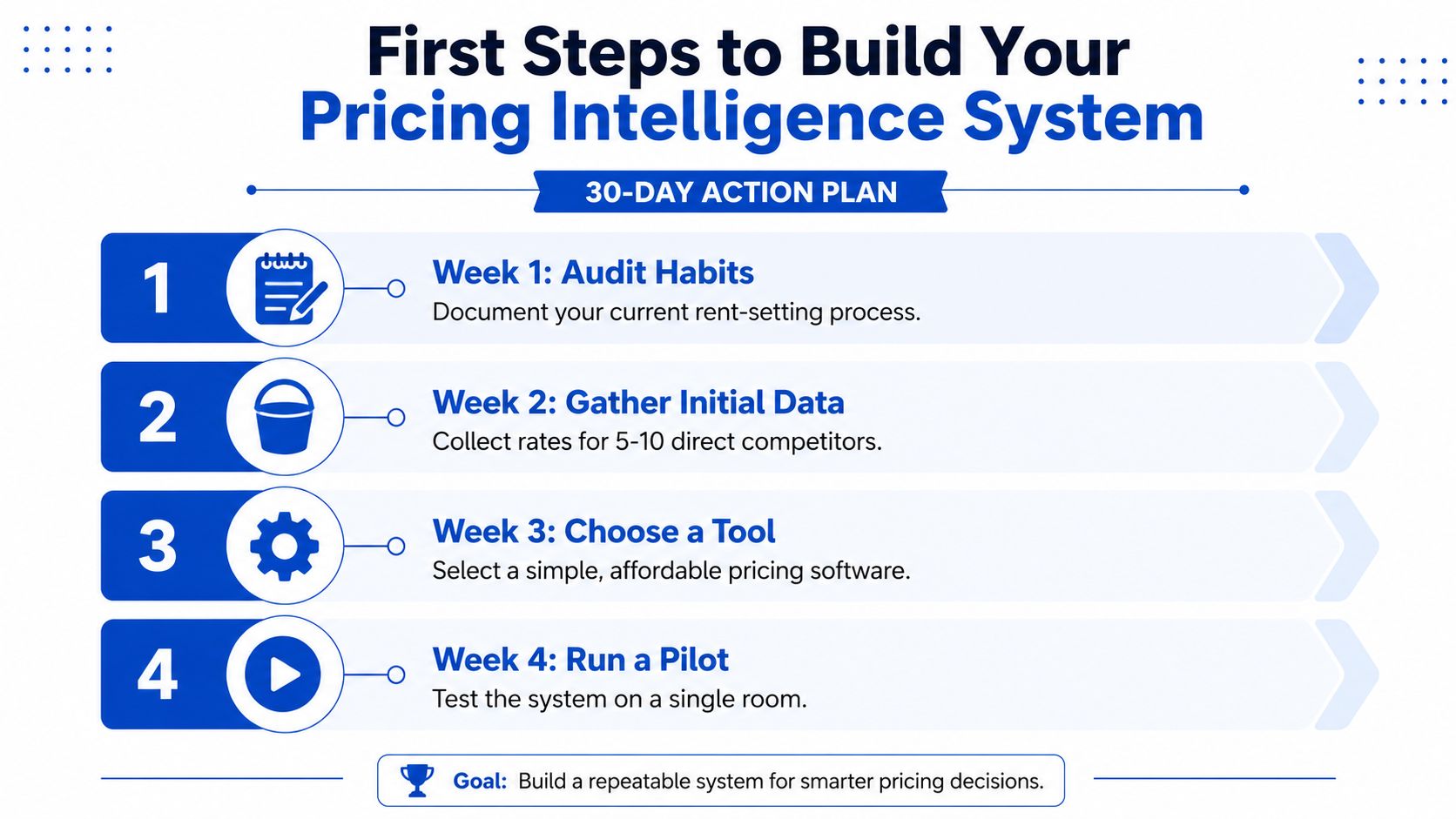
Use this 30-day sequence:
- Week 1, audit current habits: Write down how you set rents today. Identify the biggest blind spot, usually stale comps, missing room-level details, or failure to record concessions.
- Week 2, gather initial data: Choose one reliable source, such as Zillow rental comps, Rentometer, or a local MLS feed. Track 5 to 10 nearby room-by-room or studio listings each week, recording the details that make each comp relevant.
- Week 3, choose a tool: Build the workflow in a spreadsheet first. If the process produces useful decisions, then evaluate affordable pricing software or an API-based collection method.
- Week 4, run a pilot: Test the system on one vacant room. Record the recommendation, your final decision, the listing changes, and the leasing result.
Set vacancy triggers carefully. A rule such as automatically dropping rent by 3% after 14 vacant days, or raising it by 2% after two rooms lease within 48 hours, should only be used where those thresholds fit your market, legal requirements, and margin goals. Treat them as testable policies, not universal formulas.
Review your comps every Monday. The operator who maintains a clean weekly record will make better decisions than the operator who waits for a quarterly review and tries to reconstruct what happened.
PadPulse is being built to bring room pricing, market intelligence, messaging, financial visibility, and co-living operations into one workflow for PadSplit hosts and room-by-room operators. Visit PadPulse to join the interest list for launch updates and potential beta access, with no billing required before launch.