Cash Flow Management for Co-Living Operators
August 27, 2026
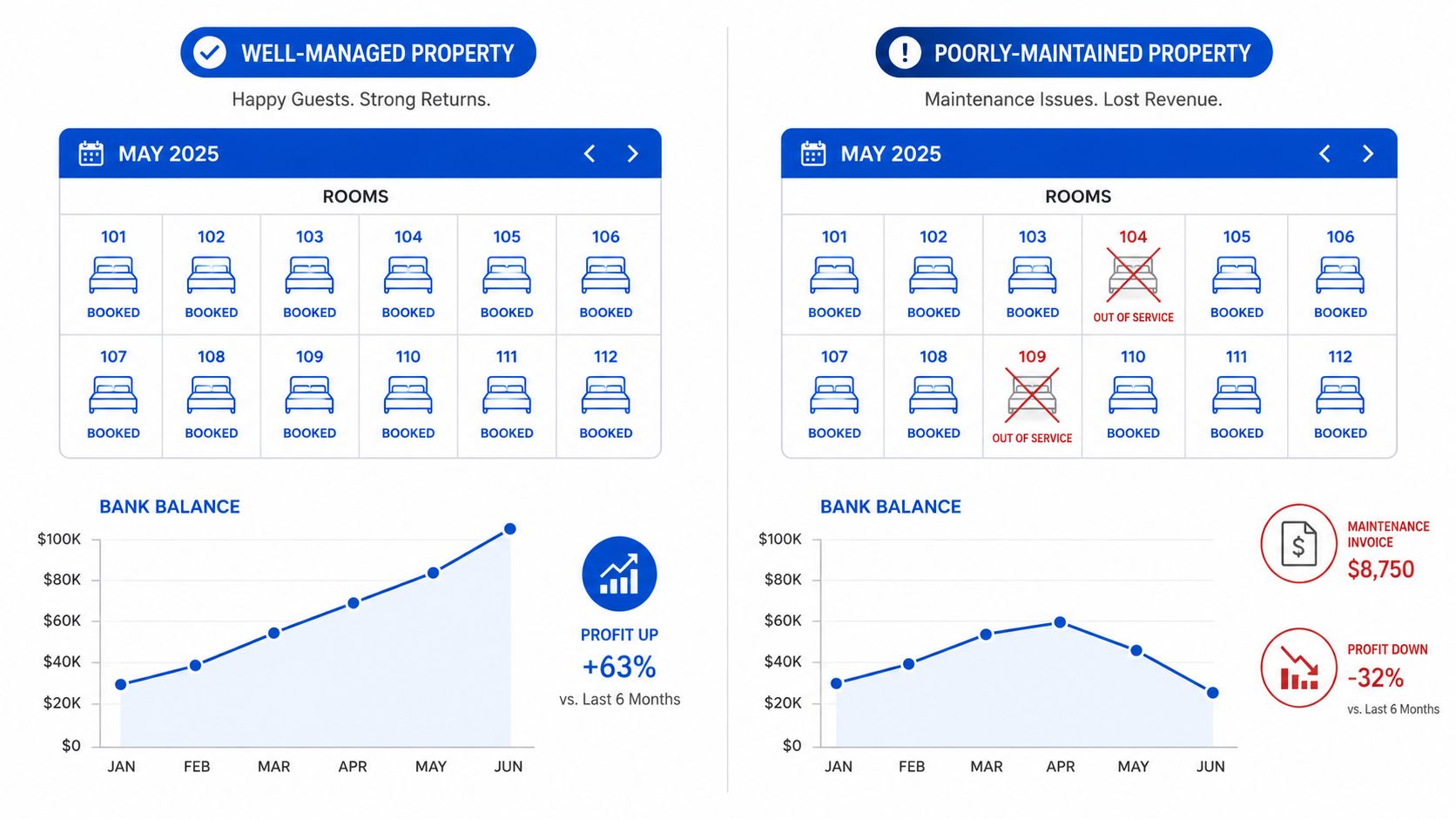
The calendar says every room is occupied. Your bank balance looks comfortable. Then two tenants leave in the same week, a plumbing invoice arrives, and the replacement deposits won't clear until after the mortgage, utilities, and cleaner are due. Nothing is wrong with the property's long-term revenue, but the cash isn't available when the bills demand it.
That timing problem is the heart of cash flow management for co-living operators. Room-by-room rentals create fragmented income, independent move-outs, partial payments, and frequent expense timing mismatches. The number that keeps a house alive isn't rent earned on paper. It's rent collected before the next unavoidable outflow.
What Cash Flow Really Means for Co-Living Operators
Cash flow is the movement of money into and out of the business. A cash flow statement classifies those movements into operating, investing, and financing activities, with operating cash covering day-to-day activity such as customer receipts, salaries, utilities, and taxes, as explained by OpenStax's accounting guidance.
For a co-living operator, the practical distinction is simple. Billed rent is what tenants owe. Collected rent is what has reached the bank. Profit may recognize income when it's earned, but your mortgage company, utility provider, and maintenance contractor care whether cash is available on the due date.
Practical rule: Track receipts by the date money actually arrives, not the date rent was posted or invoiced.
Room-by-room rentals make this more volatile than a single whole-property lease. One room can be vacant while eleven others pay normally. Another tenant may pay weekly, someone else biweekly, and a third may make a partial payment after a reminder. Each room turns independently, so a house can look full in a monthly report while its weekly cash position is weakening.
The three numbers to review every week
- Collected rent versus billed rent: Compare cash received with the amount scheduled. The difference belongs in an arrears or pending-payment view, not in your available operating cash.
- Days of cash on hand: Divide usable cash by the average daily operating outflow. Keep debt proceeds and ring-fenced reserves separate unless they're genuinely available for routine bills.
- Net operating cash after fixed outflows: Subtract mortgage payments, payroll, utilities, recurring services, insurance, and known supplier obligations from collected rent.
This weekly view exposes the gap that monthly profit reports hide. QuickBooks reported that 59% of businesses had invoices overdue by 30 or more days in 2026, up from 47% the prior year, and businesses with unpaid invoices were owed an average of $17.7K (QuickBooks late-payments report). The figures concern business invoices rather than room rents, but the operating lesson applies directly: revenue doesn't become liquidity until someone pays.
For a broader framework on identifying gaps between inflows and outflows, operators can use Resolut to improve cash flow, then adapt the same discipline to individual rooms, move-in dates, and collection promises.
Building a 13-Week Cash Flow Forecast
A monthly budget is too smooth for a room-by-room property. Build a rolling 13-week cash flow forecast with one column for each week and one row for each cash driver. The forecast should show when money is expected to land, not merely when revenue is recognized.
Start with the current bank balance, excluding restricted funds. Then add expected receipts by room. For every room, record the tenant's payment frequency, expected amount, planned move-in date, planned move-out date, deposit timing, and any agreed pro-ration. Add expenses by their actual payment week, including mortgage, utilities, payroll, cleaning, supplies, insurance, taxes, and maintenance.
A six-room property might look like this:
Sample 13-Week Cash Flow Forecast Template
| Week | Rooms Occupied | Expected Rent Collected | Scheduled Outflows | Net Cash Flow | Running Balance |
|---|---|---|---|---|---|
| 1 | 6 | $6,000 | $4,200 | $1,800 | $11,800 |
| 2 | 6 | $6,000 | $2,700 | $3,300 | $15,100 |
| 3 | 6 | $6,000 | $2,700 | $3,300 | $18,400 |
| 4 | 6 | $6,000 | $3,600 | $2,400 | $20,800 |
| 5 | 6 | $6,000 | $2,700 | $3,300 | $24,100 |
| 6 | 5 | $5,000 | $4,500 | $500 | $24,600 |
| 7 | 5 | $5,000 | $2,700 | $2,300 | $26,900 |
| 8 | 5 | $5,000 | $2,700 | $2,300 | $29,200 |
| 9 | 4 | $4,000 | $3,900 | $100 | $29,300 |
| 10 | 5 | $5,000 | $2,700 | $2,300 | $31,600 |
| 11 | 5 | $5,000 | $2,700 | $2,300 | $33,900 |
| 12 | 5 | $5,000 | $3,600 | $1,400 | $35,300 |
| 13 | 5 | $5,000 | $2,700 | $2,300 | $37,600 |
The figures above are an illustrative template, not a performance benchmark. The point is the shape. A room flips in week six, another in week nine, and the forecast shows the temporary compression before a replacement arrives.
Forecast accuracy depends on the review cycle. Benchmark data reports 87% average accuracy for 13-week forecasts, compared with 72% for annual forecasts, while weekly updates were reported to produce 25% better accuracy than monthly updates (cash flow forecasting benchmark). Treat those figures as directional evidence for shortening the planning cycle, not as a promise for every property.
Every Friday, close the week that ended. Replace estimates with actual bank receipts and actual payments, calculate the variance, add a new thirteenth week, and update room-level assumptions. Don't smooth occupancy into an annual average. That makes a vacant room look like a fraction of a room occupied, which may be mathematically tidy but useless when the mortgage is due next Tuesday.
Modeling Seasonal Occupancy and Dynamic Pricing
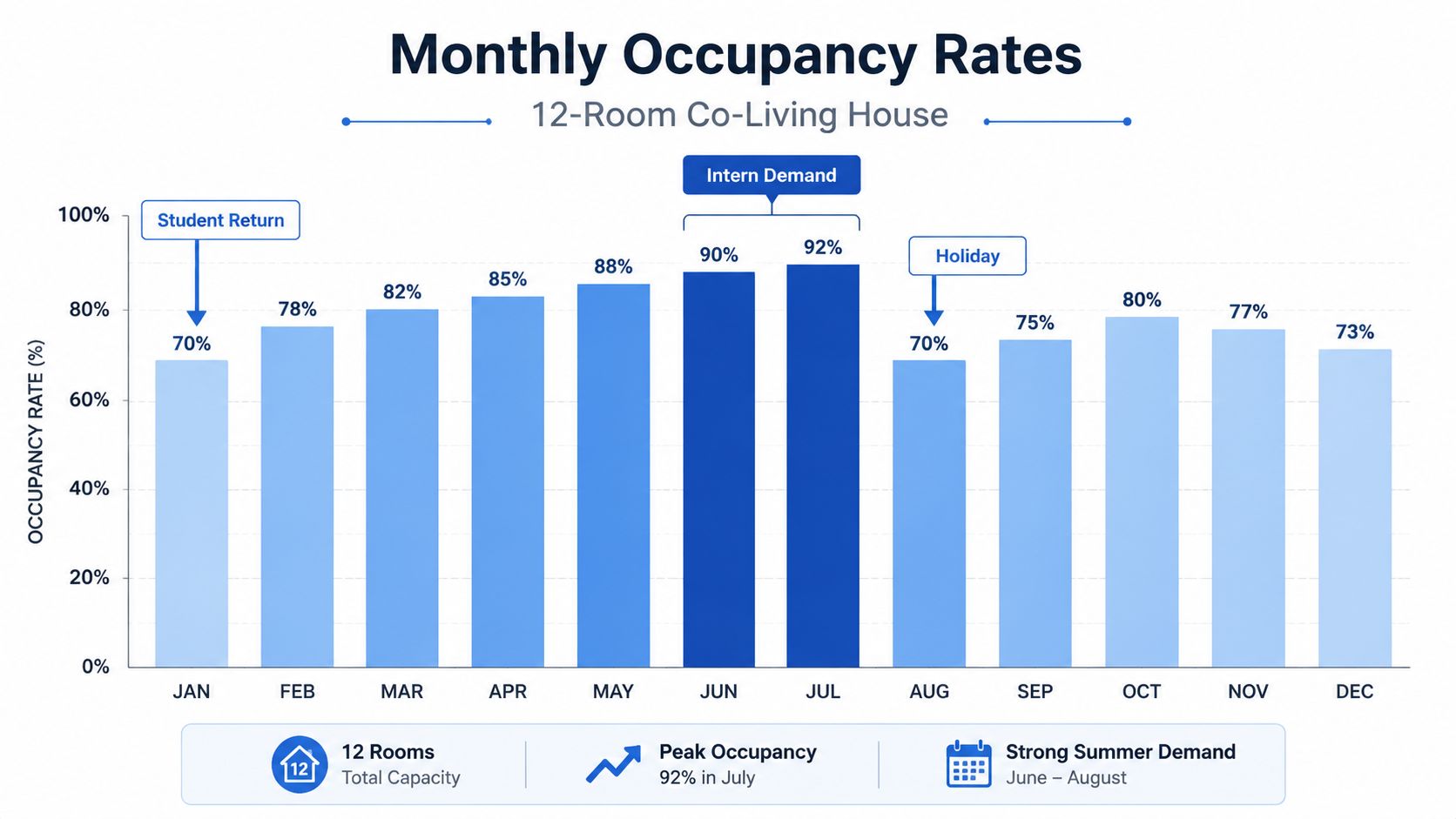
A twelve-room house serving interns and students can have a strong annual story and a difficult weekly one. Summer intern demand may push occupancy to 92%, while January and August may fall to 70% as students return home or relocate. Those figures describe the required scenario, not a general market benchmark.
A flat annual average hides the operational damage. If several move-outs cluster in a softer period, the forecast loses rent immediately, while utilities, staffing, insurance, and debt payments continue. In a 13-week view, the seasonal dip appears as a lower receipt line and a tighter running balance. That visibility lets the operator respond before the vacancy becomes a reserve problem.
Pricing should solve a cash problem
Dynamic pricing isn't about discounting every room. It's about choosing where a small price change can bring cash forward.
- A room empty beyond 14 days: Test a modest weekly reduction and show the revised expected collection date in the forecast.
- An ensuite during peak demand: Apply a premium when the room's features support it, then compare the added receipt with the risk of a longer vacancy.
- A tenant approaching a seasonal move-out: Offer a mid-stay incentive when retaining that tenant costs less than remarketing, cleaning, and carrying an empty room.
The trade-off is important. A lower weekly rate may improve occupancy but reduce revenue per occupied room. A premium may raise billed rent but lengthen vacancy. The right decision is the one that improves the projected cash position after considering vacancy duration, turnover costs, and payment reliability.
For each room, record the current price, expected collection date, vacancy days, and next decision date. A property can then see whether pricing is shortening the cash gap rather than merely lifting an occupancy percentage in a separate report.
Streamlining Rent Collection and Arrears Workflows
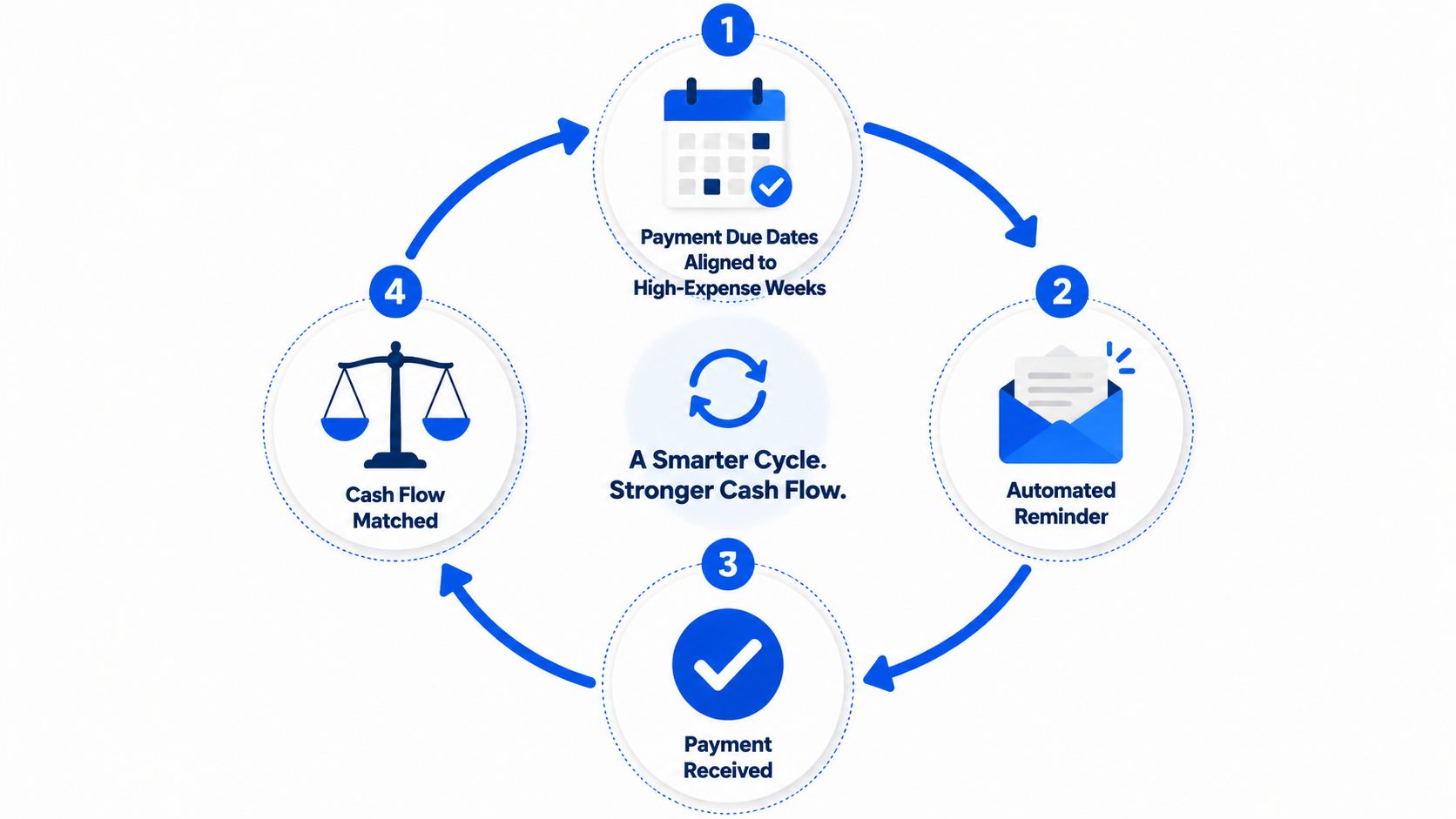
Fragmented rent needs a fragmented collection process. One reminder for an entire house won't work when tenants pay on different days and in different amounts. Start by mapping payment due dates against the weeks when your largest outflows leave the account.
Set up authorized debit mandates or recurring payment instructions that match each tenant's weekly or biweekly cycle. Confirm the amount, date, and payment status automatically. Keep deposits, rent, fees, and partial payments as separate transaction types, because combining them creates a misleading arrears balance.
A calm escalation sequence
Use consistent language and keep every contact in the tenant record.
- Day 1 reminder: “Hi [Name], your rent payment due today hasn't appeared in our records yet. Please confirm when it will be sent, or reply if there's a payment issue we should help resolve.”
- Day 3 follow-up: “Hi [Name], we're following up on the outstanding rent. Please send the payment today or confirm the exact amount and date you can pay.”
- Day 7 partial-payment option: “If you can't clear the full balance today, reply with the amount you can pay now and the date for the remainder. We'll record the arrangement in writing.”
- Day 14 formal notice: “This message confirms that rent remains outstanding. Please review the attached balance and payment deadline. Further action may follow under the agreement and applicable local requirements.”
These scripts aren't legal notices. Use the correct tenancy process for your jurisdiction and have formal documents reviewed when necessary. The operational goal is earlier visibility, respectful communication, and fewer undocumented promises.
Log the conversation, promised payment date, promised amount, actual receipt, and remaining balance. An arrears dashboard should distinguish paid, partially paid, promised, disputed, and unresponsive. “Tenant said they'll pay soon” isn't a cash forecast category.
A twelve-room house can recover rent that previously slipped into the next cycle by tightening reminders, payment mandates, and follow-up ownership. The example here uses an 8% monthly-rent recovery as a defined operating scenario, not a general result. The gain comes from moving receipts earlier, not from creating new revenue.
Operators comparing software options can review rent collection software for room-by-room operations and assess whether the system supports varied schedules, partial payments, audit trails, and automated reminders.
Setting Operating Reserves That Actually Hold
A reserve target should follow the property's expense calendar, not a round number selected because it sounds prudent. List every predictable outflow by due date, including mortgage, utilities, payroll, cleaning, insurance, taxes, supplier invoices, and recurring repairs. Then identify the minimum cash required to complete one full expense cycle without relying on a perfect collection week.
Guidance for volatile small-business conditions increasingly recommends scenario testing, credit-line readiness, and three to six months of operating reserves (2026 cash flow resilience strategies). For co-living, that range should be tested against actual room turnover, not copied blindly. A property with stable long-term tenants and a property with frequent weekly moves don't carry the same timing risk.
The reserve target in this operating model is one full expense cycle plus a buffer equal to 10% to 15% of monthly revenue. The percentages are a planning rule for the example, not a universal requirement.
Operating Reserve Calculation Example
| Expense Category | Monthly Outflow ($) | Reserve Allocation | Drawdown Trigger |
|---|---|---|---|
| Mortgage or debt service | $7,200 | Full scheduled payment | Cash would miss the due date |
| Utilities | $1,800 | Full expected cycle | Unexpected bill or usage spike |
| Payroll and cleaning | $2,400 | Full scheduled cycle | Operating cash falls below due outflows |
| Supplier invoices | $1,200 | Full scheduled cycle | Approved invoice arrives before collections |
| Repairs and maintenance | $1,000 | Dedicated repair portion | Safety or habitability issue |
| Revenue buffer | $1,800 | 10% to 15% planning range | Vacancy cluster or repeated negative variance |
The dollar values are illustrative. A twelve-room operator rebuilding after a six-week vacancy dip would first restore the reserve from positive weekly operating cash, then pause discretionary expansion spending until the target is reached. If a repair draws the account down, the forecast should show the replenishment schedule instead of treating the reserve as permanently available.
Draw reserves for consecutive weeks of negative variance, emergency repairs, or clustered vacancies that threaten essential obligations. Don't draw them for one slow collection week if the next receipts cover the shortfall, or for a planned expense that already has dedicated funding.
For recordkeeping structure, operators can review reserve account accounting practices and apply the same separation between operating cash, reserves, deposits, and owner funds.
Automating Reporting and Weekly Cash Reviews
The minimum useful reporting stack has four layers. A property management system records room status and tenant obligations. A payment system records actual receipts. A bank feed and reconciliation process confirms movement. A weekly dashboard compares collected rent with earned rent and shows upcoming outflows, reserve balance, arrears aging, and forecast variance.
Automate repetitive actions, but keep judgment with the operator.
- Automate reminders: Send due-date, overdue, and payment-confirmation messages according to each tenant's schedule.
- Automate reconciliation support: Match bank receipts to tenant records, then flag unmatched deposits for review.
- Automate alerts: Trigger notifications for overdue balances, failed payments, upcoming move-outs, and forecasted negative weeks.
- Review manually: Investigate unusual variances, disputed balances, repairs, lease endings, and pricing decisions.
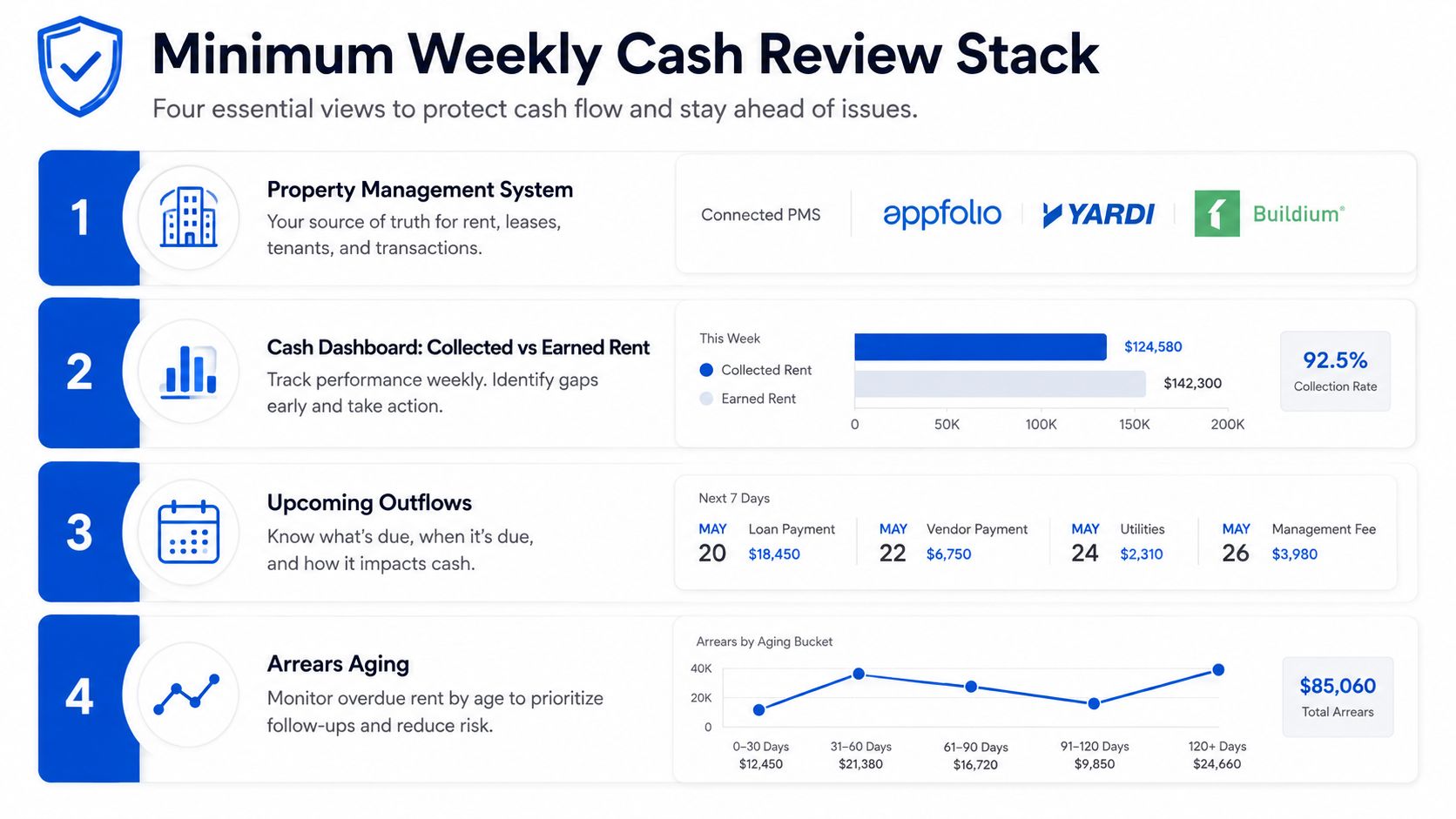
A dashboard doesn't replace a Monday review. It makes the review faster and more reliable. Before noon, answer six questions:
- What rent was collected last week, and what was billed?
- Which rooms have overdue or partial balances?
- Which five variances were largest?
- What expenses leave the account in the next two weeks?
- Which leases or room agreements end soon?
- Does the forecast require a collection action, pricing change, expense delay, or reserve decision?
A useful custom reporting tool can help organize payment and variance data, provided the underlying room records remain accurate. The software shouldn't turn estimates into facts. Every expected receipt needs a confidence level based on payment history, tenant communication, and the actual due date.
Consider a week where a utility bill is $1,200 higher than expected and collections are 14% below plan. Those figures describe a specific review scenario. Catching both on Monday gives the operator time to delay nonessential spending, contact overdue tenants, and protect the reserve instead of discovering the problem after the account falls short.
For teams replacing manual spreadsheet handoffs, a workflow covering reporting automation for property operations can connect the dashboard to recurring review responsibilities.
Putting It All Together and Avoiding Costly First-Year Mistakes
The most effective cash flow management habit is a short Monday review. Close the prior week, compare actual receipts and outflows with the forecast, inspect arrears by room, then decide whether the next two weeks need a collection action, pricing adjustment, expense conversation, or reserve decision.
That rhythm matters because co-living cash flow changes one room at a time. The worldwide cash conversion cycle reached 67 days in 2025, about three days above its 10-year average, while days sales outstanding rose by 0.3 days in the reported period (Deloitte working-capital performance trends). The broader point is that small collection delays can offset improvements elsewhere in the operating cycle.
Five first-year mistakes to remove
- Counting gross rent as cash: Billed rent doesn't pay this week's invoice. Tag every room as collected, partially collected, promised, overdue, or vacant.
- Ignoring partial payments: A partial receipt is useful cash, but it isn't a cleared balance. Record both amounts separately.
- Treating reserves as a slush fund: Owner withdrawals, optional upgrades, and ordinary overspending shouldn't consume emergency liquidity.
- Smoothing occupancy: A twelve-room average can hide two empty rooms in the same week. Forecast room events on their actual dates.
- Leaving marketing outside the forecast: A six-month-old house operator can appear profitable until marketing spend, deposits, cleaning, and replacement-room costs arrive together. If those outflows aren't in the weekly model, payroll can become the first obligation at risk.
The cash flow statement gives useful classification, but the operator still needs a collection-date view. Use operating, investing, and financing categories for financial reporting, then maintain a room-level cash schedule for decisions. For broader bookkeeping and reporting perspectives, operators can explore our blog as an additional accounting resource.
This week, close the current period using actual bank activity. Open a fresh 13-week template, add the next week, list every room's collected-versus-earned status, and enter expenses on their payment dates. Then set a Monday calendar reminder and make the review a fixed commitment.
PadPulse is being developed as an all-in-one toolkit for room-by-room operators, with planned features for dynamic pricing, messaging workflows, smart-home integrations, and financial visibility across properties. Visit PadPulse to join the interest list for beta updates and build your weekly cash flow routine around clearer room-level data.