Rent Collection Software: Streamline Payments in 2026
July 23, 2026
You're staring at a spreadsheet with half a dozen room-by-room payments marked “pending,” two tenants texting about a late fee they don't understand, and one bank transfer that still hasn't matched the ledger. Meanwhile, maintenance requests keep coming in and the month-end close is already late. For a co-living operator, that mix of follow-up, bookkeeping, and tenant questions can turn rent day into a weekly fire drill.
Rent collection software replaces that scramble with a single workflow for collecting payments, sending reminders, posting receipts, and tracking balances. For first-time operators, the biggest change isn't just speed, it's clarity. You can see who paid, what's overdue, and where each transaction landed without digging through emails or chasing screenshots.
Introduction to Rent Collection Software
A shared house runs on small details. One tenant pays by card, another wants ACH, a third says they sent cash to a roommate, and someone else asks whether the grace period applies to their room or the whole property. When all of that lives in spreadsheets and message threads, errors pile up fast.
Rent collection software gives you one place to handle the payment side of the business. Instead of treating rent day like a monthly cleanup project, you get a structured process for collection, reminders, receipts, and accounting records.
For co-living hosts, that structure matters because room-by-room operations create more edge cases than a standard apartment lease. Every room can have a different payer, different timing, and different follow-up. Software helps turn that complexity into a repeatable routine instead of a manual guessing game.
Practical rule: if you're still checking payments in three different places, your workflow is already costing you time.
Understanding Key Concepts of Rent Collection Software
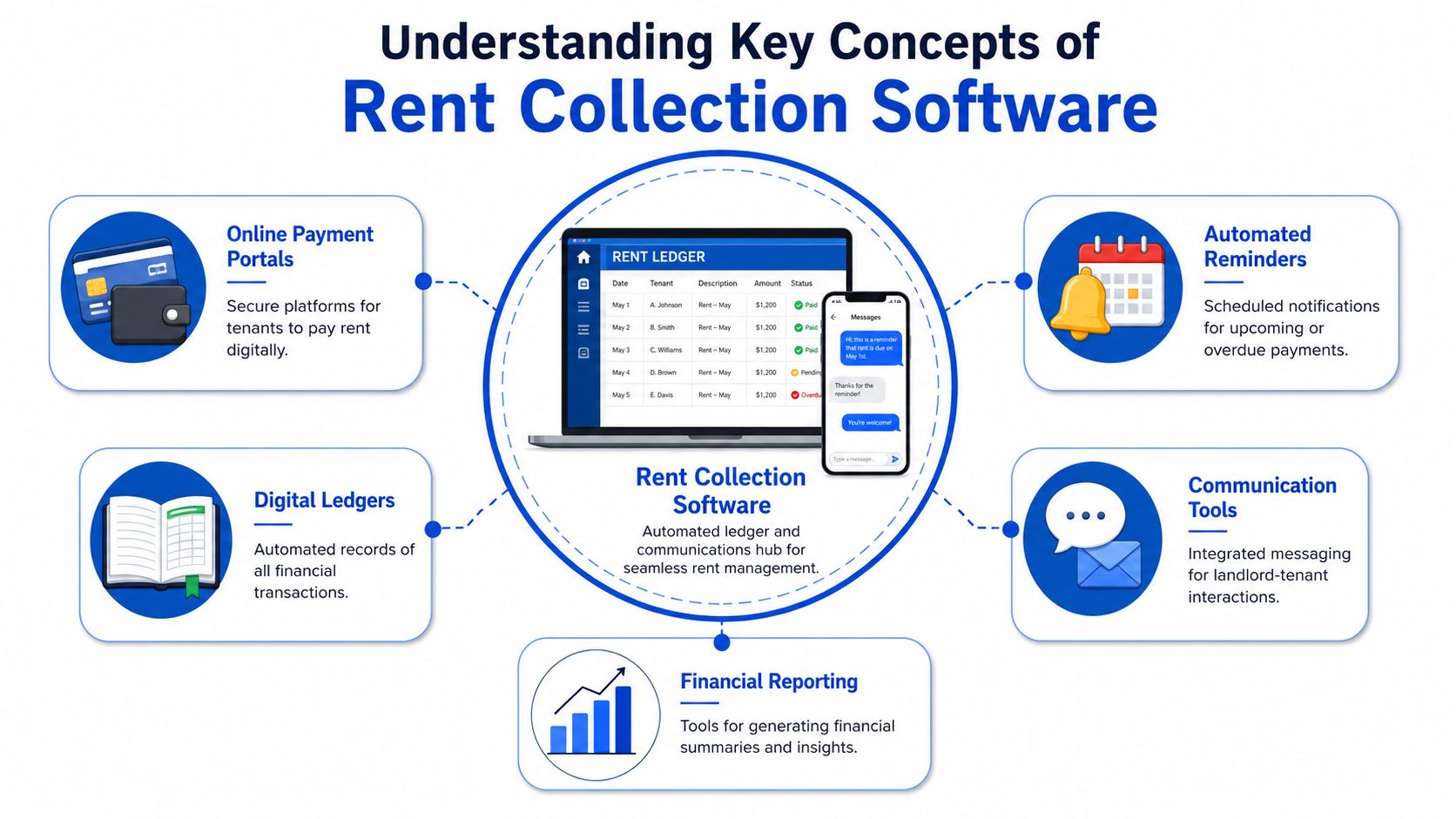
Think of rent collection software as an automated ledger and communications hub. It doesn't just take payments. It also records them, reminds tenants, stores receipts, and keeps lease-related information connected so you aren't reconciling by hand.
That shift matters because online payment behavior is now mainstream in major rental markets. One industry report cited by Buildium says 78% of tenants prefer to make rent payments online, and in 2024 credit cards accounted for 35% of payments while debit cards accounted for 30% Buildium's rent payment app report. For operators, that means digital rent collection isn't a novelty. It's the default expectation for many residents.
The core idea behind the software
The best way to understand the category is to break it into a few connected parts:
- Online payment portals let tenants pay digitally instead of mailing checks or sending bank transfers manually.
- Automated reminders nudge tenants before and after due dates, so every reminder isn't a personal text from the landlord.
- Digital ledgers record transactions in one place, which makes the books easier to trust.
- Communication tools keep payment messages connected to the rental record.
- Financial reporting helps you see rent status across rooms or properties without rebuilding the numbers yourself.
The deeper value is the source of truth. In a co-living house, the same tenant record can drive the balance due, the receipt, the late fee, and the ledger entry. That reduces double-entry and lowers the odds that a payment is applied to the wrong room.
For a broader view of how the category fits into the rest of a property tech stack, this overview of property management software is a useful companion.
Exploring Core and Advanced Features of Rent Collection Software
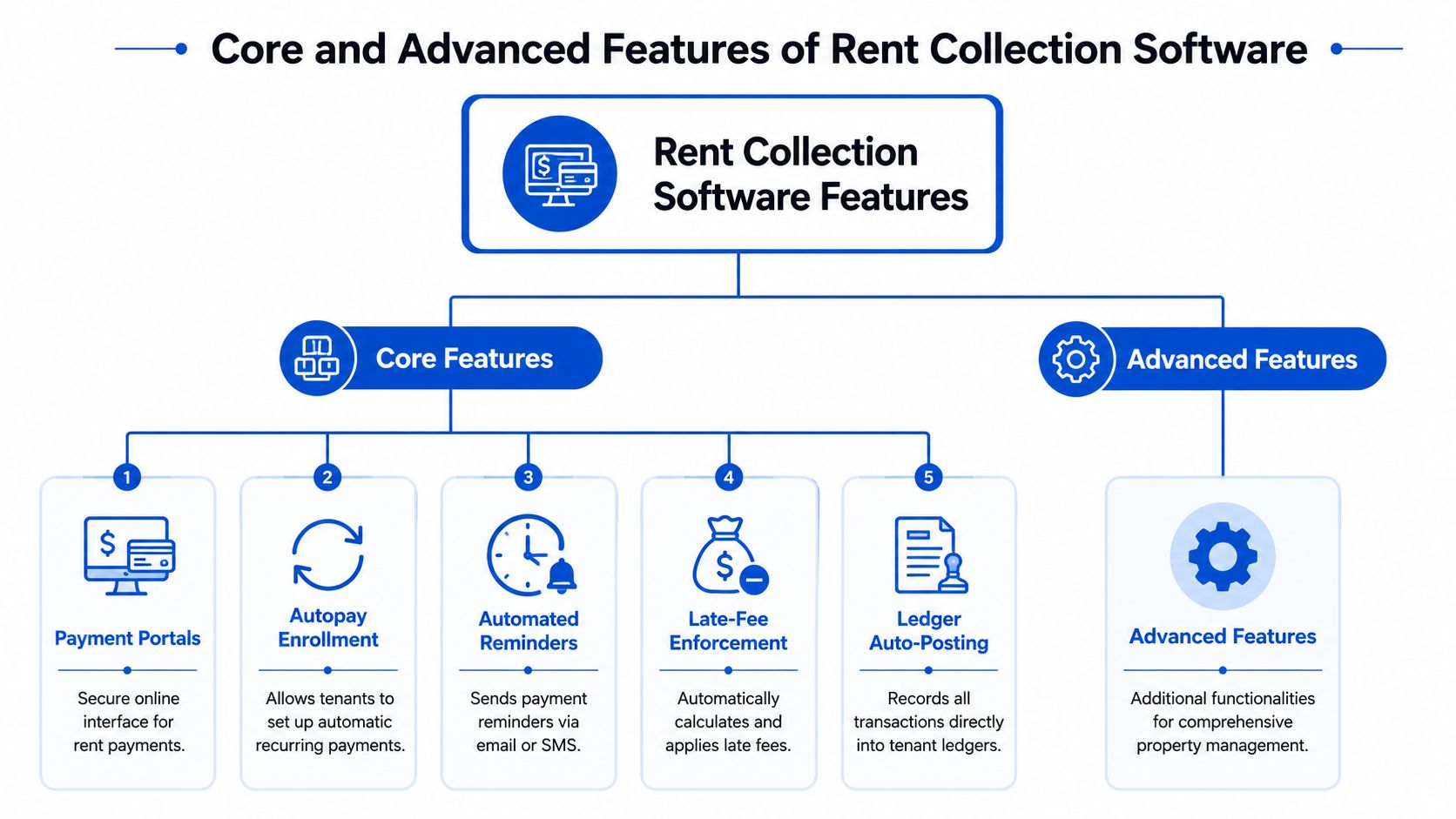
The feature list looks simple at first glance, but its true value shows up in how the pieces fit together. A payment portal is useful. A payment portal that also posts the receipt, updates the ledger, and triggers the right reminder is much better.
Core features you'll use every month
Payment portals are the front door. Tenants log in, pay, and get confirmation without emailing you to ask where to send funds.
Autopay enrollment removes one of the biggest sources of missed rent, since tenants can schedule recurring payments instead of remembering each month.
Automated reminders keep the tone consistent. A platform can send notices before rent is due, on the due date, and after it becomes overdue.
Late-fee enforcement matters because the software can apply lease-based penalties consistently instead of forcing you to calculate them manually.
Ledger auto-posting is the quiet feature that saves the most time, because each payment updates the tenant record without extra data entry.
For operators managing rooms one by one, the workflow starts to feel manageable. A tenant pays online, the ledger updates, the receipt is stored, and your bookkeeping doesn't wait for a separate cleanup session.
Advanced features that matter once the basics are stable
Some platforms go beyond payment collection and add stronger operational controls. One example is integration with accounting systems, which helps reduce manual exports and duplicate entries. Independent guides also highlight real-time cash-flow tracking and exportable rent-roll reports as major differentiators because they improve visibility across the portfolio Steadily's rent collection guide.
Advanced systems can also support arrears workflows, APIs, and custom reports. A mature platform doesn't just tell you that someone is late. It helps you see which account needs attention first and which balances are aging into harder-to-recover territory.
A good platform should reduce exceptions, not create new ones.
For a collections-specific feature overview, see the collections feature page.
One more point matters for room-by-room operators. Current product descriptions increasingly bundle online payments, reminders, autopay, tracking, receipts, and audit trails into one workflow, which means rent collection software now behaves more like an operations system than a payment tool. That's why the best platform usually feels less like a checkout page and more like the control center for recurring income.
Benefits for Room by Room and Co Living Operators
Shared housing creates a lot of small payment events, and small payment events create admin work. A single missed payment may be easy to chase, but ten rooms across a few houses can turn the same task into an afternoon of follow-up.
Why operators feel the difference quickly
The biggest benefits are practical:
- Fewer reminders to send manually. The software handles the timing, so you're not texting every resident separately.
- Cleaner month-end reconciliation. Each payment already lives in the right ledger line, which shortens the close process.
- Better tenant experience. Residents can pay the way they're used to paying online, which reduces friction.
- Less room for billing disputes. When lease terms, balances, and receipts all sit in one system, it's easier to answer questions clearly.
That matters even more when each room has its own payer, its own due date rhythm, or its own late-fee logic. In a standard apartment setup, one lease often maps to one household. In co-living, the software has to keep room-level detail straight without turning every payment into a special case.
A simple five-room example
Consider a five-room house with mixed payment habits. One tenant uses autopay, two prefer debit cards, and the other two tend to pay close to the deadline. A manual system forces the operator to track all of that across texts, bank statements, and spreadsheets.
With software, the operator can see the status of every room in one dashboard. If one payment is late, the reminder goes out on schedule and the ledger already shows what's outstanding. That saves the host from acting like a human reminder engine.
The key win is not only time. It's steadiness. A cleaner payment process makes it easier to spot patterns, follow up early, and keep the house financially organized without constant intervention.
Selection Checklist and Evaluation Matrix
Choosing rent collection software gets easier when you compare systems the same way every time. The wrong question is, “Which app has the most features?” The better question is, “Which platform makes room-by-room collections simplest for my actual workflow?”
A major underserved angle is how software handles payment-method tradeoffs, balancing convenience, cost, and reconciliation complexity for small or room-by-room operators Innago's selection guide. That's the question many generic app lists skip. Card payments can feel easier for tenants, while ACH can be simpler for operators, but the best choice depends on how much exception handling you want to manage.
What to check before you buy
Look for these essentials:
- Payment rails: ACH, debit cards, credit cards, and mobile payments if your tenants expect them.
- Late-fee logic: The platform should match lease terms, not guess at them.
- Audit trails: You need to know who paid, when, and how the payment was recorded.
- Accounting integration: Exporting or syncing with bookkeeping tools saves duplicate work.
- Security and support: If money moves through the system, the platform should handle access and troubleshooting cleanly.
- Enrollment flow: Tenants should be able to sign up without a long onboarding process.
Sample Evaluation Matrix
| Criterion | Weight | Platform A Score | Platform B Score | Platform C Score |
|---|---|---|---|---|
| Payment method flexibility | High | |||
| Reconciliation ease | High | |||
| Late-fee automation | Medium | |||
| Reporting quality | High | |||
| Tenant setup simplicity | Medium | |||
| Accounting integration | High | |||
| Support responsiveness | Medium |
Score each platform on a simple scale that works for you, then compare the totals against your actual workflow. If a tool looks cheap but creates more manual review, it may cost more in operator time than it saves in software fees.
Implementation Steps and Change Management
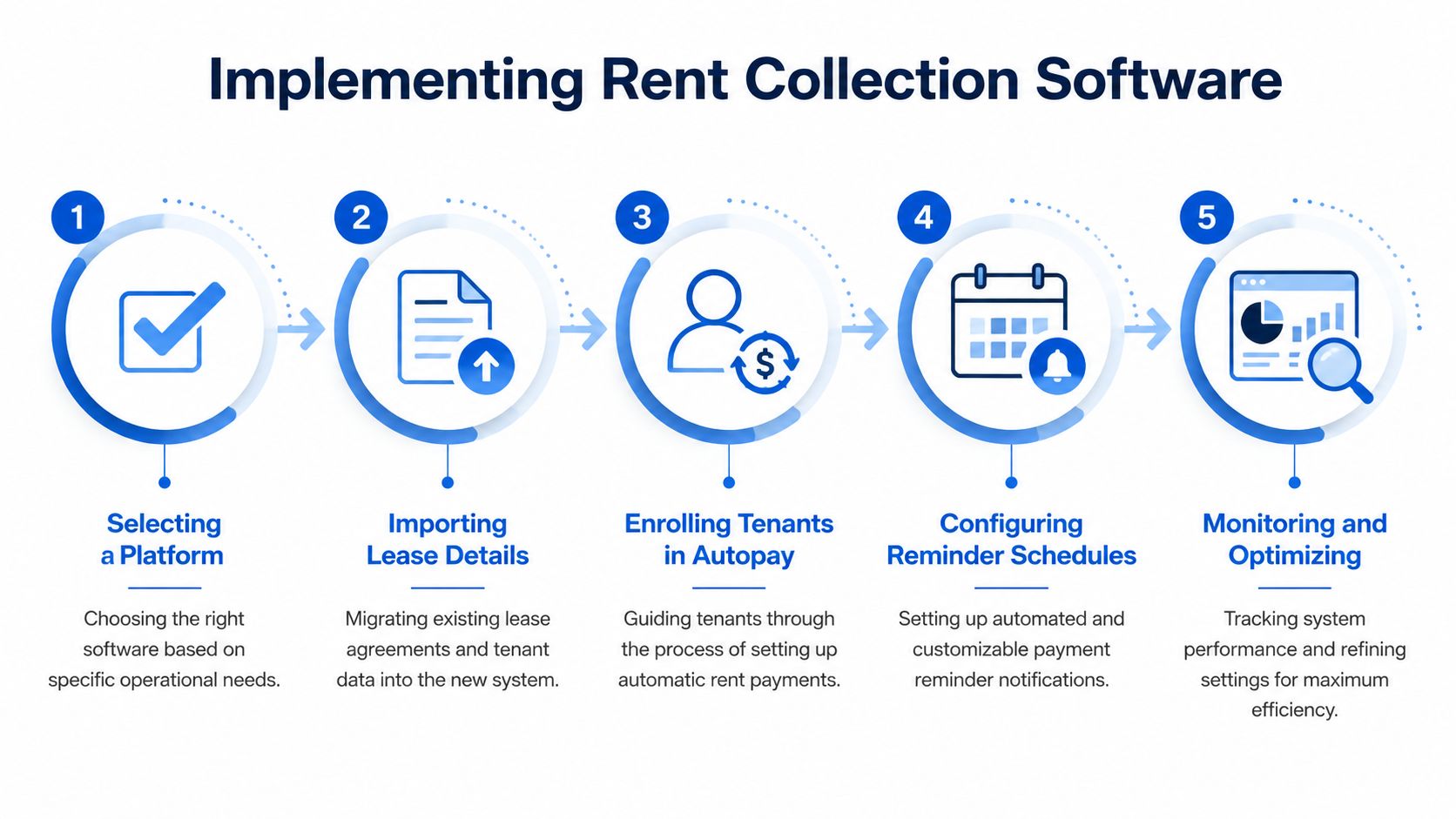
A clean rollout matters as much as the software itself. If the setup is messy, tenants get confused, staff keep working in old spreadsheets, and the new system never becomes the real system.
A simple rollout sequence
A documented setup flow recommends five steps, choose a platform, enter lease details, enroll tenants in autopay, configure reminders, and connect a bank account, with at least three reminder triggers tied to the rent cycle TenantCloud's landlord setup guide. That sequence is useful because it follows the actual path money takes through the business.
Use a reminder pattern tied to the due date, rather than sending random nudges. A practical schedule is one notice before rent is due, one on the due date, and one after the due date if the payment still hasn't arrived. That keeps the process predictable for residents and staff.
What change management looks like in practice
Your rollout should include three things:
- Tenant communication templates. Send one clear message that explains how to pay, when reminders will arrive, and where receipts will live.
- Staff training. Everyone who answers tenant questions should know the payment flow well enough to explain it in plain language.
- A short test window. Run a small group through the system first so you can catch problems before the whole property moves over.
If residents are used to paying roommates or sending screenshots, don't assume they'll adjust instantly. Clear instructions and a simple timeline reduce resistance.
The technical setup is only half the work. The other half is making the new process feel normal enough that tenants stop asking where to send rent after the first cycle.
ROI Examples and Practical Templates
The business case gets easier to see when you map the software to operating costs. Independent market commentary says automated rent collection can cut administrative costs by 40% and reduce late payments by 40–60%, driven by centralized workflows rather than convenience alone US Tech Automations on rent collection billing software.
That doesn't mean every property gets the same result. It means your savings depend on how much manual work you're replacing. A house with mixed payment methods, frequent follow-up, and lots of bookkeeping gets more value from automation than a simple, low-touch property.
A quick ROI template you can reuse
Use this basic worksheet logic:
- Current manual hours spent on reminders, reconciliation, and follow-up.
- Software hours saved once payments and receipts post automatically.
- Late-payment reduction from better reminders and autopay.
- Net savings after fees and any implementation time.
If you want a simple starting point, the savings calculator can help you frame the financial case before you compare tools.
What to track after launch
Don't stop at collection rate. Track the operational pieces that show whether the system is reducing friction:
- Time spent on payment follow-up
- Time spent on reconciliation
- Number of payment exceptions
- Tenant questions about receipts or balances
- Frequency of late-payment reminders
If the software only shifts your work from spreadsheets to email threads, the rollout isn't done yet.
The best outcome is boring in the best way. Payments show up on time, records stay clean, and you spend less of the month putting the rent process back together.
Conclusion and Next Steps
Rent collection software is most valuable when it removes hidden work. For co-living operators, that means fewer payment exceptions, clearer records, and a smoother way to manage room-by-room complexity. The right platform isn't just convenient, it gives you a tighter operating system for recurring income.
Start by comparing payment rails, reconciliation effort, and reporting quality, then test your rollout with a simple reminder schedule and clear tenant communication. Use the evaluation matrix, the implementation steps, and the ROI template to decide what fits your property instead of picking a tool on features alone.
If you're ready to modernize rent-by-room operations and want early access to a platform built for co-living workflows, join the PadPulse beta and help shape what comes next. A CTA for PadPulse.