AI Property Management: A Guide for Co-Living Hosts
July 14, 2026
If you run a co-living house, your day probably gets chopped into tiny tasks. One room is sitting vacant, another prospect wants a tour tonight, a current member forgot the move-in steps, and someone else is asking whether utilities are included. Meanwhile, you're still trying to decide whether Room A should be priced higher than Room B because one has better light, a shorter walk to the bathroom, or a quieter corner of the house.
That's where most generic property management advice breaks down. Whole-unit rentals are simpler. Co-living isn't. Each room behaves like its own micro-market, and the friction shows up everywhere: pricing, messaging, maintenance, access, renewals, and reporting.
AI property management matters because it removes that drag. Used well, it works like an operating layer across your portfolio. It helps you price rooms faster, answer repetitive questions automatically, spot issues earlier, and keep the business from depending on constant manual intervention.
The Future of Hosting Is Already Here
A lot of hosts still run room-by-room rentals with spreadsheets, inbox filters, smart lock apps, and a lot of memory. That works for a while. Then the portfolio grows, or turnover picks up, and the cracks become expensive.
One room stays empty because pricing wasn't updated quickly enough. Another gets underpriced because it was compared to the wrong comp set. A late-night inquiry sits untouched until morning, and by then the lead has moved on. None of that feels dramatic in the moment. Across a portfolio, it erodes NOI.
That's why AI property management has moved from a nice-to-have into a serious operating advantage. The category itself is growing fast. The global AI-Enhanced Property Management market reached USD 2.4 billion in 2024 and is projected to grow at a 18.7% CAGR to USD 12.2 billion by 2033, according to Growth Market Reports' AI-enhanced property management market analysis.
Co-living operators don't usually lose money from one giant mistake. They lose it in dozens of repeated manual decisions that should've been systematized.
In room-by-room rentals, the pressure is sharper because you're not managing one lease per unit. You're managing multiple prices, multiple occupancy timelines, multiple conversations, and often different service patterns under one roof.
That's why the best use of AI in this niche isn't flashy. It's practical.
- Pricing support: adjusting room rates based on live demand instead of gut feel
- Lead handling: replying to common inquiries without making prospects wait
- Operational follow-through: keeping move-ins, renewals, and maintenance from slipping
- Portfolio visibility: seeing what's happening by room, not just by property
For hosts who are new to the category, the important point is simple. AI property management isn't about replacing judgment. It's about taking repetitive work off your plate so you can make better decisions where judgment still matters.
What AI Property Management Means for Co-Living
For beginners, the easiest way to think about AI property management is this: it's an autopilot for the parts of your portfolio that repeat.
A basic automation follows a rule. If a guest submits a form, send an email. If rent is late, trigger a reminder. That's useful, but it doesn't learn much.
AI goes further. It looks at patterns in your pricing, inquiry volume, occupancy, maintenance history, and market activity, then recommends or performs actions based on what it's seeing. In co-living, that matters because room-by-room operations generate messy, uneven signals. One room type fills instantly. Another lags. One house gets more short-notice demand. Another gets better renewal behavior.
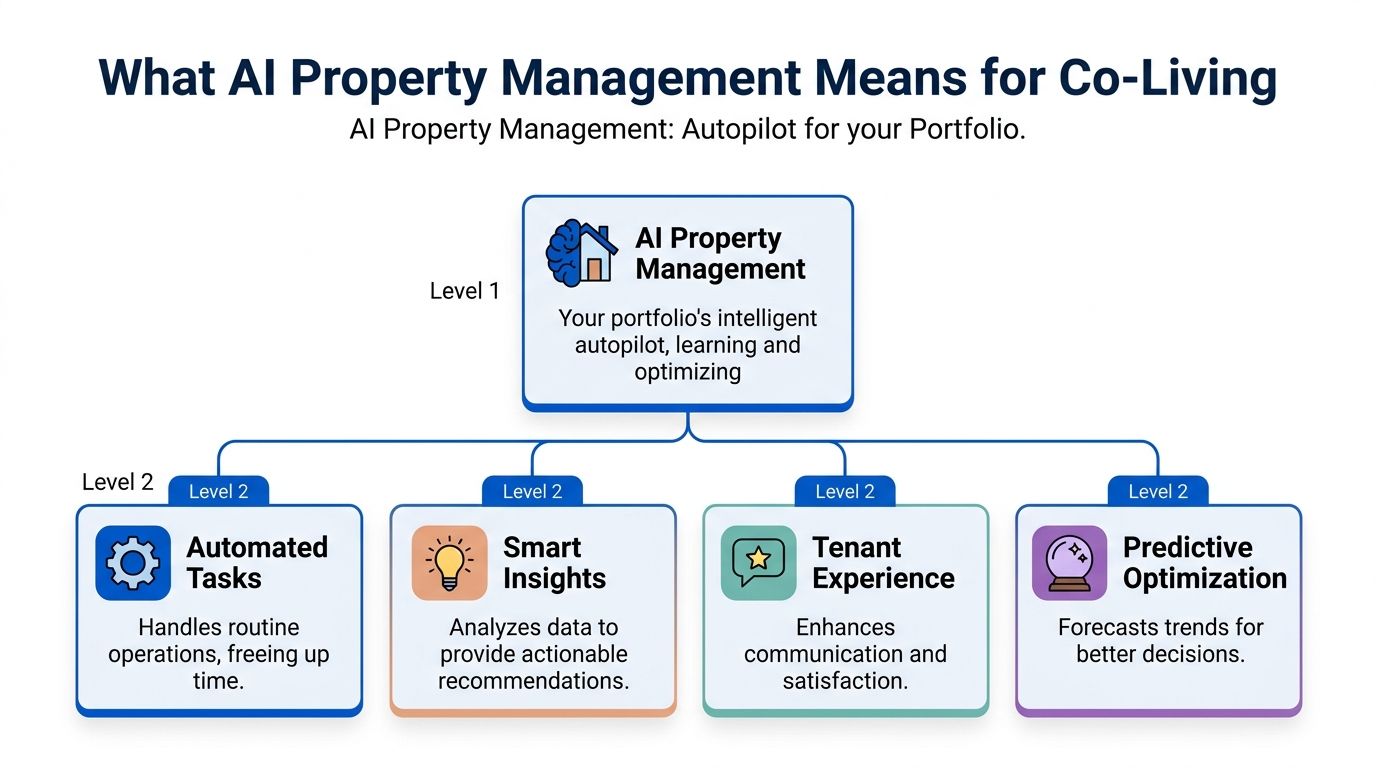
It's not just automation
In a co-living setting, simple automation might send the same canned answer to every lead. AI should do more than that. It should understand context, pull the right information, and improve recommendations as more data comes in.
That distinction matters most in fragmented portfolios. A whole-unit platform often assumes one rent, one vacancy status, one lease path, and one set of unit features. Co-living doesn't behave that cleanly. You may have per-room rents, shared utility allocations, different furnishing levels, different access permissions, and room-specific turnover timing in the same property.
Four practical pillars
Most useful AI property management workflows for co-living fit into four buckets:
- Pricing: room-level rate recommendations based on local demand, room features, seasonality, and comparable listings
- Communications: automated replies for inquiries, lease questions, reminders, and maintenance updates
- Operations: coordination across move-ins, lock access, cleaning, inspections, and recurring admin tasks
- Analytics: visibility into occupancy, pricing decisions, lead flow, and portfolio performance at the room level
Practical rule: If a task happens often, follows a pattern, and still takes staff time every week, it's a strong candidate for AI.
Where co-living gets harder
The challenge isn't deciding whether AI sounds useful. The challenge is getting your data into a shape where AI can help.
Room-by-room rentals usually store information in fragmented ways. Some details live in leasing software, others in smart lock apps, others in spreadsheets, and others only in a manager's head. That's why many operators get stuck at basic messaging instead of advanced pricing or forecasting.
For non-technical hosts, the takeaway is straightforward. AI property management works best when it has structured, room-level inputs and a narrow operational job to do. Start with that mindset, and the technology becomes much less intimidating.
The Core Capabilities of an AI Management Platform
A useful AI platform for co-living earns its place in the first week. A vacant ensuite needs a price update. A prospect asks whether couples are allowed in Bedroom 3. A current member reports that the smart lock on the side entrance stopped working. If your team still has to jump between five tools and two spreadsheets to answer those basic questions, the platform is not doing enough.
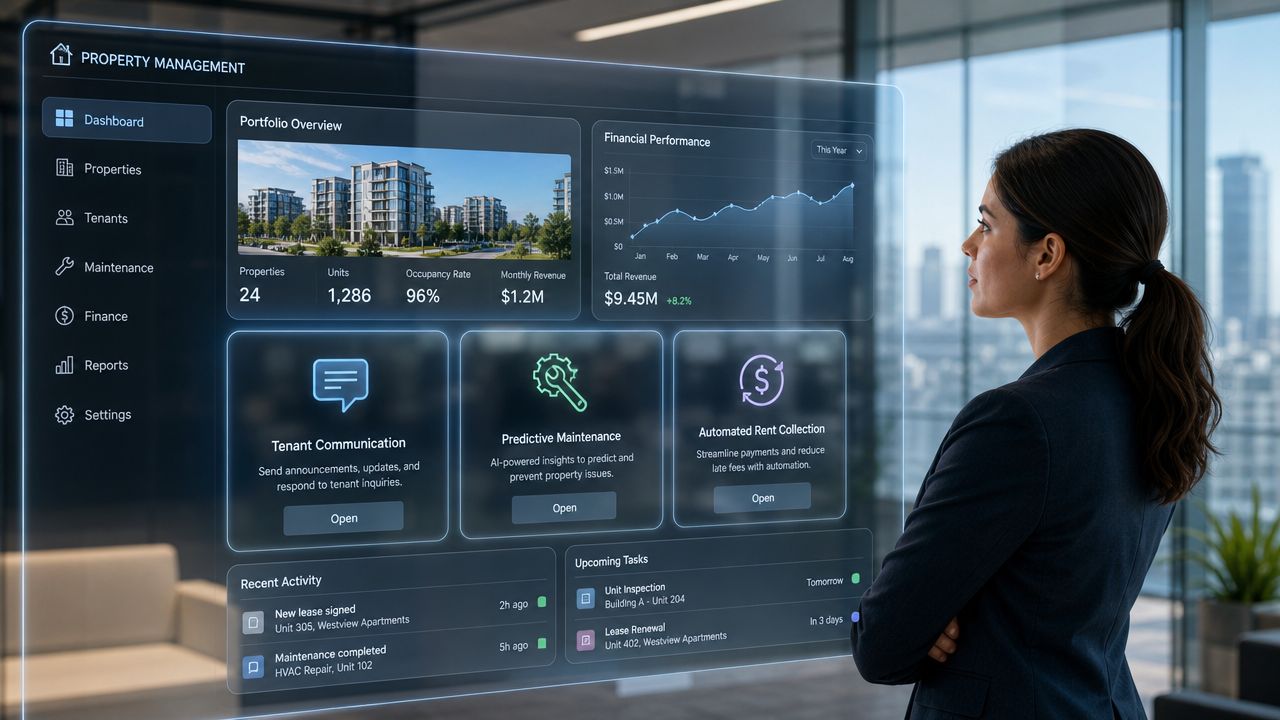
For room-by-room rentals, the core capabilities are different from what managers need in standard apartment portfolios. The platform has to work at the room level, keep fragmented operational data in sync, and support fast decisions across pricing, resident communication, device control, and reporting. If you are still sorting out the baseline category, this guide to what property management software covers is a useful reference. AI for co-living has to go further.
Dynamic pricing for individual rooms
This is usually the first place generic tools break.
Whole-unit pricing logic does not translate cleanly to shared housing. In one house, the front room with two windows and a private bath may justify a premium, while the smaller interior room next to the kitchen needs a different strategy, even if both sit under the same roof. Operators who price every bedroom off a house average usually leave money on the table or create avoidable vacancy.
AI-powered pricing engines can analyze 50+ market variables, including vacancy rates, seasonal trends, and competitor pricing, to optimize rents in real time with weekly adjustments based on demand signals, according to Botway's rental pricing playbook.
The practical test is simple. The system should recommend a rate for Room A, not just for 123 Main Street.
| Workflow | Before AI | After AI |
|---|---|---|
| Room pricing | Manual comp checks across marketplaces | Suggested room-specific rates based on live demand signals |
| Repricing cadence | Sporadic updates when someone remembers | Regular recommendations tied to market changes |
| Decision quality | Heavy reliance on gut feel | Data-backed suggestions with room for manual override |
Manual override still matters. I have seen pricing models miss local nuance, especially around roommate mix, parking friction, or a noisy block face that does not show up cleanly in market data. Good AI narrows the decision. It does not replace operator judgment.
AI messaging that handles routine volume
Leasing and resident communication is full of repeat questions. Availability. Deposit terms. guarantor rules. Wi-Fi speed. House rules. Move-in instructions. Maintenance updates. Late fee policies. In co-living, the repetition is higher because each property has shared spaces, room-specific details, and more frequent turnover.
Deloitte reports that autonomous and generative AI can resolve a large share of common customer service contacts without human intervention, often in the 60% to 80% range for routine requests in well-scoped workflows, as explained in Deloitte's analysis of agentic AI in customer service. For co-living operators, that means staff can spend time on exceptions instead of answering the same ten questions all day.
The setup that works best is narrow and structured:
- Inquiry triage: AI answers common leasing questions and captures lead details
- Status updates: residents get automatic reminders for payments, move-ins, inspections, and maintenance progress
- Escalation logic: disputes, safety issues, and unusual requests go to staff with the conversation history attached
That last point matters more than vendors admit. Bad automation creates resident frustration fast. Good automation answers the routine question, logs the interaction, and hands off edge cases before the conversation goes sideways.
Later in the workflow, video can help teams visualize how these systems fit together operationally.
Smart-home automation that supports operations
In co-living, smart-home tools affect NOI because they shape turnover speed, access control, labor hours, and avoidable maintenance tickets.
The most useful platforms connect locks, thermostats, leak sensors, noise monitoring, and task workflows into one system. When a resident signs a lease for Room 4, access permissions should update for that bedroom and the correct common doors only. When that resident moves out, the platform should revoke access, create a cleaning task, schedule an inspection, and flag any missing handoff steps. When a sensor catches a water issue early, the team should get the alert before drywall and resident trust take a hit.
At ten rooms, teams can patch this together manually. At fifty or a hundred, app sprawl starts causing missed cleanings, wrong-code lock assignments, and wasted staff time.
Predictive analytics for room-level visibility
Co-living operators need reporting that matches how the business runs. Property-level occupancy is too blunt. A house can look healthy on paper while one room type consistently underperforms, one floor plan churns faster, or one leasing channel sends weak leads.
A strong AI platform surfaces patterns by room, not just by building. It should show where discounts are recurring, which room attributes support premiums, how long each room type sits vacant between leases, and where renewals are softening. Those details help operators fix revenue leakage that standard dashboards miss.
This is also where data cleanup pays off. If room names are inconsistent, if amenity tags are incomplete, or if lease events live in disconnected systems, the reporting will be noisy. Once the data model is cleaned up, the visibility gets much better, and so do the decisions that follow.
How AI Drives ROI for Room-by-Room Rentals
In co-living, ROI comes from a handful of operating levers. Fill rooms faster. Price them better. Cut repetitive admin work. Keep good members longer. AI property management affects all four at once, which is why the gains compound instead of showing up in only one department.
Companies using AI in property management report a 15% average decrease in vacancy rates, a 3% to 7% increase in annual rental income, and some managers save an estimated 50 hours per week through automation, according to Estately's analysis of the AI adoption gap in property management.
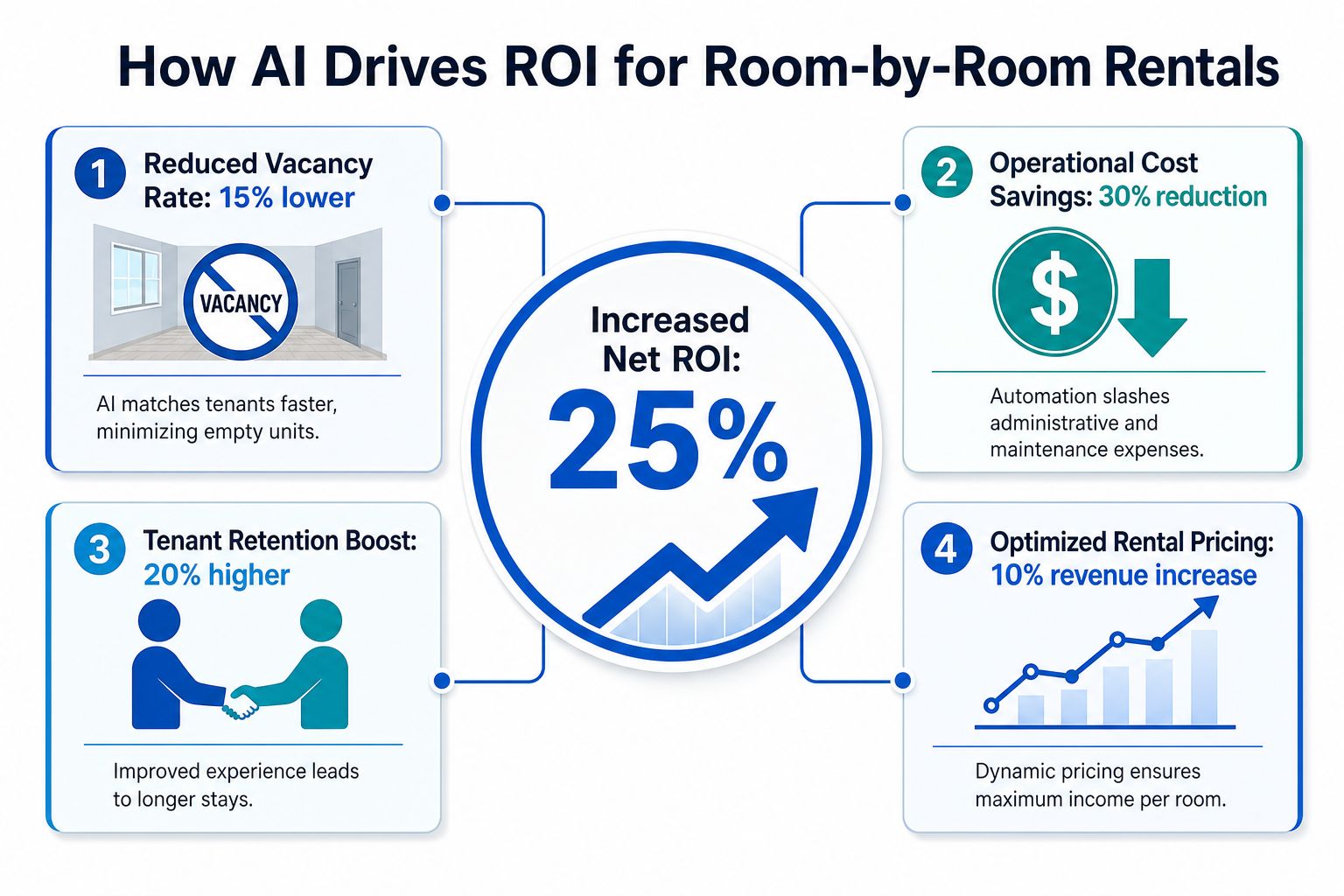
If you're still learning the mechanics behind room-level pricing, this overview of dynamic pricing strategy for rentals gives useful background.
Revenue improves when pricing gets granular
Whole-property averages hide a lot. In room-by-room housing, a larger room, a furnished room, a quieter room, or a room with a private bath often deserves different pricing logic. AI helps operators stop treating every room like a flat commodity.
That's where the extra rental income usually comes from. Not from charging more blindly, but from pricing more accurately and adjusting more consistently.
Vacancy gets cheaper when leasing response time improves
A vacant room in co-living has a short revenue cycle. Every slow reply, missed inquiry, or delayed application step hurts.
AI helps by keeping the front end of leasing moving even when your staff is busy. Prospects get answers faster. Follow-ups don't slip. The lead stays warm while you're handling exceptions instead of routine questions.
Admin overhead falls when repetitive work disappears
Manual co-living operations tend to create invisible labor. Staff answer the same questions, push the same reminders, check the same documents, and repeat the same move-in steps.
Those hours add up. Getting them back changes staffing math. It also changes owner attention. Instead of spending your time inside the workflow, you can work on pricing strategy, acquisition, retention, and standards.
Better NOI in co-living usually comes from tighter execution, not just higher rents.
Retention benefits from consistency
Residents stay longer when communication is prompt, access works, and maintenance feels organized. AI doesn't create hospitality on its own, but it does reduce the operational sloppiness that often causes frustration.
In room-by-room rentals, that consistency matters because shared living magnifies friction. One delayed response can affect the entire house experience.
Your High-Level Implementation Roadmap
Monday at 9:00 a.m., one room shows as occupied in your PMS, vacant in your smart-lock dashboard, and "ready next week" in the leasing spreadsheet. If you roll out AI on top of that, the system will automate the confusion.
That is why co-living implementations should start small and get more advanced in stages. Room-by-room rentals have more status changes, more edge cases, and more naming problems than whole-unit portfolios. A practical rollout begins with clean operating rules and cleaner inputs. This guide on workflow optimization for property operations is a useful starting point because AI only performs well when the underlying workflow is consistent.
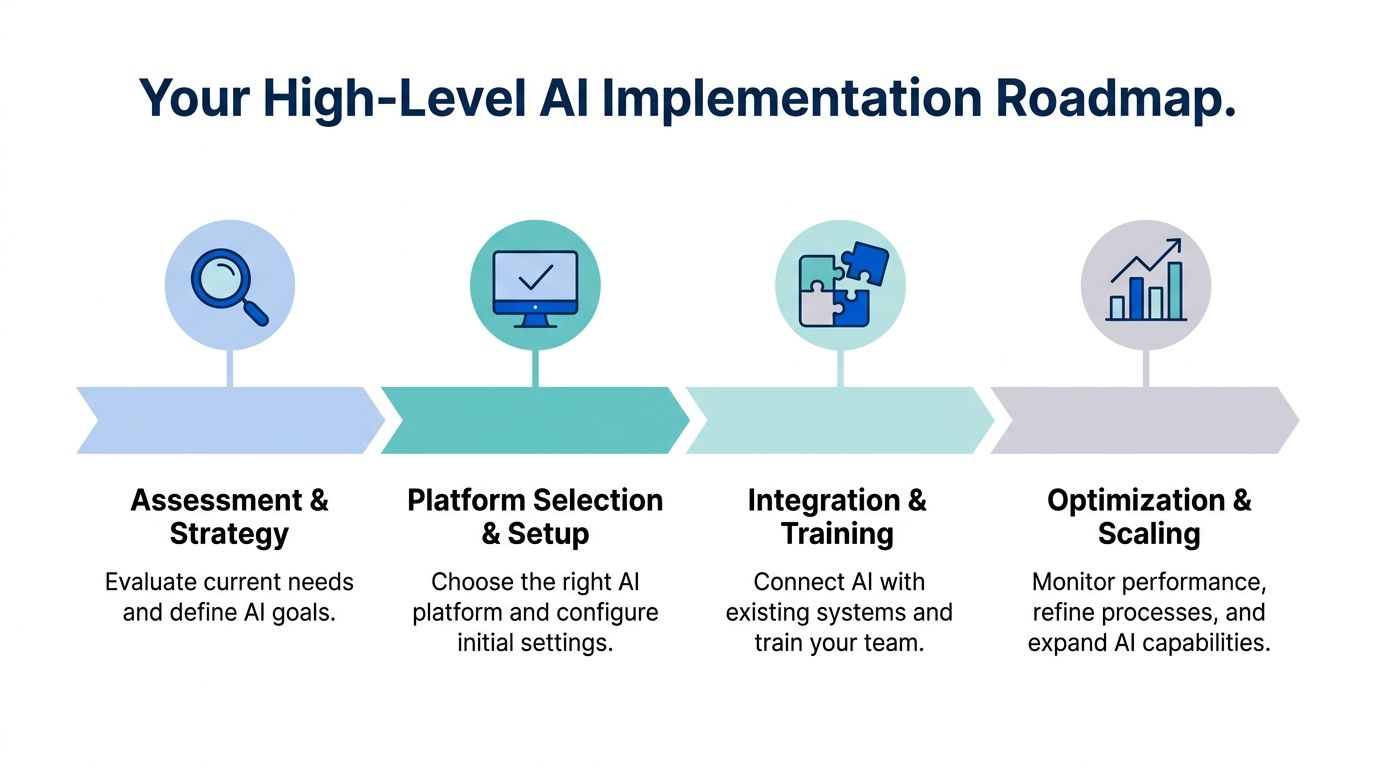
Most operators get better results by rolling AI out in phases, proving one use case before adding the next. That matters even more in co-living, where one bad room record can distort pricing, leasing, maintenance, and reporting at the same time.
Phase 1 clean your room-level data
This is the work nobody wants to do.
It is also the step that determines whether your pricing engine, messaging assistant, and maintenance alerts will be useful or noisy. In co-living, data problems usually sit below the property level. Room names vary by house, amenities are recorded inconsistently, lease dates live in different tools, and smart devices are often assigned to the wrong space.
Start by standardizing the basics:
- Room inventory: assign every room a consistent ID, layout type, furnishing status, and availability status
- Pricing history: keep prior asking rents, signed rents, discounts, and lease start timing by room
- Operational events: record tours, applications, approvals, move-ins, transfers, renewals, and turns in one format
- Device mapping: tie locks, thermostats, leak sensors, and common-area devices to the right room or shared space
I have seen operators skip this step and blame the software later. The problem was not the model. The system was reading messy room labels and conflicting status rules.
Phase 2 automate communications first
Communications are usually the safest first deployment because the rules are clear and the labor load is high. Good starting points include lead replies, tour confirmations, application reminders, move-in instructions, late-rent nudges, and maintenance status updates.
This phase gives your team a controlled way to build trust. Staff can approve templates, set escalation rules, and review conversations without handing over judgment calls. In co-living, that matters because prospects often ask room-specific questions that generic leasing bots mishandle unless you train them on shared-bath setups, furnished rooms, house rules, parking, and common-area access.
Phase 3 add pricing and predictive maintenance
After room data is reliable and communications are stable, add the systems that affect NOI more directly.
For co-living, dynamic pricing has to work at the room level, not just the unit level. A larger room with an ensuite bath should not move in lockstep with a smaller interior room across the hall. Pricing logic also needs to account for staggered vacancy dates, seasonality by room type, and house-level mix. A house can be 90 percent occupied and still have a pricing problem if the same room type sits vacant every turn cycle.
Predictive maintenance belongs here too, but only if the inputs are dependable. Sensor data, work-order history, and recurring issue tags need to be accurate enough to flag patterns instead of producing false alarms.
AI works best when operators treat it like a decision support layer, not a substitute for field knowledge.
Human review still matters. A pricing recommendation may miss that a room backs up to a loud alley, or that one house consistently leases faster because the common areas were recently upgraded.
Phase 4 measure and scale
Scale after the first property, or first cluster, is producing repeatable results.
For room-by-room rentals, the review should happen below the property level. Portfolio averages can hide bad pricing and bad process. One house can look healthy while two room types underperform every month.
Use a scorecard like this:
| Metric | Why it matters in co-living |
|---|---|
| Occupancy by room type | Shows whether certain room categories are priced wrong or marketed poorly |
| Days on market by room | Exposes leasing friction that gets buried in property-level averages |
| Revenue per available room | Shows whether room-level pricing is improving realized income |
| Renewal patterns | Helps spot whether service consistency is improving resident retention |
Once those numbers improve consistently, expand to the next set of houses. That approach is slower for a few weeks and faster over a year because your team is scaling a working system instead of fixing the same setup mistakes across the portfolio.
Choosing the Right AI Vendor for Your Portfolio
The wrong vendor usually sounds impressive in a demo. The right vendor understands how co-living operates.
Many platforms were built around whole-unit assumptions. That creates immediate problems for room-by-room operators. You need pricing, reporting, communications, and device logic that can operate below the property level. If a tool can't think in rooms, beds, shared spaces, and staggered occupancy, it will force your team back into workarounds.
What to evaluate first
Start with the pricing model. If the vendor only supports one market rent per unit, that's a bad fit for co-living.
Then look at integrations. Smart locks, thermostats, accounting tools, messaging systems, and listing workflows all need to connect cleanly. If the AI layer sits on top of disconnected tools without a reliable data model, you'll still spend your day reconciling information manually.
Ease of use matters too. The best system in the world won't help if onsite staff avoid it.
Vendor Selection Checklist for Co-Living AI
| Criterion | What to Look For |
|---|---|
| Room-level pricing support | Can the system price individual rooms instead of only full units? |
| Data structure | Does it support room attributes, shared amenities, and staggered occupancy? |
| Messaging workflows | Can it handle leasing FAQs, resident updates, and escalation rules in one place? |
| Smart-home integrations | Does it connect with smart locks, thermostats, and sensor-based workflows? |
| Human override controls | Can staff review, approve, or reject pricing and automation decisions? |
| Reporting depth | Can you see performance by room, property, and portfolio, not just top-line totals? |
| Onboarding practicality | Will the vendor help map your current messy data into a usable structure? |
| Scalability | Does pricing stay workable as you add more rooms, houses, and users? |
Questions worth asking on every demo
- How does your system handle room-by-room pricing in shared housing?
- What data fields are required before your AI recommendations become reliable?
- How do staff override recommendations when local knowledge differs?
- What happens if one room has incomplete history or unusual turnover patterns?
- Can the platform separate property-level and room-level reporting cleanly?
A generic tool can still be useful for simple automation. For serious co-living operations, specialization usually wins.
Common Pitfalls to Avoid When Adopting AI
A co-living operator adds an AI pricing tool, turns on automated messaging, and expects cleaner performance within a month. Instead, Room 3A is listed three different ways across the PMS, the lock system, and the leasing spreadsheet. One furnished room is grouped with unfurnished inventory. A private bath flag is missing on half the portfolio. The software is not failing. It is applying logic to bad inputs.
That is the mistake I see most often. Teams expect AI to repair broken operating habits. In room-by-room rentals, the opposite is usually true. Weak data structure gets exposed faster because every pricing recommendation, turnover forecast, and resident message depends on details at the room level, not just the property level.
Analysts at Bridging Main's analysis of AI use in property management found that many property management companies still keep AI use limited to communications. In practice, that tracks with what happens in co-living portfolios. Messaging is easier to automate early. Reliable room-by-room pricing is harder because the data is fragmented across leasing, maintenance, smart-home tools, and manually maintained sheets.
Four mistakes that cause trouble
- Starting with dirty room data: If room names, bath type, furnishing status, floor, shared amenity access, and occupancy status are inconsistent, pricing recommendations will drift quickly.
- Letting automation run without operator review: House-level constraints still matter. One room may price lower because of noise, window size, or a bad bathroom layout that the software cannot infer cleanly from historical data.
- Judging the system too early: Early outputs are often useful but rough. AI gets better after rate history, lead outcomes, and turn times are mapped correctly.
- Choosing software built for whole-unit rentals: A platform that treats every address as one rentable product usually struggles with staggered move-ins, room-level comps, and partial occupancy.
The fix is operational, not cosmetic. Standardize naming conventions. Clean feature tags. Decide which system owns occupancy status, room attributes, and pricing history. Then automate in stages.
Teams that do this well usually start with one or two houses, test recommendations against manager judgment, and correct obvious data errors before expanding across the portfolio. That takes work up front. The payoff is real. Once the structure is clean, AI can save hours every week on pricing checks, lead replies, and exception handling, while improving occupancy and NOI at the room level.
For co-living hosts, AI property management works best as a disciplined operating layer for fragmented inventory. Treat it that way, and the time savings are substantial. Treat it like a magic button, and it will surface every weakness in the portfolio.
PadPulse is building an all-in-one platform specifically for PadSplit hosts and co-living operators who want tighter room-by-room pricing, smarter messaging, better smart-home coordination, and clearer NOI visibility. If that sounds like the system your portfolio has been missing, join the PadPulse interest list to get product updates, beta access details, and early launch information.