Administrative Burden for Room-by-Room Operators
September 24, 2026
At 6:15 a.m., the first text arrives: a resident has a leaking toilet and can't find the shutoff valve. By breakfast, another resident is asking about a late payment, a vendor wants access to the house, and an applicant is waiting for a screening decision. For a room-by-room operator, the work rarely arrives in a neat queue. It arrives across texts, apps, spreadsheets, email, and the front door.
That's administrative burden. It's the time, money, attention, and coordination required to keep a rental operation moving when every room has its own resident record, payment status, lease file, maintenance issue, and compliance trail. In co-living, duplicated work doesn't stay duplicated once. It repeats across every door, and it can compress NOI long before the operation looks obviously broken.
A Tuesday in the Life of an Overloaded Host
Maya manages ten rooms across two houses. At 6:15 a.m., she opens her phone to a text about the leaking toilet, then checks the smart-lock app because the resident says the bathroom door is stuck. At 6:42, she switches to email to confirm a plumber's availability. The plumber can come later, but Maya has to be there.
At 7:10, she opens three different rent and banking apps to chase one late payment. The resident paid part of the balance through one channel and promised the rest through another. Maya copies the amounts into a ledger, checks the lease terms, and drafts a reminder. By 8:05, she's already handling information that should live in one resident record.
She leaves for the property at 9:20 to meet the vendor. The drive isn't just travel time. It displaces the work she planned to do, including reviewing an applicant and calling an insurance broker. At the house, she discovers that the plumber needs access details that are sitting in a text thread with her co-host.
The problem isn't one difficult task. It's the constant cost of finding the latest version of every fact.
At 11:40, Maya manually reconciles a utility bill split across ten rooms. One resident moved in midway through the billing period, another changed rooms, and a third disputes the allocation. She updates the spreadsheet, exports a copy for accounting, and saves the bill in an insurance-audit folder.
After lunch, she screens an applicant, answers questions about parking, and sends a move-in document packet. At 3:30, she updates the insurance spreadsheet because the audit requires current occupancy and room information. At 5:15, her co-host asks a compliance question. Maya searches email, a licensing folder, and an old message before replying.

She tells herself the day is over at 7:00 p.m. It isn't. More texts arrive about a replacement key, a rent receipt, and tomorrow's inspection. At 10:40, Maya closes the laptop. Nothing catastrophic happened, but higher-value work was pushed aside all day.
For many room-by-room operators, this isn't an exceptional Tuesday. It's the baseline operating tempo.
What Administrative Burden Really Means
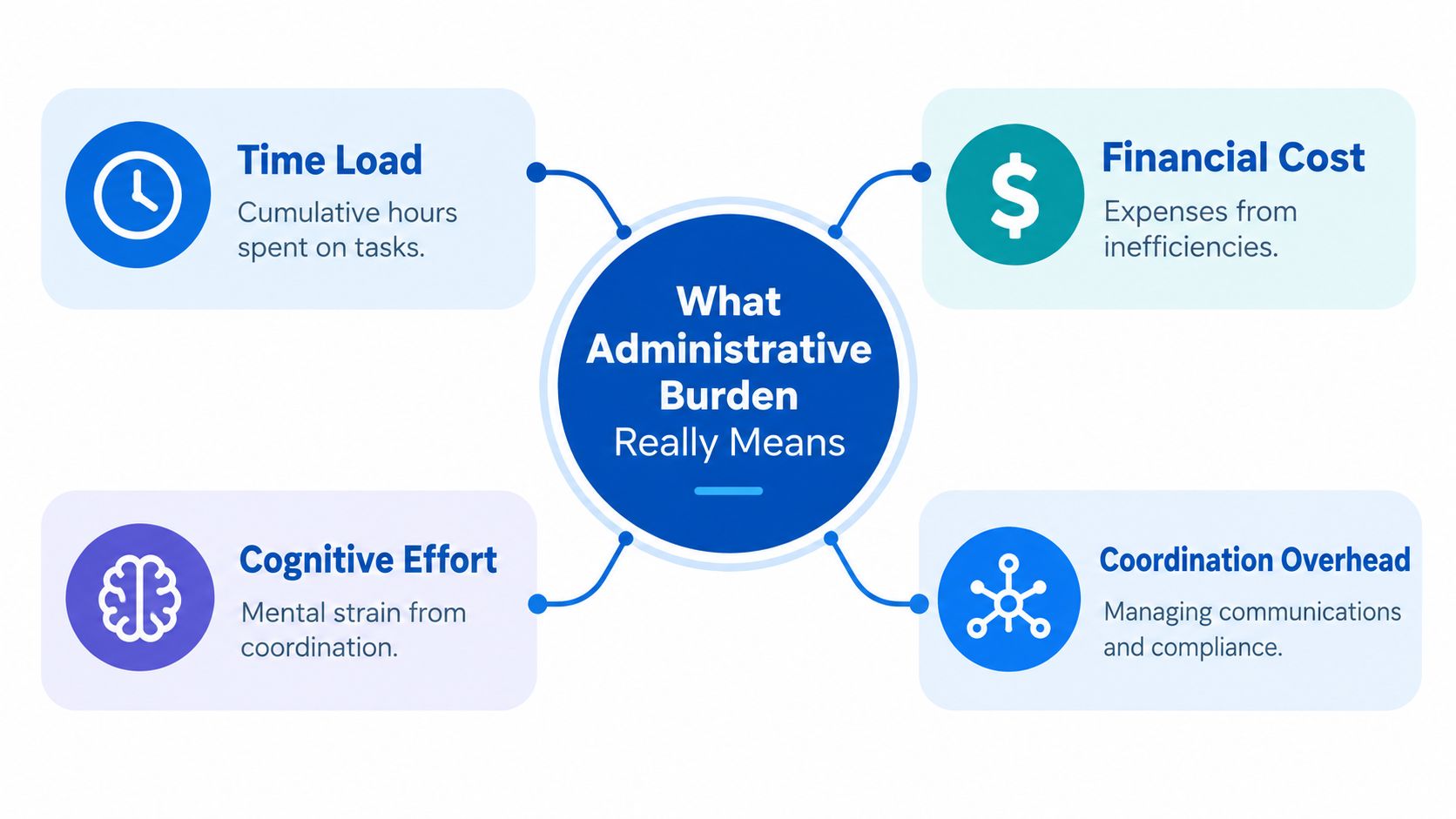
Administrative burden is more than paperwork volume. The OECD definition of administrative costs includes finding, documenting, storing, making available, and reporting information required by regulation. For an operator, the same pattern appears in rent collection, resident communication, maintenance coordination, insurance records, and move-ins.
Sort each recurring task into four cost types.
Time cost
This is the visible layer. It includes entering the same resident details into a property management system and accounting software, checking manual rent ledgers, locating a maintenance history, or sending the same payment reminder one resident at a time.
Track time by door, not only by property. Ten rooms can create ten separate payment questions, ten document packets, and ten maintenance records even when the plumbing, insurance policy, or house rules are shared.
Direct financial cost
Some burden appears on the income statement. You may pay for overlapping software, bookkeeping support, vendor coordination, duplicate storage, or a service that exists only because another system lacks a needed integration.
A process can be legally necessary and still be poorly designed. The Administrative Conference of the United States guidance on reducing process burdens recommends measuring burden through time, money, effort, and stress, rather than assuming headcount tells the full story.
Opportunity cost
Every hour spent reconciling a utility split is an hour not spent improving a vacant room, reviewing pricing, negotiating a vendor agreement, or responding quickly to a strong applicant. Delayed decisions can create downstream costs, especially when a room stays unready because the operator is buried in coordination.
Cognitive cost
Scattered information creates decision fatigue. Maya doesn't just spend time searching. She has to remember which app contains which answer, decide whether the information is current, and judge whether an exception needs escalation. That mental load increases the chance of missed follow-ups and inconsistent resident treatment.
The room-by-room model multiplies the exposure. A traditional multifamily property may manage one lease and one payment workflow per unit. A co-living house manages a separate lease, deposit, screening file, payment status, and maintenance relationship for each room. That structure can produce better revenue density, but only when the operating process handles the repeated records without requiring an owner to recreate them manually.
How Burden Quietly Eats Into NOI
Administrative burden becomes easier to manage when you translate it into the language of NOI. Start with a simple ten-room property. Gross scheduled rent comes from ten room agreements. From there, subtract vacancy, concessions, utilities paid by the owner, repairs, management costs, software, and other operating expenses. The remaining amount is NOI.
The owner's unpaid time belongs in the analysis even if it doesn't appear as a payroll line. If Maya spends eight to twelve hours each week on administrative work, that time has an opportunity cost. At an assumed $75 per hour, the weekly value is $600 to $900, and the annualized opportunity cost is $31,200 to $46,800. Those are calculated scenarios, not industry benchmarks. The hourly assumption should reflect what the owner could earn from acquisitions, leasing, asset management, or another productive use of time.
Administrative Burden Cost Model for a 10-Room Property
| Cost Category | Driver | Monthly Impact ($) | Annual Impact ($) |
|---|---|---|---|
| Owner administrative time | 8 to 12 hours weekly at a $75 opportunity cost | 2,600 to 3,900 | 31,200 to 46,800 |
| Software overlap | Duplicate systems and unused functionality | Qualitative | Qualitative |
| Rent follow-up leakage | Delayed reminders and manual reconciliation | Qualitative | Qualitative |
| Vacancy delay | Slower screening, approval, or room readiness | Qualitative | Qualitative |
| Compliance exposure | Missed records, rework, or penalties | Qualitative | Qualitative |
The table shows why the owner's time deserves a line in the decision. It doesn't claim that every operator should use the same hourly value. It gives you a method: assign a defensible value to your time, then compare it with the cost of redesigning the workflow.
The broader productivity picture reinforces the concern. A 2026 professional survey summarized by 8am found that 44% of workers lose at least four productive or billable hours each week to administrative work, while 73% say administrative tasks interfere with core responsibilities at least sometimes. The same source cites an estimate of 3.3 billion annual compliance hours across small entities, averaging more than 379 hours per business per year, or roughly ten workweeks.
Operator's calculation: Count the hours first. Then price them. A process that looks “free” because the owner does it personally may be the most expensive line in the business.
Additional leakage comes from slow rent follow-up, vacant rooms waiting for approval, overlapping subscriptions, and compliance rework. The OECD business compliance analysis reported that surveyed small and medium-sized enterprises spent nearly US$27,500 per year on tax, employment, and environmental compliance, with those costs averaging about 4% of business-sector GDP across the surveyed countries. That research is not a room-by-room property benchmark, but it illustrates why compliance administration belongs in financial planning.
Every duplicated task in a co-living model multiplies per door. Administrative burden therefore erodes NOI faster than it does in traditional multifamily, and it shows up as margin compression long before it shows up as a crisis.
Why More Tools Can Make Things Worse
Adding software feels productive because every new app promises to remove a manual step. In practice, an app can remove one task while creating three others: another login, another notification stream, and another place where the resident record can drift out of date.
A fragmented room-by-room stack often includes a spreadsheet, accounting software, a messaging app, a rent platform, a CRM, and maintenance ticketing. If each system owns part of the truth, someone has to reconcile them. The operator becomes the integration layer.
The hidden work inside a disconnected stack
- Separate logins: Maya spends time checking multiple dashboards before she can answer one resident question.
- Duplicate entry: A new move-in must be entered into several records, increasing the chance of mismatched dates or balances.
- Conflicting notifications: Two systems may alert the team about the same issue, while a third contains the actual resolution.
- Version drift: A resident changes rooms or payment status, but one record remains outdated.
- Unclear ownership: A co-host sees a message but doesn't know whether anyone has acted on it.
Claims that operators using six or more tools spend more time syncing data should be treated cautiously unless supported by a verifiable benchmark for the exact operating context. The practical point doesn't require a universal threshold. If your team spends more time comparing systems than completing the underlying work, the stack is already too fragmented for the operation.
The process automation guide is useful as a starting point, but automation should follow process ownership. First decide which system owns the resident record, payment status, room assignment, maintenance history, and compliance documents. Then decide what should flow automatically and which exceptions require a human.
Centralization isn't automatically good, either. Research on Australian universities found that administrative centralization and service automation increased perceived administrative burden for staff, as described in the 2025 Administrative Burden Survey Report. Technology can shift coordination and exception handling instead of removing them.
Design rule: Don't digitize a confusing process. Remove the duplicate step, define the exception path, then automate the clean version.
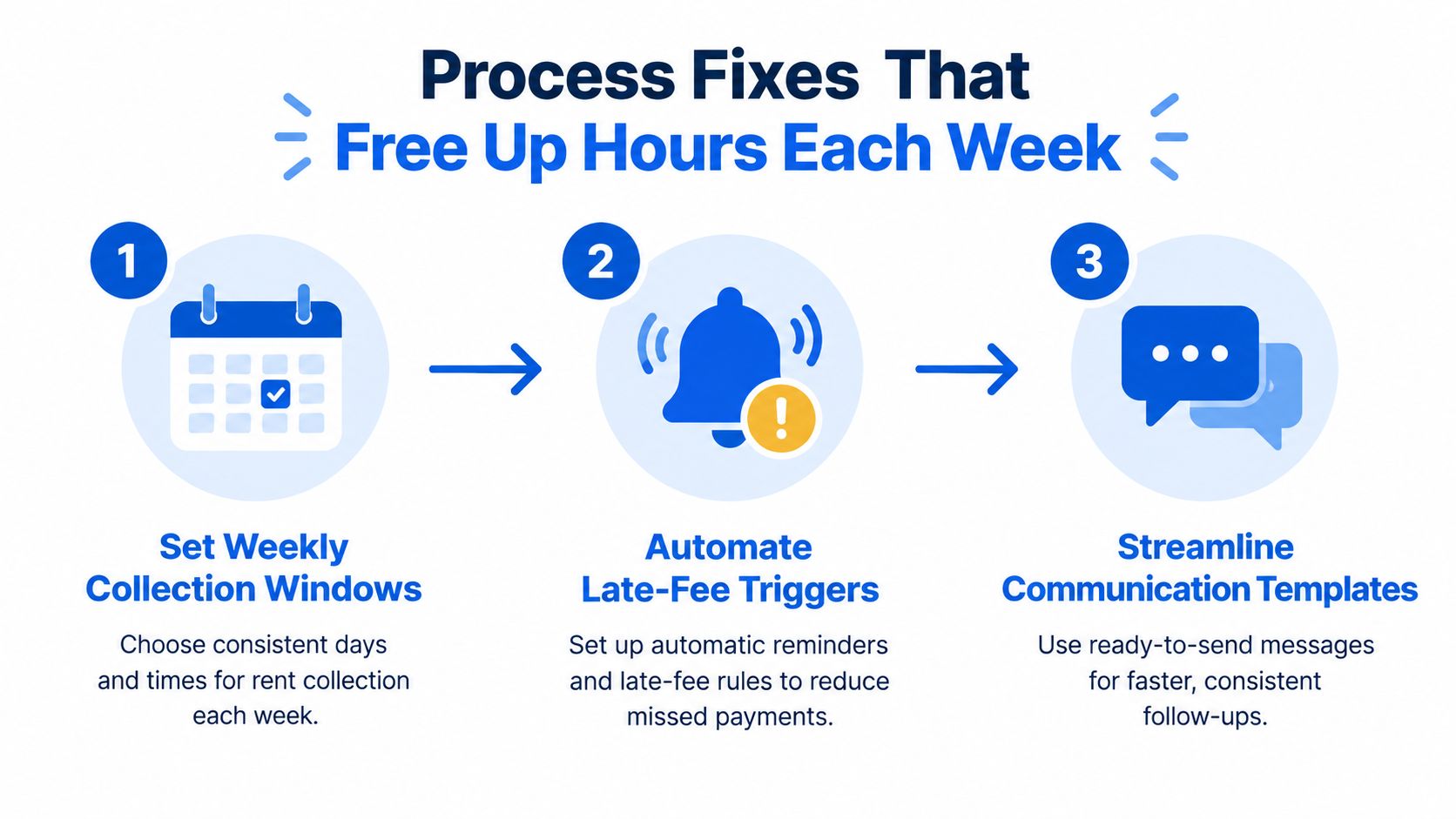
Process Fixes That Free Up Hours Each Week
The fastest improvements usually come from redesigning the sequence of work before buying software. A good process tells residents what happens next, tells staff who owns the task, and gives unusual cases a clear route instead of forcing everyone to improvise.
Rent collection
Set one weekly collection window for reviewing balances and unresolved payments. Configure late-fee triggers according to the lease and local requirements, then use a two-step escalation path before sending a personal text.
- Automated reminder: Notify the resident about the balance, due date, payment method, and next action.
- Exception review: Check failed payments, partial payments, disputes, and approved arrangements.
- Direct escalation: Contact the resident only when the first two steps don't resolve the issue.
This keeps routine collection out of the owner's personal inbox. It also creates a consistent record when a resident asks why a charge or reminder was sent.
Communication
Use one resident-facing channel for routine messages and one internal assignment system for staff follow-up. Create templates for the ten questions that arrive repeatedly, including parking, guests, utilities, maintenance access, move-out, payment receipts, lockouts, house rules, room changes, and document requests.
Set a response-time service level of under four business hours for standard inquiries. That is an operating target, not a verified industry benchmark. The important part is assigning an owner and measuring whether the team meets the promise.
Batch announcements instead of sending separate messages to every resident. A house calendar, searchable self-service guide, and reusable scripts can reduce a resident's repeated touchpoints from 14 to 5 in a worked process example, but operators should validate the result against their own message logs rather than treat it as a guaranteed outcome.
Compliance and move-in
Create a recurring monthly checklist for local licenses, insurance certificates, inspection logs, occupancy records, and required notices. Assign each item to a person, add an evidence field, and record the renewal or review date.
For intake, use one document packet and one room-readiness checklist. A practical target is to complete intake and move-in in under 72 hours when the applicant has supplied the required information and the room is ready. The checklist should cover screening, agreement execution, deposit, payment setup, access credentials, condition photos, utilities, and house orientation.
The process standardization framework can help turn those decisions into repeatable operating procedures. The measure of success is not a polished document. It's whether another team member can complete the workflow without asking Maya where every file lives.
Choosing the Right Technology Building Blocks
Room-by-room operators don't need the largest software stack. They need a small number of systems with clear ownership. Evaluate each category against three questions: Does it reduce manual entry? Does it fit co-living workflows? Is the cost justified by the time it saves?
Technology Building Blocks for Room-by-Room Operators
| Category | Primary Function | Burden Reduced | Best Fit Scale |
|---|---|---|---|
| Rent and billing platform | Collect room rent, track balances, handle split utilities | Manual ledgers, reminders, reconciliation | Small to mid-sized operators |
| Communication hub | Centralize resident conversations and assignments | Repeated replies, missed follow-ups, channel switching | Solo operators through distributed teams |
| Access control | Issue self-service codes and maintain audit trails | Lockout coordination and key handoffs | Properties with frequent move-ins |
| Accounting integration | Connect property activity to financial reporting | Duplicate bookkeeping and delayed visibility | Operators with multiple houses |
| Maintenance workflow | Log requests, assign vendors, document resolution | Text-thread searches and status chasing | Portfolios with recurring work orders |
Rent and billing systems deserve the first review because room-by-room operations depend on per-room pricing, individual balances, deposits, and utility allocations. A platform designed only around a single rent charge per apartment may force workarounds.
Communication tools should offer a shared inbox, search, assignment, due dates, templates, and a visible unresolved queue. A simple messaging app may be adequate for one house, but it becomes fragile when several people answer residents without a shared history.
Access control can reduce physical coordination when it supports self-service codes and audit trails. It doesn't eliminate the need for security policies, code rotation, or emergency procedures, so treat it as a controlled workflow rather than a magic lockout solution.
Accounting integrations matter when you need property-level reporting without exporting and cleaning files by hand. Real-time visibility is valuable only when the underlying room, payment, and expense data is accurate.
Choose the platform that owns the resident record end to end. Add specialty tools only when they outperform the core system on a clearly defined job.
KPIs to Track and How an All-in-One Platform Helps
You can't manage administrative burden if you don't measure it. A focused dashboard is more useful than a sprawling report that no one reviews.
Track the following metrics by property and, where practical, by room.
Core KPIs for Room-by-Room Operators
| KPI | What It Measures | Target Benchmark | How PadPulse Helps |
|---|---|---|---|
| Admin hours per door | Time spent on non-revenue administration | Establish a baseline, then reduce it | Centralizes recurring workflows and records |
| Average days to collect rent | Speed from due date to completed payment | Set a property-specific target | Automated rent reminders and payment tracking |
| Communication response time | Speed of resident support | Set an under-four-business-hour operating target | Centralized messaging and follow-up visibility |
| Compliance completion rate | Share of required records completed and current | Aim for complete, current files | Built-in compliance checklists |
| Vacancy turnaround | Time from move-out to ready, approved, and occupied | Establish a baseline by room type | Workflow visibility for readiness and intake |
| Effective NOI per room | Profit after vacancy and operating costs | Compare across properties and periods | Financial reporting and property-level visibility |
Each metric should trigger a decision. Rising admin hours per door means you should inspect duplicate entry and exception handling. Longer collection time points to payment friction or weak escalation rules. Slower vacancy turnaround may indicate that screening, room readiness, or document execution is split across too many owners.
A 5% rent collection lift or three-hour weekly time saving can compound across a portfolio, but those figures are scenario inputs rather than guaranteed results. Use your own baseline, apply the change to the number of rooms you operate, and document the financial effect.
PadPulse is an all-in-one platform option for capturing rent, centralized messaging, compliance checklists, and property-level reporting in one operating environment. Its value should be judged against the specific burden you can measure, not against a general promise that software will solve every process.
The all-in-one property management overview offers a useful way to think about platform scope. The decision remains operational: one system should hold the core resident record, while automations should handle routine reminders and assignments without hiding exceptions from the team.
Your First 30 Days of Cutting Administrative Burden
Use the first month to remove friction, not to redesign the entire business.
Week one
Audit every recurring task across rent, messages, maintenance, move-ins, utilities, bookkeeping, and compliance. Track one full week of administrative time and identify the three processes with the highest combination of hours, errors, and financial consequence.
Week two
Redesign two workflows, usually rent collection and resident communication. Write the new standard operating procedure in plain language, including the trigger, owner, deadline, template, and exception path.
Week three
Consolidate tools. Export the records you need, sunset redundant apps, and onboard a unified platform such as PadPulse for rent, messaging, and compliance workflows. Keep a short transition log so you can see whether the new process removes work or merely moves it.
Week four
Review the six KPIs, compare them with your pre-change baseline, and schedule a recurring weekly review. Fix one remaining bottleneck at a time instead of adding another disconnected tool.
The goal isn't to work less hard this month. It's to build an operating model that can add doors without adding headcount, spreadsheets, and stress in the same proportion.
PadPulse brings rent operations, resident messaging, compliance workflows, and property-level visibility into one platform for room-by-room operators. Visit PadPulse to review the platform and join the early-access interest list if you want to test a more unified way to reduce administrative burden.