All in One Property Management for Co-Living Hosts
August 29, 2026
You're answering a tenant's question about a clogged shower while checking whether the last room has been filled. At the same time, rent is sitting in one payment app, inquiries are arriving through several listing sites, and your financial picture depends on a spreadsheet you hope is current. That's the daily reality for many co-living hosts.
Room-by-room rentals magnify small operational delays. A single empty room can create a 25% revenue hit in a four-room house, according to this rent-by-the-room and co-living guide. The right all in one property management platform should therefore do more than store leases. It should help you price each room, respond to every lead, collect rent, control access, and see the contribution of every bedroom.
A Day in the Life of a Co-Living Host Without Centralized Tools
At 7:00 a.m., a clogged upstairs shower starts three separate conversations. The tenant sends a text, another resident posts in WhatsApp, and the maintenance contractor leaves a voicemail. You answer one message, miss another, and assume the contractor received the third.
By breakfast, Zillow has produced two inquiries and Facebook has produced another. You open an email calendar to schedule a showing, then find an existing appointment on your phone calendar. One prospect receives the wrong time. Another asks whether utilities are included, so you search an old listing description to confirm the answer and house rules.

Room-by-room rentals leave little room for this kind of delay. In a four-room house, one vacant bedroom means a quarter of the potential income is not producing rent. Every day spent reconciling calendars, leads, and access records extends that gap.
At midday, rent reconciliation begins. One resident paid through Venmo, another used a bank transfer, and the spreadsheet ledger still shows a balance from the prior month. Utility allocations require manual calculations because the electric bill covers the whole property while leases are written per room. You switch among payment records, the spreadsheet, and Zillow inquiries while checking who owes what and whether a lead has received a reply.
The afternoon handoff
The maintenance contractor calls about the shower. The affected room needs a new smart-lock code, but the lock app uses a different tenant name from the lease folder. You read the code over the phone, text access instructions, and hope the contractor removes the old code after the repair.
Vacant rooms also require steady promotion. A practical collection of actionable apartment marketing tips can help organize listing copy, follow-up, and lead generation. It cannot correct conflicting availability or room pricing stored in separate systems.
By evening, one Facebook message remains unanswered, two texts are buried under maintenance updates, and a showing has been double-booked because the calendar lives in email. At 9:00 p.m., you eat beside a notebook while reconciling deposits and assigning utility charges by hand.
The cost is operational and financial. A missed message can delay a room filling, a stale access code can create a security task, and disconnected records make it harder to see which bedroom is contributing to the house's income.
What All in One Property Management Actually Means
All in one property management means using one connected software stack for the workflows that normally require several separate applications. For a co-living operator, that can include listings, channel distribution, tenant messaging, dynamic pricing, applications, leases, payments, maintenance, smart-home access, and owner-level profit and loss reporting.
Think of the difference between a Swiss Army knife and a junk drawer. The Swiss Army knife puts related tools in one place, while the junk drawer may contain every tool you need, but finding the right one takes time. A centralized platform aims to keep the operational record connected so a new lease can update availability, pricing, payments, messaging, and access without repeated data entry.
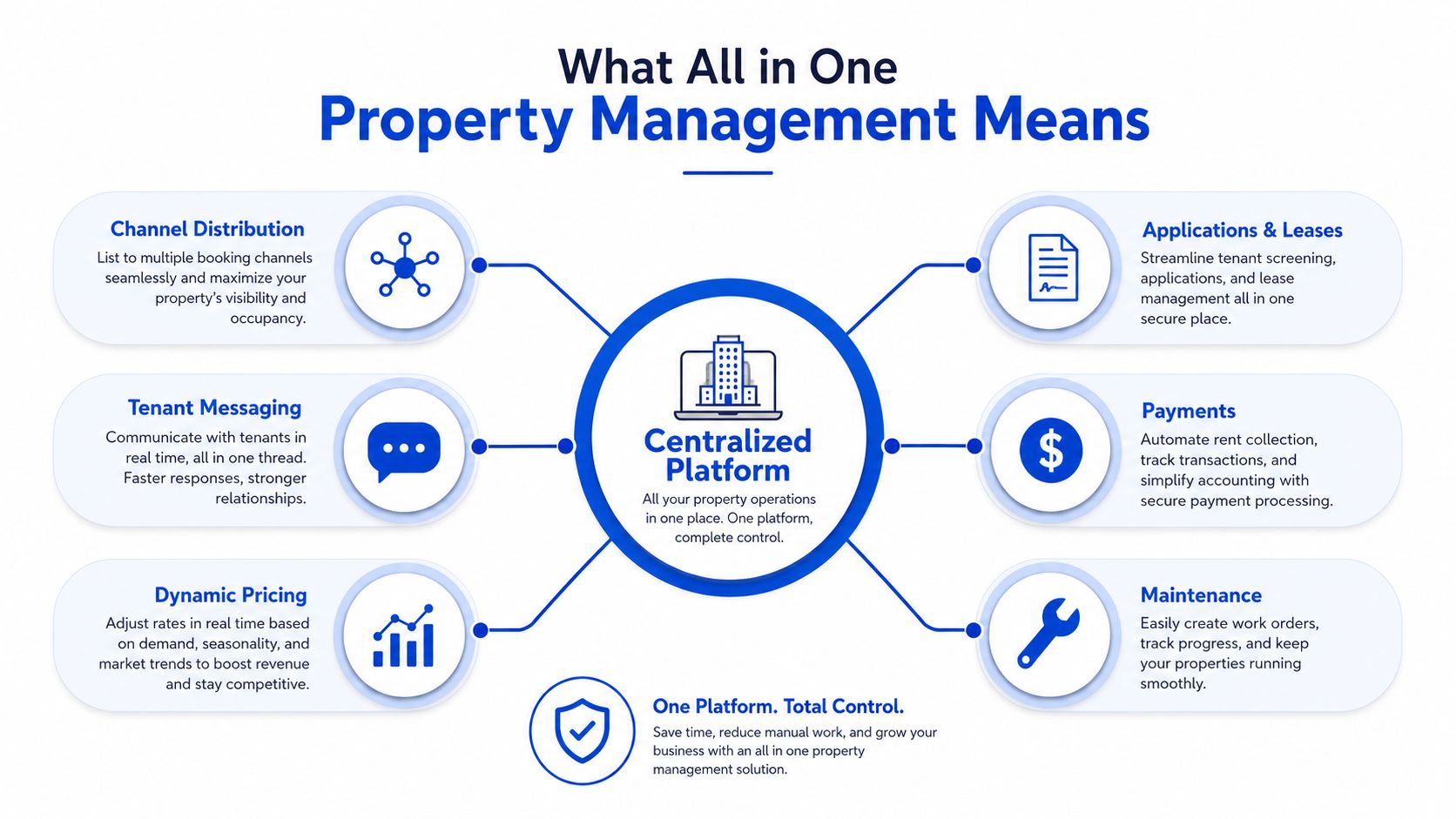
What the stack replaces
A typical fragmented setup might include:
- A property management system for leases and resident records
- A channel manager for listing distribution
- A dynamic pricing tool
- A smart-lock application
- Accounting software
- A spreadsheet for room-level tracking
An all in one platform doesn't necessarily eliminate every external tool. Instead, it should provide a shared data layer and practical connections, so an occupancy change or move-out doesn't need to be typed into multiple places.
The market's scale reflects this shift. One independent industry report valued the global property management software market at USD 3.6 billion in 2025 and projected it to reach USD 5.9 billion by 2033, with a 6.4% CAGR from 2026 to 2033. The same property management software market analysis reported that North America represented 39.4% of revenue in 2025.
What it doesn't promise
“All in one” isn't a guarantee of a lower subscription bill. It also doesn't mean every vendor bundles every feature well. A platform may have excellent accounting but weak room-level pricing, or strong messaging but limited access-control integrations.
For beginners comparing systems, a useful 3D property management guide can provide broader context on how digital property workflows are represented and organized. For co-living, the decisive question remains more specific: can the system manage per-bed inventory, per-tenant leases, and per-room pricing logic rather than treating a house as one indivisible unit?
A generic short-term rental tool may understand a property, unit, reservation, and guest. A room-by-room operator needs a property, house, bedroom, tenant, lease term, payment schedule, access credential, and room-specific vacancy status. That distinction determines whether consolidation reduces work or places old complexity behind a new dashboard.
Must-Have Features for Room-by-Room Operators
The best platform isn't the one with the longest feature list. It's the one that connects the features most closely tied to vacancy, collections, access, and room-level profitability.
Dynamic pricing that understands the bedroom
Room pricing should respond to demand, seasonality, competing co-living inventory in the same ZIP code, and the characteristics of each room. A corner bedroom with a private bath shouldn't inherit the same pricing logic as a smaller room beside the kitchen.
Algorithmic pricing has a real trade-off. An empirical study using building-level rent and occupancy data from 2005 to 2019 found that adopters lowered rents more quickly during downturns, while markets with greater algorithmic penetration later showed higher average rents and lower average occupancies during recovery periods, as reported in this study of algorithmic pricing in multifamily rentals. Pricing isn't just about pushing rates upward. It shapes demand, and the correct setting depends on the market cycle.
Short-term accommodation research makes the same point from another angle. One study reported a 22.9% occupancy increase, a 525% increase in average daily price, and a 289% increase in revenue after adopting a market-data intelligence platform, while a separate Chicago example found that dynamic pricing could raise annual income by more than 30%, with statistical significance reported at p < 0.05, according to this revenue-management research paper. Those results shouldn't be treated as a promise for every house, but they support testing pricing as a feedback loop rather than a fixed monthly guess.
Messaging that qualifies instead of creating more work
AI messaging should answer common questions about utilities, deposits, house rules, availability, and showing times. It should recognize whether a lead is asking for information or is ready to apply, then escalate qualified prospects to the host.
A useful workflow can handle a lease question at 2:00 a.m., preserve the conversation history, and avoid promising a room that has already been reserved. Be cautious with any system that calls canned replies “AI.” Ask to see how it handles an incomplete question, a conflicting move-in date, and a prospect who asks about a room that has just become unavailable.
Access control tied to resident status
Smart-home integrations should connect locks, thermostats, and leak sensors to the correct room and tenant. Move-in should create the right credential, while move-out should automatically de-provision it.
This isn't merely convenient. It limits the risk of old codes remaining active and helps the operator identify which room generated an access or maintenance event. A smart-building case study reported that optimized partial closures reduced closed-building area to 11.6% to 13.2%, cut standardized annual costs by 12.9% to 14.3%, and lowered primary energy consumption by 56 MWh to 123 MWh, depending on the energy standard, as detailed in this smart-lock and building-control case study.
Financial dashboards that show the bedroom's truth
A portfolio dashboard can look healthy while one room destroys returns. Insist on reporting for:
- Per-room NOI: Separate rent, allocated utilities, cleaning, repairs, and fees by room.
- True vacancy cost: Show lost rent from a vacant room instead of hiding it inside a property occupancy figure.
- Rent collection aging: Identify who is late, how late they are, and which balances remain unresolved.
- Lease and turnover status: Connect upcoming move-outs to advertising and pricing actions.
| Feature Area | What It Does | Co-Living Specific Check |
|---|---|---|
| Dynamic pricing | Adjusts rates as demand and competition change | Can it price each room independently? |
| AI messaging | Answers routine questions and qualifies inquiries | Can it use house rules, utility policies, and room availability? |
| Smart-home integrations | Automates access and building controls | Does it create and remove codes by tenant and room? |
| P&L and analytics | Connects revenue and costs to performance | Can it expose vacancy cost and room-level NOI? |
A more detailed feature checklist is available in this property management software features guide. Skip vendors that describe these capabilities as roadmap promises rather than shipped, demonstrable features.
How to Evaluate and Compare All in One Platforms
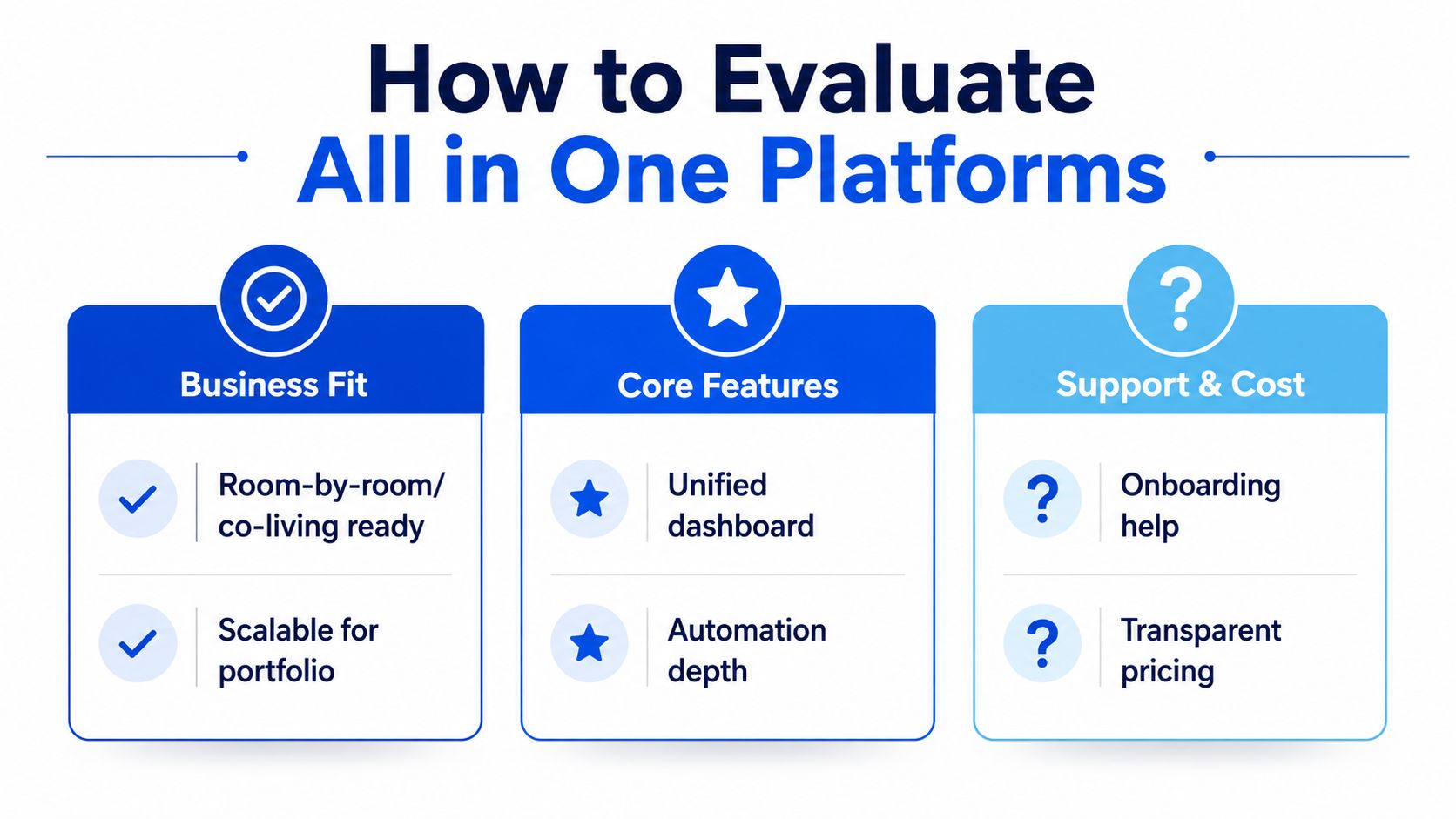
Start with the operating model, not the vendor's brand. A platform designed around single-family leases may have polished accounting and still fail when three tenants share one house, each with a different lease, payment date, access code, and room price.
Begin with business fit
Ask whether the demo environment supports:
- Room-by-room inventory
- Separate leases inside one property
- Mid-month move-ins and move-outs
- Per-room deposits and utility allocations
- Bed-level availability and turnover
- Co-living messaging and house-rule workflows
Then inspect the pricing model. A flat per-unit charge may treat a four-bedroom house as one property, while a per-room charge may scale with every bedroom. A percentage-of-rent model changes as revenue changes, and a per-booking model may suit short stays but work poorly for longer room leases. Model each option against your actual rent roll, not a generic example.
Test the connections
List the systems that must exchange data:
- PMS and listing channels
- QuickBooks or Xero
- Payment processors
- Smart-lock APIs
- Email, SMS, and messaging channels
- Screening and lease-signing tools
The phrase “integrates with” can mean a live two-way sync, a limited export, or a connection that requires manual intervention. Ask which records update automatically, how failures appear, and whether you can export your data in a usable format.
Native connectivity matters when access, payments, and resident status need to agree. If you're comparing automation tools, review practical native integration options rather than assuming every connection works the same way.
Run a difficult demo
Don't let the vendor show only a clean new lease. Give the representative a realistic scenario:
- One room is vacant and needs a new price.
- A tenant moves out mid-month.
- A replacement tenant signs before the prior lease ends.
- The old lock code must be removed.
- A utility bill must be allocated across occupied rooms.
- The owner needs an updated P&L.
Ask about data ownership, export formats, contract flexibility, support response times, included onboarding hours, and how the system handles failed payments. For broader comparison criteria, this property management software comparison resource can help you build a shortlist without relying on a ranked list.
Implementation and Migration Checklist
A platform can be well designed and still fail during migration. The risk usually appears in ordinary details, such as a missing payment record, an incorrect lease date, or a lock code that remains active after a resident leaves.
Phase one covers preparation
Before importing anything, export tenant ledgers and back up lease documents. Audit current pricing for every room, confirm deposits and payment rules, and verify that smart-lock firmware supports the intended integration.
Create a room inventory that names each bedroom consistently. Record amenities, private or shared bath status, furnishing, current tenant, lease dates, deposit balance, payment method, and access credential status. This becomes your clean reference file when systems disagree.
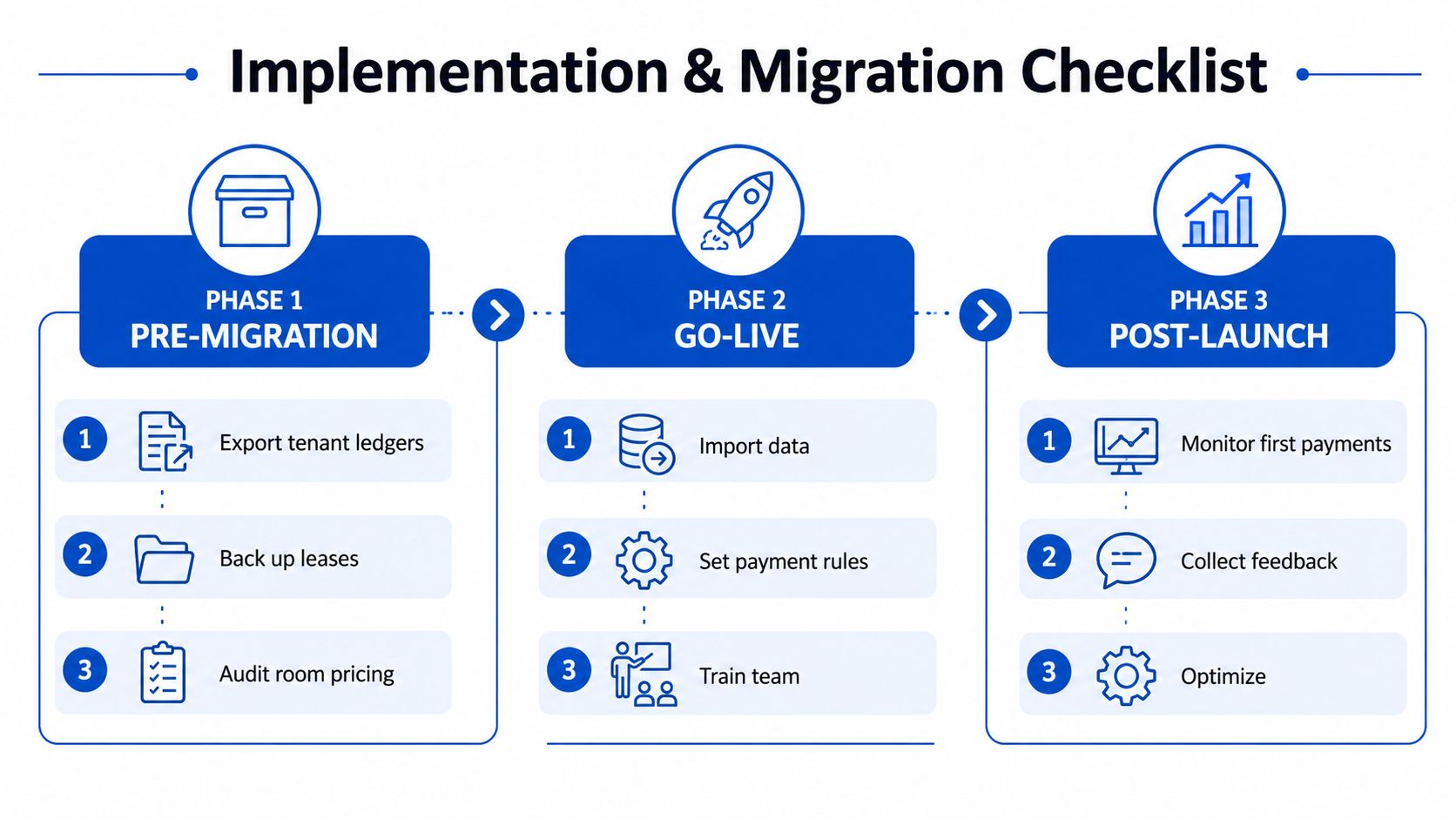
Phase two handles ingestion and testing
Bulk-import rooms, map amenity tags, configure deposit rules, and assign every active lease to the correct room. Test payment rails with a small-dollar transaction before asking residents to rely on the new payment link.
Check the records that affect cash flow first:
- Balances: Compare imported balances with the old ledger.
- Dates: Verify lease start, end, renewal, and next-payment dates.
- Allocations: Confirm utilities and shared charges follow your stated policy.
- Access: Match each code to the correct room and resident.
- Notifications: Send test messages to internal accounts before contacting tenants.
Phase three is adoption, not just training
Train staff on the dashboard using real maintenance, leasing, and collection scenarios. Brief residents on updated payment links, explain where maintenance requests now belong, and prepare a 24/7 FAQ covering payments, utilities, access, house rules, and emergency contacts.
A practical property management checklist can keep responsibilities visible during the changeover. Assign one person to own migration decisions, even if several people perform the work.
Phase four protects the launch
Pilot the system with one property for two weeks, monitor error logs nightly, and keep the legacy system read-only for 30 days as a safety net. During the pilot, compare deposits, vacancies, access events, maintenance tickets, and resident messages against the old records.
Set rollback criteria before launch. Revert or pause the rollout if payments fail, lease balances don't reconcile, residents lose access, room availability becomes unreliable, or critical records can't be exported. A clear rollback rule prevents optimism from turning a small implementation issue into a lease dispute.
Realistic ROI and Revenue Lift Examples
ROI starts with the room, not the software invoice. In a four-room house, one empty bedroom can erase 25% of potential house revenue. A platform earns its place when consolidated pricing, messaging, and access tools shorten that vacancy, protect collections, or reduce coordination work.
Measure rate and occupancy together. A 2024 study of 37 hotels that adopted dynamic pricing found occupancy rose from 47% to 59%, RevPAR increased by more than 18 CHF to an average of 107 CHF, and ADR reached 173 CHF, about 7 CHF higher than before the software was introduced, according to this dynamic pricing study.
Short-term rental research reported an 11.6% revenue increase after hosts adopted market data intelligence. The result combined a 13.3% occupancy increase with a 15.8% price decrease, as reported in this peer-reviewed short-term rental study. For co-living operators, the lesson is practical: a slightly lower rate can produce more collected revenue if it fills a bedroom sooner.
Translate the evidence carefully
Those findings do not predict the result for your house. Use them to build a property-level baseline:
- Track each room's asking rate and achieved rate.
- Record vacant days between leases.
- Compare inquiry response time with completed applications.
- Separate rent recovered from operator time saved.
- Review occupancy and rate together, not as isolated wins.
A single vacancy often costs more than a small administrative inefficiency. If a room sits empty, faster responses, clearer availability, and reliable access coordination can affect revenue before any pricing change does.
| Feature | Monthly Revenue Lift | Time Saved (hrs/wk) | Net ROI (Year 1) |
|---|---|---|---|
| Dynamic pricing | Depends on achieved rate and occupancy | Depends on current repricing workload | Calculate from incremental collected rent minus subscription cost |
| AI messaging | Depends on qualified lead flow and vacancy duration | Depends on inquiry volume and manual follow-up | Calculate from earlier lease starts and recovered labor |
| Smart-home automation | Protects access and may reduce coordination costs | Depends on current code and vendor workload | Calculate from avoided callouts and faster turnover |
| P&L analytics | Improves decisions about pricing, utilities, and repairs | Depends on spreadsheet complexity | Calculate from identified leakage and faster reporting |
Apply the calculation to actual bank deposits and lease records. For each room, compare the previous baseline with the period after implementation. Include subscription fees, payment costs, setup work, and any added access or messaging charges.
Do not assume a fixed conversion lift, guaranteed labor savings, or universal return multiple. Your first property should establish whether the platform closes enough vacancy and revenue leakage to justify its cost.
Next Steps and Early Adopter Opportunities
Shortlist two or three platforms that pass the room-level test. Request a live demo using your own scenarios, including a vacant bedroom, a mid-month change, a late payment, a maintenance request, and a lock-code removal. A generic tour of dashboards won't show whether the system can protect NOI in a shared house.
Prepare three files before the demo:
- Room-level P&L: Revenue, utilities, repairs, cleaning, and other costs by bedroom.
- Vacancy record: Current open rooms, prior vacancy periods, asking rates, and achieved rents.
- Smart-lock inventory: Lock model, room assignment, tenant status, and integration requirements.
Ask the vendor to explain the migration sequence before discussing a contract. You want to know who cleans the data, who tests payment flows, who verifies access credentials, and what happens if the import doesn't reconcile. A lower subscription price isn't attractive if the team spends weeks rebuilding records manually.
Some all-in-one platforms, including Omev AI's room-by-room suite, are opening limited early-adopter or design-partner cohorts. These programs can let hosts shape the roadmap, secure lower pricing tiers, and migrate alongside the founding team, but you should still confirm which features are live, which are planned, and what support the cohort includes.
The most useful action today is simple. Book a 20-minute call, share one recent month of room revenue, and ask the provider to return a prioritized rollout plan for your first property. That conversation should tell you whether consolidation will improve vacancy, collections, and visibility, or merely replace several logins with one expensive dashboard.
PadPulse is being built for PadSplit hosts and co-living operators who need room-level pricing, messaging, smart-home access, and financial visibility in one workflow. Visit PadPulse to join the early-adopter interest list and explore whether its planned toolkit fits your first property.