What Is a Lease Option? a Guide for Landlords & Investors
June 21, 2026
A lease option is a contract that gives a tenant the right, but not the obligation, to buy a property during or at the end of the lease term, usually at a price set in advance. In practice, that makes it a useful strategy for landlords who want rental income now, flexibility later, and a possible sale path without committing to sell today.
If you're a landlord holding a good property in an uncertain market, this setup can solve a real problem. You may want to keep collecting cash flow, avoid listing the property right away, and still give a strong tenant a path to ownership. That combination is why lease options keep coming up in investor conversations.
For co-living and room-by-room operators, the idea gets more interesting. You're not just thinking about one lease and one tenant. You're thinking about occupancy, house dynamics, turnover, compliance, and whether a future sale fits the operating model of a shared home. A lease option can work well there, but only when the structure matches the business.
A newer landlord often hears "rent to own" and assumes it's one standard thing. It isn't. The details matter, and in this part of the business, details are what separate a smart tool from an expensive mess.
A Flexible Exit Strategy for Savvy Landlords
A lease option works best when you want to keep control.
Say you own a house that performs well as a rental. You don't want to sell into today's market unless the numbers make sense. But you also know a resident or operator who would stay longer, treat the place more seriously, and may want to buy later. A lease option can align those interests without forcing either side into a sale today.
For landlords, that flexibility is the main attraction. The tenant gets a defined chance to buy. You keep ownership unless they exercise the option correctly. That makes the arrangement very different from a plain lease and very different from a straight sale.
Why landlords use it
A standard lease is simple, but it ends with one obvious question. Renew, move out, or raise rent. A lease option adds a fourth outcome. Sell, but only if the tenant chooses to move forward under the agreed terms.
That can be useful when you want to:
- Hold income now: Keep collecting rent while preserving a future sale path.
- Reduce sales pressure: Avoid rushing a listing because of timing or market noise.
- Attract commitment: A tenant with purchase interest often behaves differently from a short-term renter.
- Create optionality: You can keep the property productive while testing whether a sale is realistic.
In shared housing, flexibility has value. Operators often need time to see whether a property is better kept as a cash-flow asset or repositioned for sale later.
Why co-living operators should pay attention
In co-living, lease options aren't usually about handing every resident a path to ownership. More often, they show up in two practical ways.
First, an operator may lease-option a whole property from an owner and run it room by room. Second, a landlord may give a master tenant, resident manager, or experienced operator an option to buy later if the arrangement proves successful.
Both models can work. Both also create extra friction if the contract is vague, the house has unstable occupancy, or the future sale idea was never realistic to begin with.
Deconstructing the Lease Option Agreement
A lease option lives or dies on the paper. I have seen arrangements that looked profitable on day one turn into expensive disputes because the parties agreed on the big idea, then got sloppy on the mechanics.
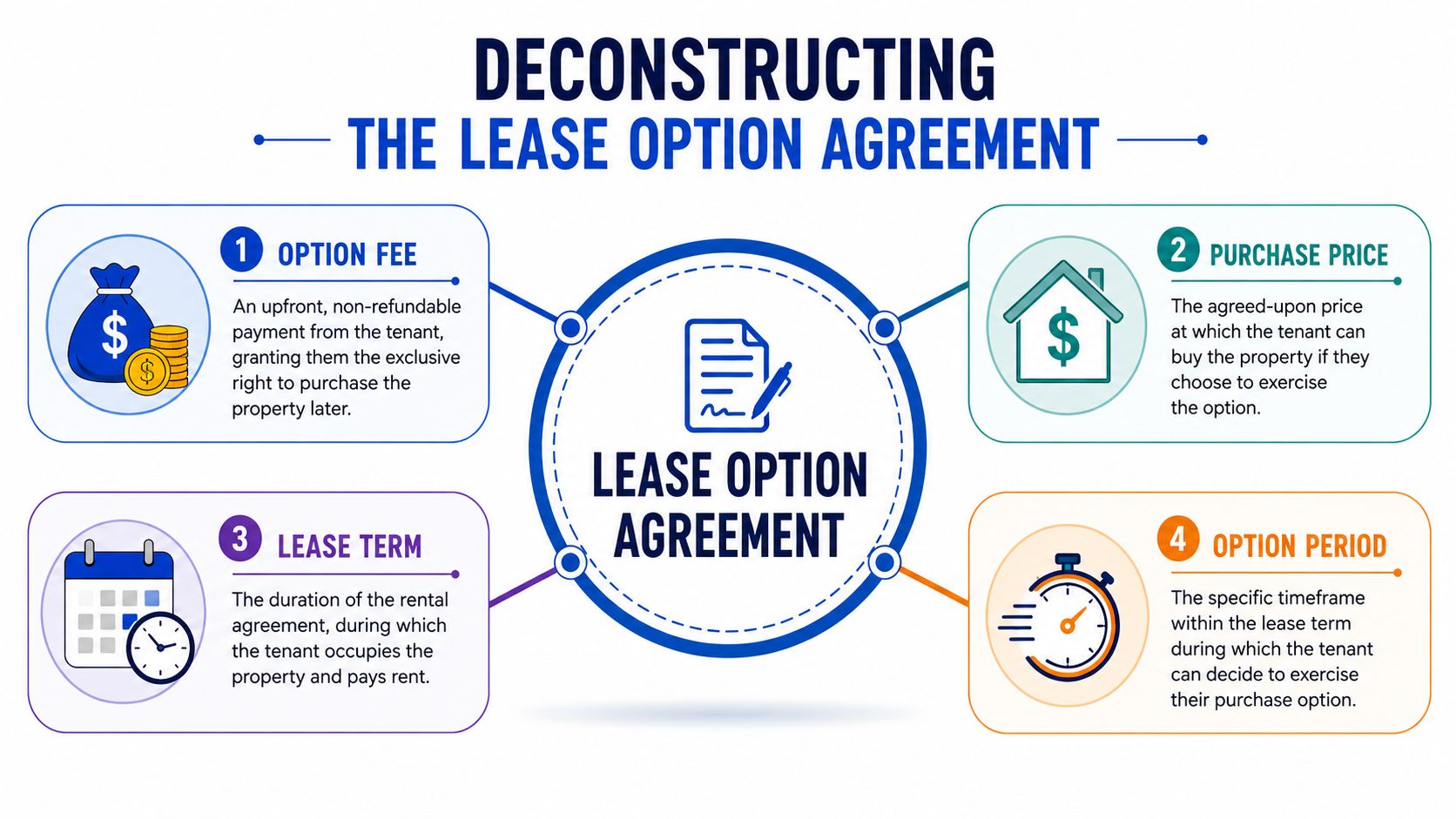
At a minimum, the agreement needs to spell out four things with precision. The option consideration, the purchase price, the option period, and the exercise process. If any one of those is fuzzy, the deal gets harder to enforce and easier to fight over.
The option fee
The option fee is the money paid for the right to buy later. It is separate from the security deposit and separate from monthly rent. In practice, some deals use a meaningful upfront payment and others use a smaller amount, but the point is always the same. The owner is giving up flexibility for a period of time, and the tenant-buyer is paying for that right.
That payment changes behavior fast.
An occupant who has real money tied to the option usually pays closer attention to the property, deadlines, and financing. An operator leasing a house for co-living with a purchase option also tends to treat setup costs differently. Furniture, safety upgrades, and room turnover systems make more sense if there is a realistic path to owning the asset later.
The hard part is default language. The contract should say whether the option fee is refundable, whether any part of it is credited toward the purchase price, and exactly what happens if the tenant misses a deadline or breaches the lease. If that section is vague, both sides will read it in their own favor.
The purchase price and option period
The purchase price can be fixed now or determined by a clear formula later. Either approach can work. Sloppy wording cannot.
A strong contract answers practical questions a lawyer, title company, and lender will ask right away:
- What is the purchase price, or the formula for setting it?
- When does the option start and when does it expire?
- Can the option be exercised at any time, or only during a stated window?
- How must notice be delivered?
- What happens if the lease is extended but the option language is silent?
Chase's explanation of lease options notes that clear terms around timing, notice, and price matter because missing material terms can make the option difficult to enforce.
I treat the notice clause as a risk-control clause, not boilerplate. If the agreement says notice must be delivered by certified mail by 5 p.m. on a specific date, then an email sent the next morning should not count. That sounds harsh until a sale falls apart and everyone starts arguing about what was "close enough."
Rent credits
Rent credits are optional. Many newer landlords assume they come with every lease option because that is how these deals are often marketed. They do not.
If you offer rent credits, define them with care. State how much of each payment is credited, whether the credit applies only if rent is paid on time, whether late fees wipe out that month's credit, and whether the credit is applied against the purchase price, closing costs, or both. Loose wording here creates false expectations fast.
For co-living operators, rent credits can get messy. If the operator is leasing the whole house and earning income room by room, the master rent they pay the owner is not the same thing as a resident's rent in a typical rent-to-own story. If the owner promises credits without tying them to actual performance standards, the operator may build their numbers around savings that never materialize.
How this looks in a shared housing setup
In shared housing, the lease option agreement has to deal with operating reality, not just sale terms. A single-family form pulled from a generic template often ignores furnished rooms, resident turnover, common-area wear, utility allocation, licensing rules, and who is responsible for compliance if the property is being run as a co-living business.
That is where inexperienced landlords get hurt. They grant an option to a strong-sounding operator, but the contract says little about occupancy minimums, maintenance standards, unauthorized subletting, or what happens if the city pushes back on the use.
A better agreement deals with those trade-offs directly. If the operator wants a fixed purchase price two years out, the owner may want tighter reporting, inspection rights, and clearer default triggers. If the owner wants a large nonrefundable option fee, the operator may push for cure periods or partial credits tied to capital improvements. Good lease options do not avoid tension. They price it and document it.
Lease Option vs Lease Purchase vs Rent to Own
A landlord agrees to a "rent to own" deal with a co-living operator, assuming the house will sell at the end of the term. Two years later, the operator walks because the numbers no longer work after turnover, repairs, and local enforcement pressure. The landlord is shocked. The operator says the contract gave them that choice. That dispute usually starts with one problem. The parties used three different labels for one deal and never pinned down what each label meant.
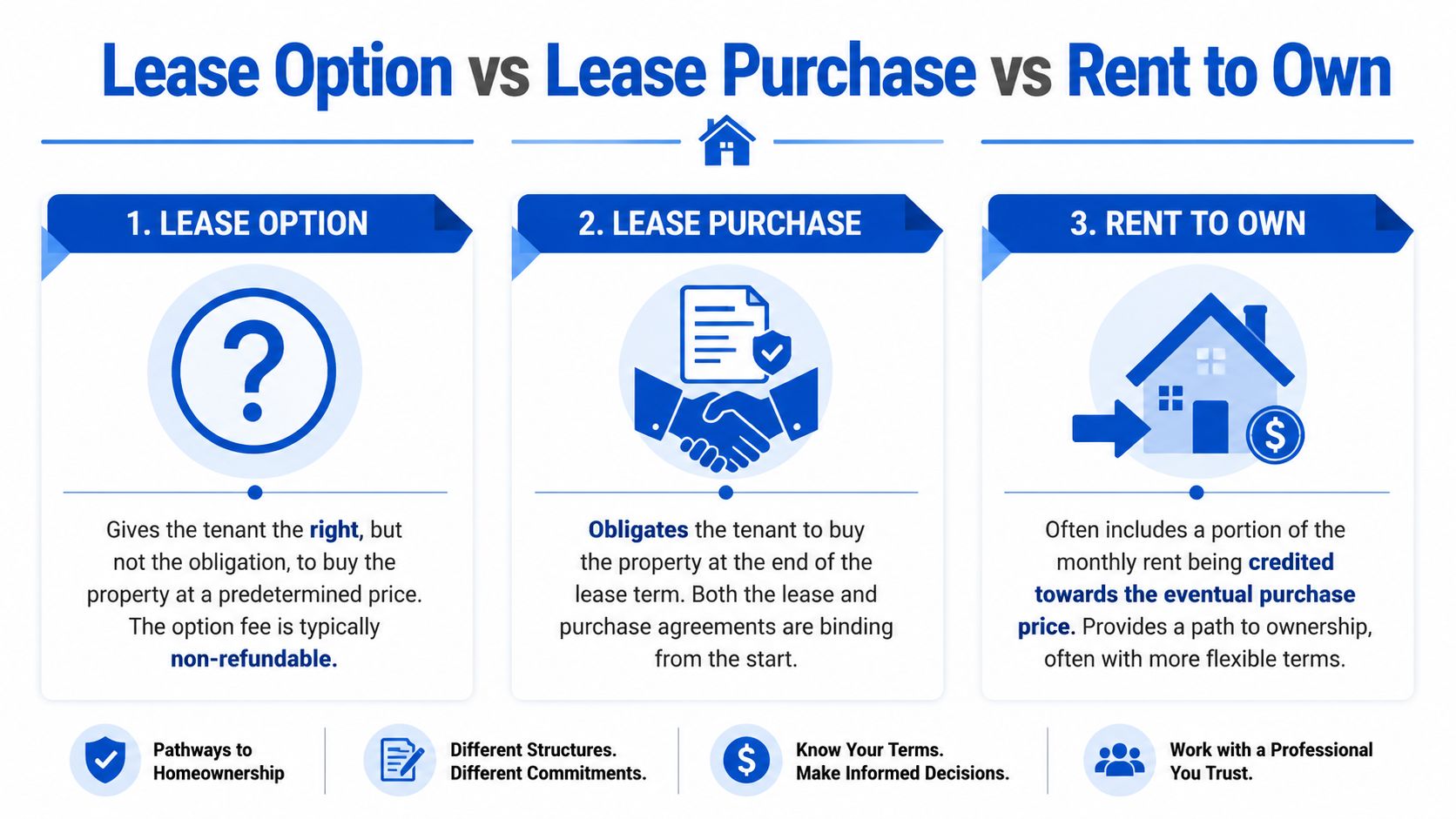
The side-by-side distinction
| Structure | Core commitment | End of term outcome | Main risk |
|---|---|---|---|
| Lease option | Tenant has the right to buy | Tenant may buy or walk away | Tenant can lose the option fee |
| Lease purchase | Tenant is expected to buy | Sale is usually part of the binding deal | More serious default risk if the buyer cannot close |
| Rent to own | Umbrella term | Depends on the actual contract | People assume terms that may not exist |
The legal difference is straightforward, but the business consequences are not. In a lease option, the tenant or operator is paying for choice. In a lease purchase, they are taking on a future closing obligation. "Rent to own" can mean either one, and that loose wording causes real trouble in shared housing.
For a standard homeowner, that confusion is bad enough. For a room-by-room operator, it gets more expensive.
An operator may sign what they call a rent-to-own deal on a six-bedroom house, furnish it, stabilize occupancy, and spend money on systems and common areas. If the document is a true lease option, they can decide later whether the purchase still makes sense. If the document is a lease purchase, failure to close can trigger default, damages, or litigation. That is a very different risk profile, especially when house performance depends on licensing, occupancy limits, and resident churn rather than one simple lease.
A short explainer can help if you're discussing this with partners or newer team members.
Why the umbrella term causes trouble
"Rent to own" is marketing language. It is not a precise deal structure by itself. What matters is whether the contract gives a choice to buy, requires a purchase, applies any rent credits, sets a purchase price now or later, and spells out what happens if the operator does not close.
Landlords run into three recurring mistakes:
- They market flexibility and contract for obligation. The listing says the operator can buy later, but the agreement reads like a required sale.
- They assume monthly rent builds equity. Unless the contract clearly grants credits and explains how they are earned, rent is usually just rent.
- They ignore operational risk unique to co-living. A house can produce solid gross rent room by room and still fail as a purchase candidate if compliance issues, deferred maintenance, or neighborhood opposition cut into long-term value.
The name on the flyer matters far less than the paper signed at closing. In co-living, I want the contract to answer one question without any room for argument. Is the operator buying a right, or promising a future purchase? If that point is muddy, the rest of the deal usually is too.
Strategic Benefits and Risks for Co-Living Operators
A lease option can fit co-living, but it doesn't fit casually. Shared housing adds moving parts that don't exist in a standard single-tenant rental.

Where it can work well
For a room-by-room operator, a lease option can create a cleaner long-term relationship with an owner. If the operator has a credible plan, wants control over the house, and may want to own the asset later, the option creates a path without requiring an immediate acquisition.
That can be attractive when financing is hard to secure today but the operator believes the property works operationally. In that setup, the operator gets time to prove the model, improve the house, stabilize residents, and decide whether buying still makes sense later.
A landlord may also like the structure because it can attract a more invested counterparty. Someone who may eventually buy usually pays closer attention to property condition, resident quality, and long-term stability than someone treating the house as a short stop.
Where co-living gets messy fast
The problems start when people copy a single-family template into a shared housing business.
A co-living house isn't just a property. It's an operating system. There are multiple residents, furnished rooms, common-area standards, house rules, maintenance coordination, and often a thin margin for disruption. If the option holder starts acting like an owner before they own the place, conflict follows.
Common friction points include:
- Control of improvements: Who approves furniture changes, layout changes, or room conversions.
- Resident experience: One party may prioritize future resale while the other prioritizes occupancy and NOI.
- Maintenance decisions: Small repair delays can affect the whole home, not just one unit.
- Exit timing: A future sale can collide with active leases, renewals, and house occupancy plans.
Affordability and expectation risk
Many lease-option deals lead to disappointment. People assume they're automatically helping someone buy. Often, the math is less friendly.
The Consumer Financial Protection Bureau warns that rent-to-own arrangements can be complex and costly, with renters at risk of losing upfront payments. The National Association of Realtors also notes that lease options often don't credit monthly rent toward a down payment, which weakens the idea that they automatically build equity, as discussed in NAR's lease-option guidance.
For co-living operators, that warning matters in two directions. If you're the owner offering the option, you need to avoid overselling the path. If you're the operator taking the option, you need to treat the option fee and rent terms as business inputs, not as proof that ownership will happen.
In shared housing, a lease option only works when the operating plan and the purchase plan are both real. If either side is wishful thinking, the deal becomes expensive drift.
A practical fit test
A lease option tends to make more sense in co-living when:
- The property already performs well: You aren't using the option to hide a bad house or weak location.
- The operator has stable systems: Room turnover, collections, and maintenance are already under control.
- The parties agree on property use: No one expects a major model shift halfway through.
- The future sale is plausible: The option holder has a believable path to financing or another purchase strategy.
It tends to go wrong when a landlord uses it as a desperation tactic, or when an operator treats it like cheap control with no serious purchase plan.
The Essential Legal and Financial Checklist
This is not a do-it-yourself form deal. A lease option needs legal drafting, operational clarity, and basic financial discipline before anyone signs.
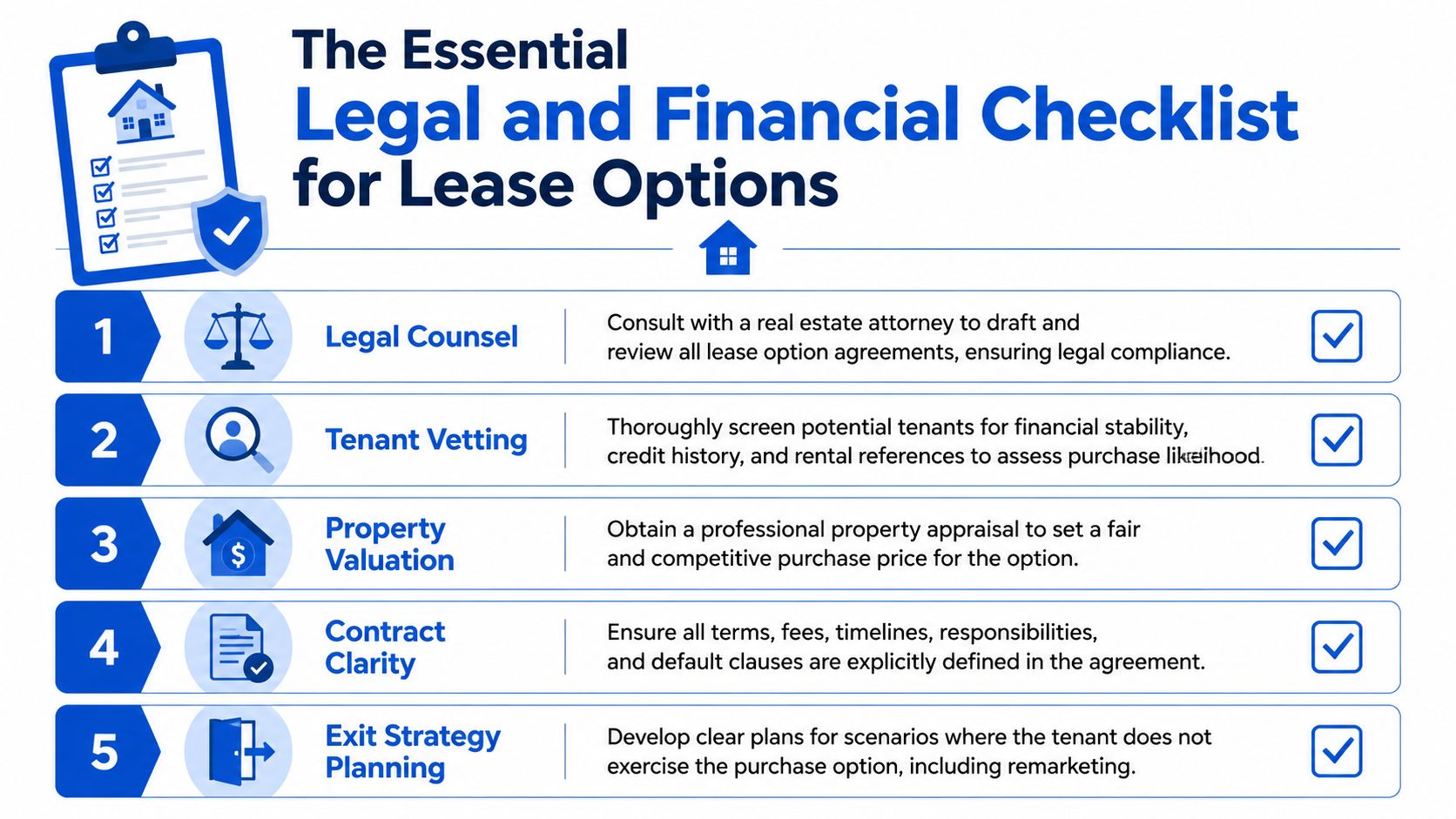
The non-negotiables
Start with counsel. Not a generic template. Not a friend who has "done a few deals." A real estate attorney who understands your state, your local landlord-tenant rules, and the fact that shared housing often creates extra operational issues.
Then work through the checklist below.
Get the structure reviewed locally
State and local rules can affect disclosures, enforceability, notices, default rights, and how the deal is treated if the tenant doesn't exercise. A contract that looks fine online may be weak where your property sits.Define every material term clearly
Don't leave room for interpretation on price, timing, notice, fees, or rent treatment. If there's a rent credit, spell out exactly how it works. If there isn't one, say that plainly.Assign maintenance responsibility in writing
In co-living, this point matters even more than in a standard lease. Who handles appliances, lockouts, common-area wear, pest issues, furnishing replacement, and turn costs? If the option holder is operating the home, the contract should match the operating reality.Model the exit before the entry
What happens if the tenant doesn't exercise? What if they want to but can't close on time? What if they default under the lease but still claim option rights? You want those answers before signatures, not after conflict.Review accounting and insurance treatment
The option fee, rent handling, and property use can all create accounting and risk-management questions. Your accountant and insurance broker should know exactly how the arrangement works.
What newer landlords often miss
The usual mistake isn't bad intent. It's sloppy administration.
A lease option creates dates, notices, signatures, amendments, and decision points that need tracking. If you're managing multiple properties, that administrative load grows fast. That's why operators who want cleaner execution usually build a repeatable paperwork process and automate document workflow instead of relying on inbox searches and memory.
Questions to take to your attorney and accountant
Use a short working list when you get professional advice:
- Enforcement question: If the tenant misses the exercise window, is the option clearly extinguished?
- Default question: Does a lease default also terminate the option, and under what conditions?
- Use question: Does room-by-room occupancy change any required language?
- Money question: How should the option fee be handled and documented?
- Coverage question: Does your current insurance still fit the arrangement?
"If it isn't written down with precision, it isn't a strategy. It's a future argument."
A good checklist feels boring. That's the point. The boring work keeps a creative structure from turning into an expensive legal problem.
How to Implement Lease Options at Scale
One lease option can be managed with a sharp calendar and disciplined follow-up. A portfolio of them can't.
If you operate multiple homes, the challenge isn't understanding what a lease option is. It's making the strategy repeatable without introducing avoidable risk. That means standardizing what deserves to be standardized, while keeping legal review for each actual deal.
Build a repeatable screening framework
Not every property belongs in this bucket. Not every tenant or operator does either.
A practical portfolio rule set often includes:
- Property fit: Only homes with stable performance and clear long-term positioning.
- Counterparty fit: Only tenants or operators with a credible path to exercising the option.
- Operational fit: Only houses where a future sale won't break current resident operations.
- Documentation fit: Only deals that can be tracked through a central system from signature to expiration.
That discipline matters more in a higher-rate market, where a future locked-in purchase price can look appealing but only makes sense if the option holder is realistically likely to exercise. Rocket Mortgage notes that lease options can become more attractive in strained affordability conditions, but the ultimate decision depends on market volatility and the probability of exercise, as outlined in Rocket Mortgage's lease-option explainer.
Standardize the workflow, not the judgment
At scale, I wouldn't reinvent the process every time. I'd create a standard internal package: intake checklist, approved addendum language, review steps, deadline tracking, and exit procedures.
The goal isn't to turn every property into the same deal. The goal is to make sure your team handles each deal with the same discipline.
A simple operating table helps:
| Portfolio task | What needs to happen |
|---|---|
| Approval | Decide which properties and counterparties qualify |
| Drafting | Use reviewed language and property-specific terms |
| Tracking | Monitor exercise dates, notice deadlines, and lease milestones |
| Operations | Align house management with any option-holder rights |
| Exit | Prepare for exercise, expiration, or remarketing |
If you're managing multiple houses, software becomes part of risk control. A team that wants fewer missed dates and cleaner recordkeeping should understand what property management software does for growing operators and why specialized workflows matter more once agreements stop being one-off.
What scaling gets wrong
The common failure isn't complexity. It's inconsistency.
One manager promises flexibility. Another enforces strict deadlines. One deal includes operational control language. Another leaves it out. One house is marketed like a future sale. Another is treated like a normal rental with a side promise. That drift creates disputes, resident confusion, and missed opportunities.
A scalable lease-option program needs one thing above all. Internal discipline.
Is a Lease Option Right for Your Rental Business?
A lease option makes sense when it supports your actual business model, not when it sounds clever.
If your goal is long-term hold and stable cash flow, a lease option may be unnecessary friction. If you want a flexible future sale path while keeping the property productive today, it can be a strong tool. For co-living operators, the key question is whether the option supports the house as an operating asset instead of disrupting it.
Use a simple filter:
- Goal fit: Are you trying to hold, sell later, or test a future disposition path?
- Risk fit: Can you handle market changes, failed exercise, and contract administration?
- Operational fit: Can your team manage deadlines, notices, resident impacts, and legal coordination?
If the answer is yes across all three, a lease option may belong in your toolkit. If one of those is weak, the structure can create more work than value.
The best landlords and operators don't use every creative strategy. They use the right one for the asset, the resident profile, and the stage of the business. If you're still defining your approach, it helps to understand the broader types of real estate investors and where your rental business really sits on that spectrum.
A lease option isn't passive. It can be powerful, though, when the paperwork is tight, the exit is believable, and the house operations can support the plan.
PadPulse is building an all-in-one platform for PadSplit hosts and co-living operators who want tighter control over room-by-room operations. If you want a simpler way to manage pricing, communications, access, reporting, and portfolio visibility as you grow, join the early interest list at PadPulse.