Resident Engagement Platform Guide for Co-Living Operators
August 6, 2026
You know the feeling. Your phone won't stop buzzing, one resident needs access right now, another is asking about a move-in date, a vacant room is still sitting empty, and the smart lock you trusted last week is acting up again. If you're running a co-living house or PadSplit-style portfolio, that chaos isn't a bad day, it's the cost of managing rooms with tools that weren't built for room-by-room operations.
A resident engagement platform fixes that by pulling communication, requests, access, and tracking into one operating system for the house. For co-living operators, that matters because every room is a revenue unit, and every missed message, slow reply, or broken workflow hits occupancy and NOI fast. The old approach, personal texts, spreadsheets, paper notes, and generic property software, can't keep up once you're managing multiple residents, multiple entry points, and turnover that never seems to stop.
Why Co-Living Hosts Need a Better Way to Engage Residents
A common host routine looks like this. You wake up to five resident messages, two of them urgent, one maintenance request got buried in the wrong thread, and the vacant room you've been trying to fill has gone quiet for another week. At the same time, a lock code didn't sync, the thermostat is set wrong, and someone new wants to know how move-in works before noon.
That is an operations problem. When messaging, task tracking, access control, and resident history sit in different tools, you waste time rebuilding context instead of managing the asset.
Rooms need operational visibility, not guesswork
In a room-by-room model, every resident interaction affects revenue. A slow reply can delay lease-up, a missed maintenance follow-up can push a resident to leave, and a sloppy move-in can sour the relationship before the key is even handed over. Generic property systems usually treat the building as the unit of record, which is too blunt for shared housing.
A resident engagement platform gives you a clearer view of what is happening room by room. That matters because resident engagement is no longer treated as a soft metric, it is now used as an operational signal tied to retention and revenue. An IntouchLink analysis says older methods like quarterly surveys or monthly paper logs create delayed snapshots, while a real-time platform keeps the data “never older than the last activity” and updates leadership dashboards throughout the day. The same analysis ties ROI to census retention and says preventing even one move-out per quarter can protect $4,000 to $6,000 per month per unit in revenue.
Practical rule: if your current stack cannot tell you who is engaged, who is drifting, and which room is at risk, you are flying blind.
Hosts do not need more apps. They need fewer handoffs, faster decisions, and one place where the resident relationship lives.
For co-living operators, that also means using better tenant communication tools to keep room-by-room issues from turning into empty rooms and avoidable churn.
What a Resident Engagement Platform Actually Does
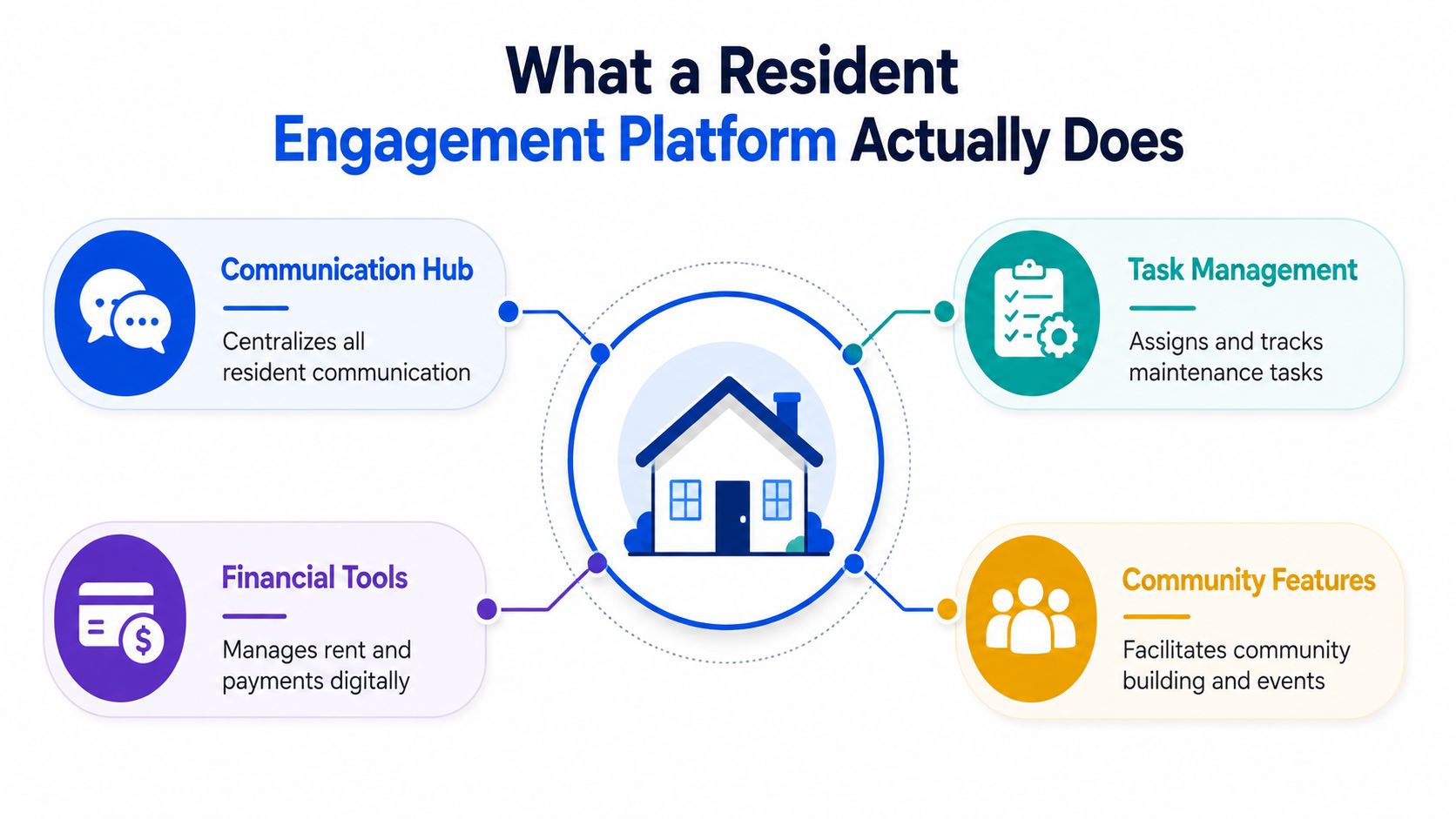
A resident engagement platform pulls the day-to-day resident workflow into one place, so your team can see the whole picture without bouncing between texts, spreadsheets, and inboxes. For a room-by-room operator, that matters because the actual unit of performance is the room, not just the building.
One hub, many resident touchpoints
A good platform centralizes communication, service requests, announcements, onboarding, feedback, and community features. The practical payoff is obvious. Every resident interaction lives in one place, so you can track who said what, when they said it, and whether your team responded. That is the difference between a resident engagement platform and a basic messaging app.
The category is commonly described as a single hub for communication, amenity booking, and feedback, with features such as event promotion, surveys, social feeds, resident services, package updates, onboarding workflows, and mobile app notifications, according to the ElevateOS glossary. For operators, that means one system can handle the routine work that chews up the day and keeps staff stuck in admin mode.
From delayed snapshots to live operations
Older engagement tracking relied on paper logs and periodic surveys. That is too slow for shared housing, because by the time a pattern shows up, the resident may already be gone. Real-time dashboards keep leadership data updated throughout the day, so you can spot drift early and act before it turns into a move-out.
If you already use texting tools, they help, but they do not cover the full workflow. A stronger communication stack should also handle structured requests, escalation paths, and resident history, which is why many hosts pair resident communication with a broader platform approach. A useful starting point is tenant communication tools, especially if you are comparing basic messaging against a full resident engagement layer.
Must-Have Features for Room-by-Room Operations
A co-living operator should be ruthless here. Don't buy features you won't use, and don't ignore the ones that directly affect occupancy, response speed, and room-level NOI.
Messaging automation that actually removes work
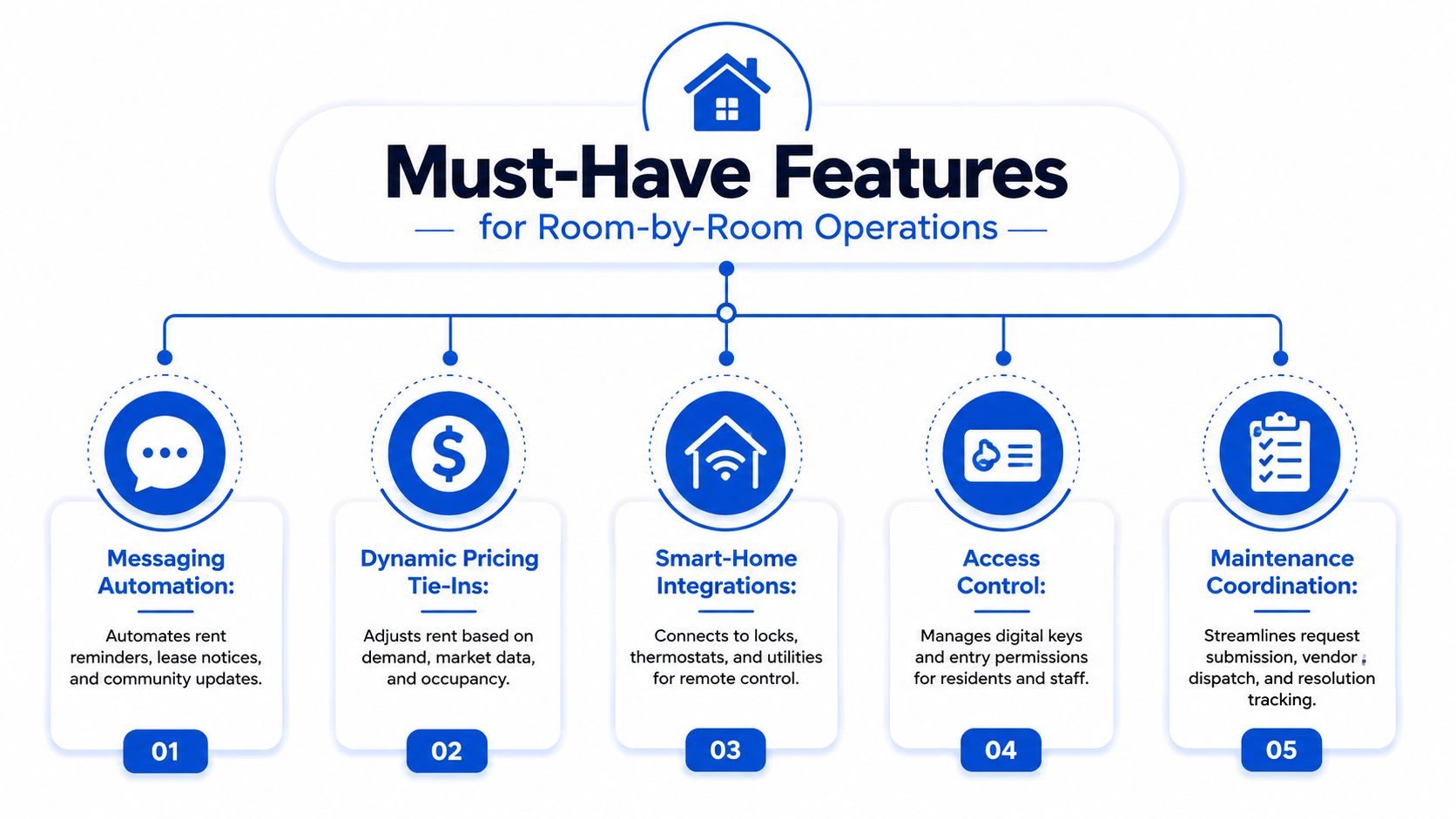
This is the first filter. You need automated workflows for inquiry responses, onboarding, reminders, maintenance follow-ups, and move-out notices. If your team still writes the same replies over and over, you don't have automation, you have a fancy inbox.
Look for AI-powered workflows that can handle routine questions, route edge cases to a person, and keep the resident moving through the process without you babysitting every step. A platform should also let you customize templates by house, room type, or stage of the resident journey.
Dynamic pricing tie-ins for room revenue
For room-by-room operators, pricing can't sit in a separate silo. Engagement data should inform pricing decisions because interest, response speed, and vacancy status all affect how fast a room fills and what it should earn.
You want a platform that connects communication and occupancy signals to your pricing process, not one that treats pricing as a disconnected spreadsheet exercise. That matters especially if you manage multiple rooms in the same house, because one weak workflow can leave a room underpriced or vacant longer than necessary.
Smart-home integrations and access control
Keyless locks and thermostat controls are not bells and whistles in shared housing. They reduce physical key management, make move-ins cleaner, and give you tighter control over who can enter what and when. If a platform doesn't integrate cleanly with access hardware, you'll end up doing manual provisioning forever.
Access control should work at the room level, not just the property level. That includes move-ins, move-outs, guest permissions, and staff access. A resident engagement platform should make those transitions predictable instead of dependent on somebody remembering to send a code.
Analytics that show what's actually happening
Don't settle for pretty charts with no operational value. You need portfolio-level P&L tracking, market intelligence on comparable rents, and demand trend visibility. In co-living, analytics should help you answer a simple question, which rooms are producing the most revenue and which ones are dragging performance down?
Rule of thumb: if a feature doesn't help you fill faster, charge smarter, or cut labor, it's noise.
Measurable Benefits for Co-Living Operators
A resident engagement platform earns its keep through operating results. If it does not shorten vacancies, speed up service, and reduce staff time, it does not belong in a room-by-room portfolio.
Vacancy and retention move first
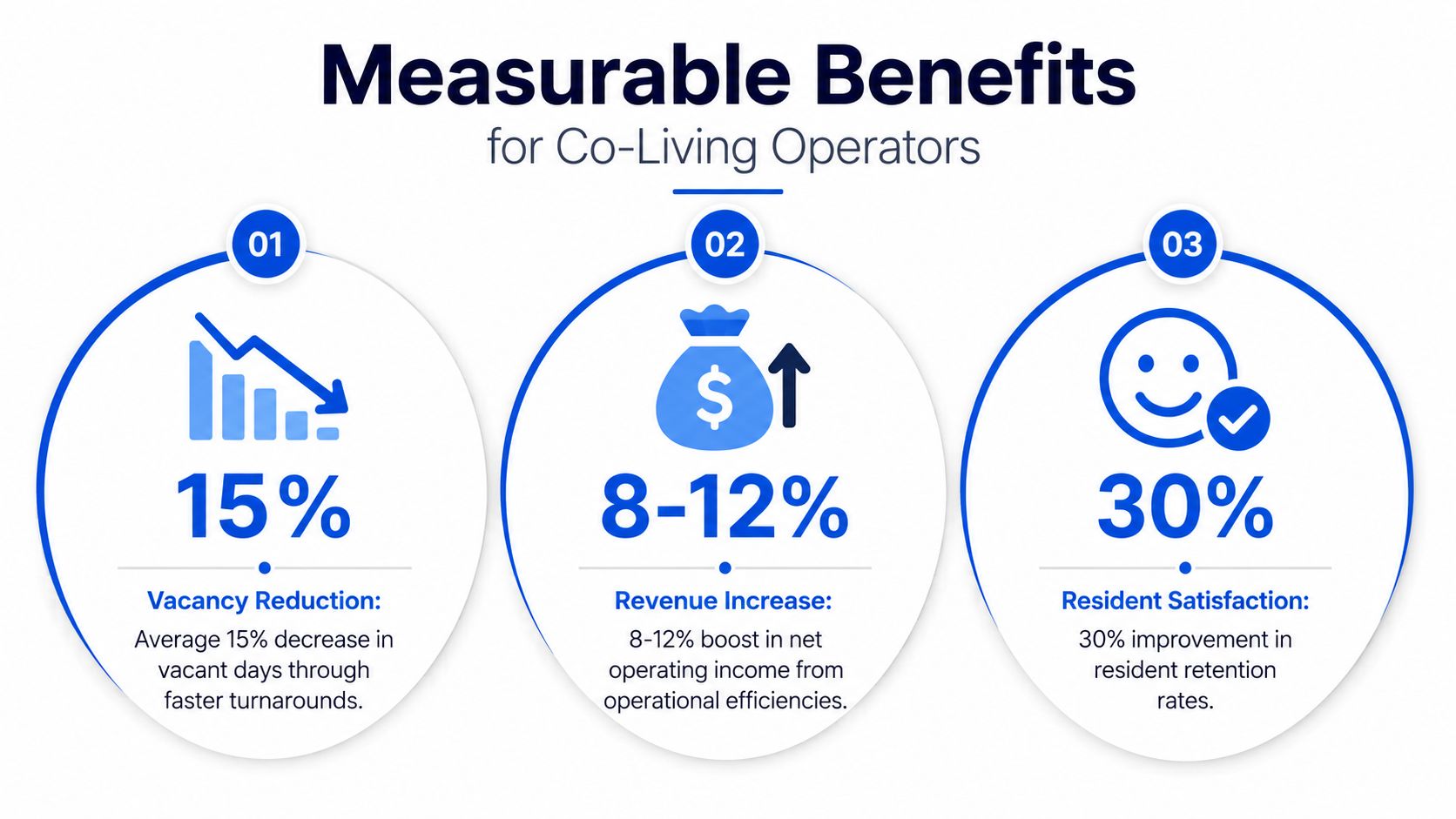
Retention drives the economics. One source on real-time resident engagement tracking says preventing even one move-out per quarter can protect $4,000 to $6,000 per month per unit in revenue (a real-time resident engagement tracking explanation from IntouchLink). For co-living operators, that is the kind of loss prevention that shows up fast in per-room NOI.
The logic is simple. Better engagement helps you spot residents who are drifting, respond sooner, and reduce the friction that pushes them out. Faster intervention means fewer avoidable turnovers, and fewer turnovers mean less vacancy.
Time savings show up in daily operations
The strongest operational gains come from systems residents use. In a 2024 study, implementing a resident engagement system was associated with a 30% rise in event attendance and a 25% reduction in maintenance response times (IJIRSET resident engagement study). Those are not cosmetic gains. They point to better coordination, faster follow-through, and more resident participation.
A LeadingAge case study of HumanGood reported that 61% of residents had an account, two-thirds of those accounts were used weekly, residents used the technology to directly make 55% of requests, the deployment had handled more than 10,000 requests, and staff saved 10 hours of work per week per community (LeadingAge case studies). That is what mature adoption looks like. Residents handle more on their own, and staff get time back for the work that needs attention.
Better portals drive more self-service
Portal quality matters more than many operators think. A 2026 analysis of G2 Spring 2026 data reported a 94% tenant portal satisfaction rating for AppFolio, versus 82% for Yardi Voyager and 71% for RealPage OneSite (a resident engagement software analysis). Higher satisfaction usually means more self-service, which lowers staff touchpoints for payments, maintenance, and announcements.
A 2026 Parks Associates smart-living study found 41% of apartment renters and 66% of condo owners already use a resident mobile app or web portal, with satisfaction at 71% for resident apps/portals and nearly 80% for property-provided smart home devices and services (a Quiltt benchmark based on the Parks Associates study). The practical takeaway is straightforward. Platforms work better when they connect to the tools residents already use every day.
How to Evaluate and Choose the Right Platform
Don't shop for the platform with the longest feature list. Shop for the one that fits your workflow, your hardware, and your room-level revenue model.
Use a scorecard, not a gut feeling
| Evaluation Criteria | Why It Matters for Co-Living | What to Look For |
|---|---|---|
| Integration maturity | Your platform has to fit existing PMS, accounting, access control, and smart-home tools without creating extra manual work. | Open APIs, documented integrations, and clear setup steps. |
| Data ownership and audit trail | You need to know who changed what, when, and why, especially when issues turn into disputes. | Role-based controls, logs, and transparent record history. |
| Mobile accessibility | Residents won't use a clunky desktop-first portal. | Fast mobile experience, simple login, clear notifications. |
| Scalability | A tool that works for one house should also work as your portfolio grows. | Multi-property setup, repeatable templates, centralized reporting. |
| Pricing alignment | Per-room revenue needs a pricing model that doesn't punish growth. | Tiers that match small operators, with room for expansion. |
Ask the questions most vendors dodge
Buyer guidance in 2026 emphasized open APIs, documented integrations, automation roadmaps, and role-based controls as key criteria, while also calling out the harder questions around data ownership, audit trails, and AI escalation paths (MRI Software guide). That's the right lens. A clean demo means nothing if the platform breaks when a real resident issue falls outside the scripted flow.
You should also test support responsiveness and roadmap fit. If the vendor can't explain how the product handles exceptions, or how it grows from one house to a portfolio, keep looking.
Practical rule: if the platform can't explain a messy edge case, it's not ready for shared housing.
Implementation Checklist and Sample Workflows
Start small and build the system around your actual daily work. The goal is to get the platform useful fast, not to automate your entire business on day one.
The rollout order that avoids chaos
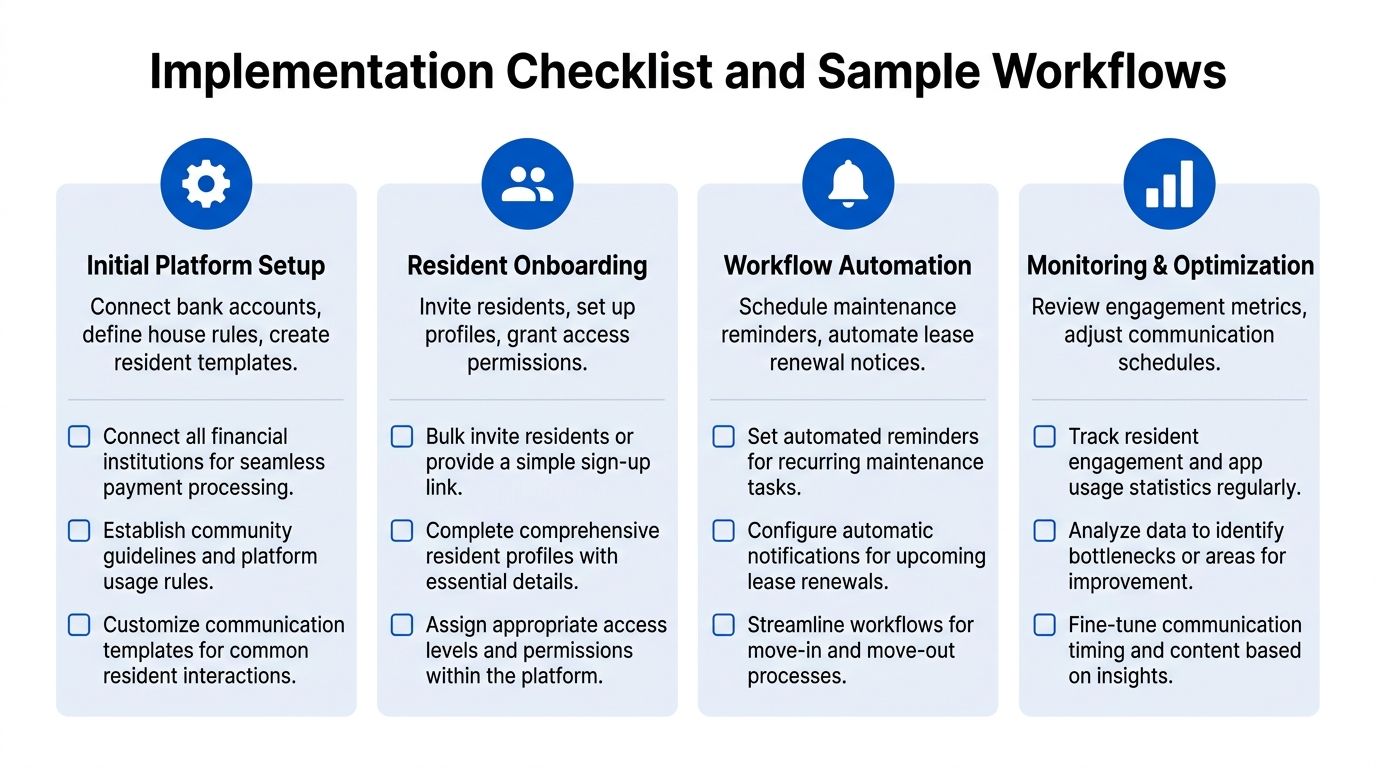
- Initial setup. Connect the core systems, load house rules, and build resident message templates.
- Resident onboarding. Invite residents, create profiles, and assign access permissions by room.
- Workflow automation. Set reminders for rent, maintenance, renewals, and common resident milestones.
- Monitoring and optimization. Review the dashboard weekly and tighten the workflows that cause delays.
This order matters because hosts who try to automate everything at once usually create more confusion than they remove. Start with the communications you already repeat every week, then layer in access control and reporting once the basics work.
Three workflows worth testing first
A new inquiry should trigger an instant reply, then a tour or application path, then a move-in sequence if the applicant qualifies. A resident maintenance request should route into the right queue, confirm receipt automatically, and escalate if it sits too long. A move-out should disable access, notify the right team members, and open the room for pricing and turnover work.
You can also pair messaging automation with the ideas in follow-up automation if your biggest leak is slow response time. That's where most small operators lose momentum, not in strategy, but in delay.
The better your implementation, the less your team has to remember. That's the whole point.
KPIs to Track and Next Steps for Getting Started
Measure the platform like an operator, not like a software buyer. If it does not move your numbers, it is not doing its job.
Track the metrics that reflect room-level health
Watch occupancy rate by room, average days on market for vacancies, resident retention rate, maintenance response time, message response time, self-service adoption rate, and net operating income per property. Those KPIs show whether the platform is helping you fill rooms faster, keep residents longer, and run the portfolio with less waste.
Set baselines before you change anything, then compare each new workflow against that starting point. A platform review should look like a business review, because that is what it is. If you want a tighter operating lens, pair resident data with operational efficiency metrics so you can see whether faster replies, cleaner workflows, and better automation are improving performance.
Start with the right next step
PadPulse is an in-development platform for PadSplit hosts and co-living operators, with planned features for automated dynamic pricing, AI-powered messaging, smart-home integrations, and portfolio-level analytics. It is targeting a Winter 2026 launch, with tiers planned from a free repricing tool to professional and enterprise options, and early adopters can join the interest list for updates and referral opportunities with no billing required before launch.
If you run rooms, stop buying generic property software and call it a strategy. You need a system built around occupancy, response speed, and room-level NOI, because that is what changes revenue in a co-living operation. Visit PadPulse to get on the interest list and keep an eye on a platform built for hosts who want tighter workflows and stronger control over pricing, communication, and access.