Co-Living Pricing Intelligence Software Guide 2026
June 29, 2026
If you run co-living homes, this probably sounds familiar. A room turns over, you open Zillow, Facebook Marketplace, maybe Apartments.com, and then start comparing listings that sort of match yours. One has a private bath. Another includes utilities. A third is cheaper, but it's in worse condition and farther from transit.
Then you stare at your own vacancy and ask the same question again: should Room 3 rent for a little more, a little less, or stay where it is?
That's the daily pricing problem in room-by-room rentals. You're not pricing a uniform apartment stack. You're pricing unique rooms inside living environments that have quirks, tradeoffs, and changing demand. Manual pricing can work when you have one house. It gets messy fast when you have several properties, rolling turnovers, and staff trying to fill rooms without giving away margin.
Stop Guessing Your Room Rates
Busy operators rarely struggle because they don't care about pricing. They struggle because pricing takes too much manual effort to do well. By the time you've checked local comps, reviewed your recent leads, and talked with your leasing team, the market may already have shifted.
That creates two expensive mistakes.
First, you can overprice a room and let it sit longer than it should. Second, you can underprice it and fill it quickly, but leave money on the table every month after move-in. In co-living, both mistakes hurt. A vacancy drags occupancy down, while a weak asking rent can gradually compress NOI across the whole portfolio.
Why co-living pricing is harder than apartment pricing
A standard apartment operator may have many nearly identical units. Co-living operators usually don't.
You might be comparing:
- Room size differences: A larger room with a better closet and more natural light
- Amenity differences: Private bath versus shared bath, furnished versus unfurnished
- House differences: One property has stronger transit access, another has newer finishes
- Timing differences: A room coming available during a strong leasing window versus a slower period
That's why a simple spreadsheet often breaks down. It can list prices, but it can't reliably tell you which local room is comparable to yours.
Practical rule: If your team spends hours checking listings and still feels unsure about pricing, the process isn't giving you intelligence. It's giving you a slower version of guesswork.
What a better workflow looks like
Pricing intelligence software gives operators a more structured way to make room-rate decisions. Instead of manually hunting for comps and trying to interpret them by memory, the software gathers market data, organizes it, and helps you act on it faster.
For a co-living host, that usually means:
- Seeing nearby competing room rates in one place
- Tracking changes over time instead of relying on one-time spot checks
- Comparing similar rooms more accurately
- Adjusting rates faster when occupancy, demand, or competition changes
Think of the shift this way. Manual pricing is like checking traffic by looking out the window. Pricing intelligence software is like using live navigation while you drive. You still choose the destination, but you stop making decisions blind.
What Is Pricing Intelligence Software Anyway
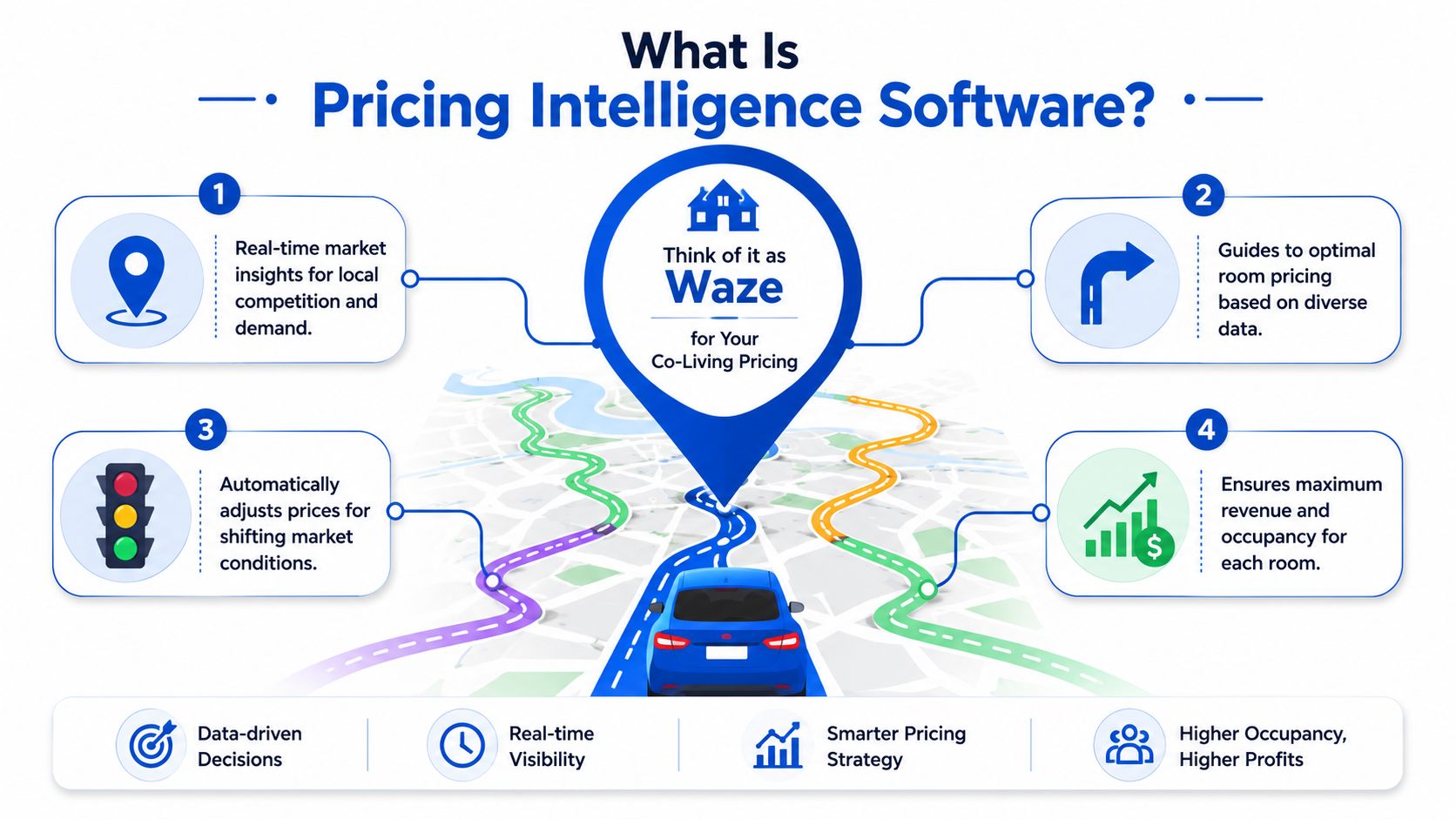
The simplest way to understand pricing intelligence software is this: it's Waze for your room rates.
You tell the system what you manage. It looks at the market around you, weighs the signals, and helps guide you toward a better pricing route. Not just the highest price. The best price for the conditions in front of you.
It does more than track competitor prices
A lot of people hear the phrase and assume it means “software that scrapes comps.” That's only part of it.
Good pricing intelligence software helps operators answer questions like:
- Which nearby listings are comparable to this room?
- Are competitors moving prices up or down?
- Are we losing leads because we're overpriced?
- Should this room be priced for speed, margin, or a balance of both?
- Are we being reactive when we should be proactive?
That's the “intelligence” part. The software doesn't just collect numbers. It helps turn scattered market data into a pricing decision.
Why more operators are paying attention
This category isn't a niche anymore. The global pricing intelligence software market is projected to grow from USD 1.95 billion in 2026 to USD 4.17 billion by 2031, according to Mordor Intelligence's price optimization software market outlook. That same market outlook says businesses are moving toward more strategic pricing because of inflation pressure and more complex market data.
For co-living operators, that trend makes sense. Managing room-by-room inventory means dealing with lots of small pricing decisions that add up fast.
A plain-English definition
Here's a practical definition that fits co-living well:
Pricing intelligence software is a tool that gathers market and performance data, compares your rooms to competing options, and recommends or automates better pricing decisions.
That can include daily pricing support, alerts when the market shifts, and dashboards that help owners, leasing staff, and asset managers work from the same picture.
Think in outcomes, not code
You don't need to understand machine learning models to use this category well. You only need to understand what the software is trying to improve:
| What you see | What the software helps with |
|---|---|
| Empty room | Better chance of pricing it to fill |
| Fast lease-up at low rent | Catching underpricing before it repeats |
| Staff checking comps manually | Less repetitive research |
| Inconsistent pricing across houses | Clearer portfolio-wide decisions |
For busy hosts, that's the key. Pricing intelligence software isn't about adding complexity. It's about removing avoidable uncertainty.
How Software Sets the Perfect Price for Every Room
A co-living operator might have two open rooms in the same house at the same time. One is a larger corner room with a private bath. The other is smaller, shares a bath, and faces the street. If both get the same price because they sit under one property address, revenue leaks in one direction or occupancy slips in the other.
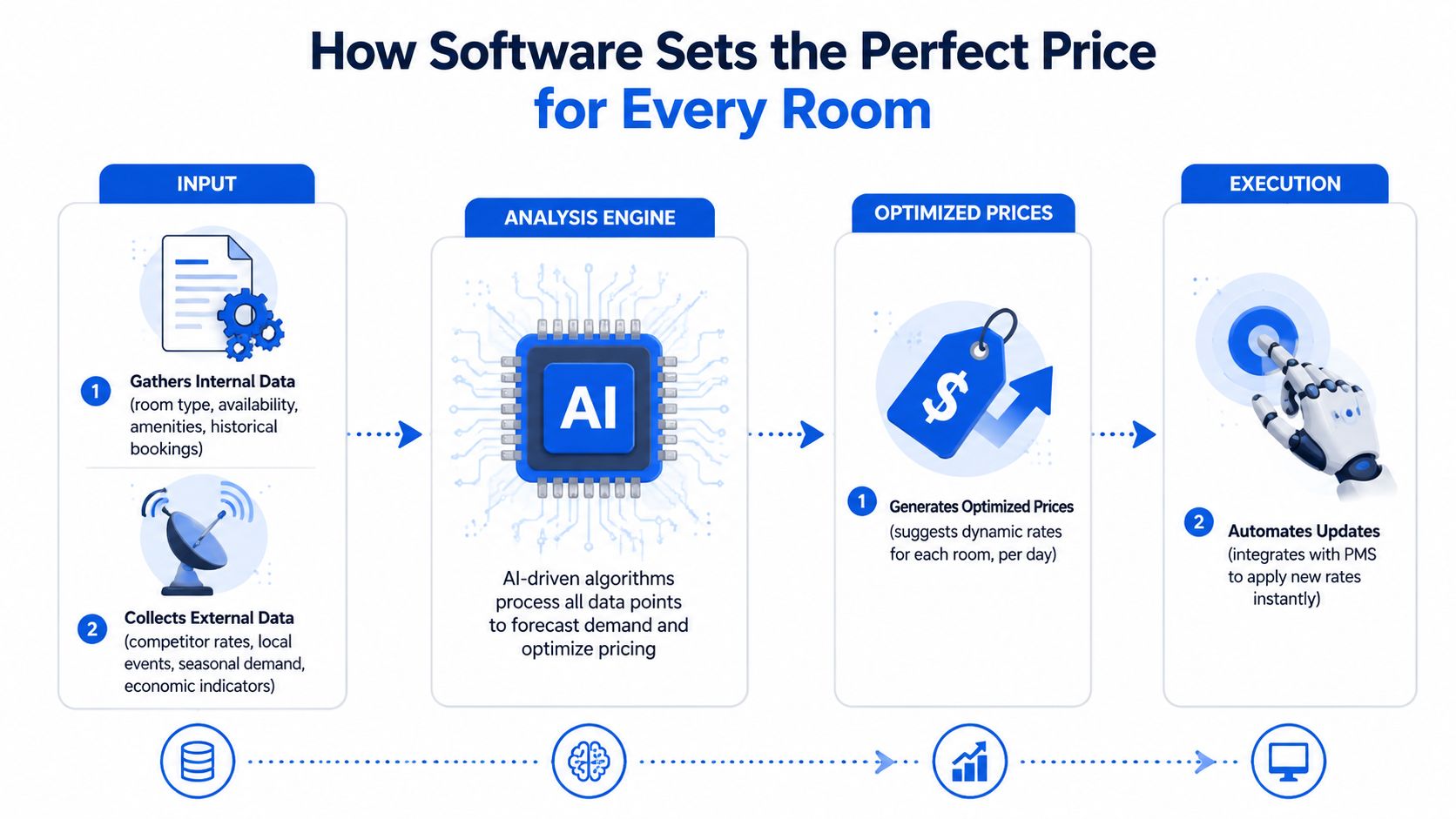
Pricing software solves that room-by-room problem through a simple process. It gathers signals, sorts out which listings are true substitutes, and recommends a rate that fits each room's demand.
Step one is gathering the right signals
The software starts by pulling information from listing sites, competitor pages, your leasing history, and internal systems. Centric Software's overview of pricing intelligence describes this as combining market and internal data so pricing decisions are based on a wider set of inputs instead of a single comp check.
For room-by-room operators, those inputs usually matter more at the room level than at the property level:
- Nearby room listings: What similar furnished rooms are asking within a tight radius
- Listing velocity: Which rooms disappear quickly and which sit for weeks
- Your leasing history: Which room types fill fast at which rent bands
- Lead feedback: Whether prospects are reacting to price, bathroom setup, furnishings, parking, or house rules
Used well, this works like airline pricing on a smaller scale. Airlines do not price every seat the same just because they are on the same plane. Co-living operators should not assume every room in the same house deserves the same rent either.
If you already track future leasing demand, pairing pricing with demand forecasting software for rental operators gives you a clearer read on whether a room should be priced to fill quickly or priced to protect revenue.
Step two is matching the right room to the right comparison
Many operators find this challenging. Collecting rents from the market is the easy part. Deciding which listings compete with your room is harder.
Room listings are messy. One host writes "private master suite." Another writes "large furnished room." A third says "quiet upstairs bedroom near transit." Those labels sound different, but two of those rooms may be close substitutes while the third is clearly a weaker option.
Good software cleans up that mess by comparing room attributes instead of relying on titles alone. It looks at factors like private versus shared bath, room size, furnishings, location within the home, parking, included utilities, and neighborhood access. That is closer to how riders experience Uber surge pricing. The app is not setting one citywide fare based on a single average. It adjusts based on the specific ride, the exact area, and current demand in that pocket of the market.
For co-living, the practical point is simple. A room with a private bath, better natural light, and more storage should not be benchmarked against the cheapest shared-bath option nearby just because both are labeled "private room."
Step three is converting market noise into a usable rate
Once the software has cleaner comparisons, it estimates a price range for each room. That recommendation usually reflects local competition, your current vacancy, lead volume, seasonality, and how similar rooms have performed before.
Some systems stop there and let your team review the recommendation. Others push updated prices into daily workflows so rates can change while the signal is still fresh.
That speed matters. In co-living, a stale rate can linger for days across multiple vacancies. One room ends up underpriced and fills too cheaply. Another sits overpriced and drags occupancy. Software helps avoid both outcomes by treating pricing as an active operating decision, not a once-a-month spreadsheet exercise.
Core Features for Co-Living Operators
The best pricing software for co-living does more than produce a number. It helps your team answer a practical Tuesday-morning question: which room needs attention right now, and what should we do about it?
That matters because co-living inventory is uneven by nature. Two rooms in the same house can perform very differently. One faces the street and gets better light. Another has the closest bathroom. A third is smaller but includes parking. Software should reflect those differences in daily operations, not flatten them into one house-level average.
Market visibility matters first
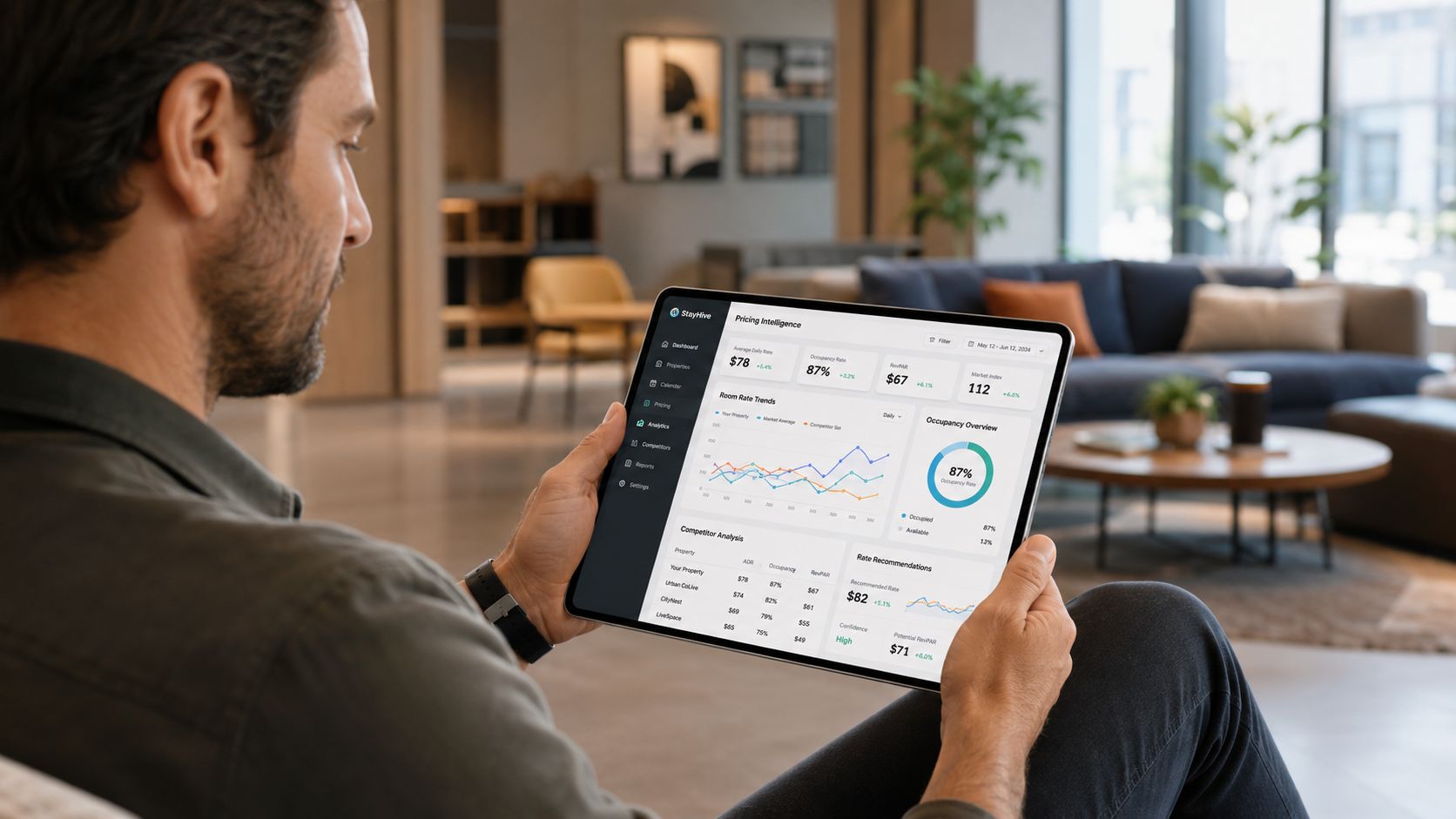
For room-by-room operators, a useful platform starts with visibility into the market around each property. If your team cannot quickly see which nearby rooms are competing for the same renter, pricing turns back into guesswork.
A strong system should also help you read the block, submarket, and transit corridor around each home through tools like local market intelligence for co-living operators. That keeps pricing tied to real neighborhood conditions instead of citywide averages that blur important differences.
Clear visibility saves time. It also prevents a common mistake in co-living: treating every vacancy as if demand is uniform across the portfolio.
Features worth prioritizing
The features below tend to matter most because they reduce manual work and help operators price each room on its own merits:
Comparable room dashboard
Your team should be able to see nearby listings that actually resemble the room in question by privacy level, furnishings, bathroom setup, amenities, and location. That cuts hours of tab-switching and gives leasing staff a cleaner starting point.Room-level pricing recommendations
Co-living operators need guidance at the room level, not just the property level. A basement room, a front-facing bedroom, and a suite with a private bath should not move in lockstep.Change alerts
Good software flags rate drops, listing removals, new competing supply, and rooms that are drifting out of line with the market. That is the pricing version of a smoke alarm. Your team gets a prompt before a vacancy turns into a longer revenue problem.Historical performance tracking
Past performance helps answer a basic but important question. Did the room sit because demand was weak, or because the asking rent was too high for that exact setup? Without that context, teams repeat the same pricing mistakes.
Useful features that often get overlooked
Some of the most helpful tools are not the ones that get the biggest demo moment.
| Feature | Why co-living operators care |
|---|---|
| Pricing rules | Lets you set floors, ceilings, and adjustment rules so staff are not rewriting every rate by hand |
| Unified dashboard | Gives leasing, operations, and ownership one shared view of vacancies, comps, and pricing decisions |
| Vacancy monitoring | Helps teams spot stale rooms early and review pricing before a week turns into a month |
| Performance reporting | Connects pricing changes to occupancy, revenue per room, and operating results |
Watch for this: If a vendor shows polished charts but cannot clearly explain how a room recommendation is generated, you may be buying reporting software rather than a pricing tool.
The right feature set should fit the way co-living teams work. You want something your staff can use during turnover, leasing follow-up, and weekly vacancy reviews. If it only makes sense in a quarterly strategy deck, it will not remove much manual work or improve day-to-day pricing decisions.
Boosting Your Revenue Occupancy and NOI
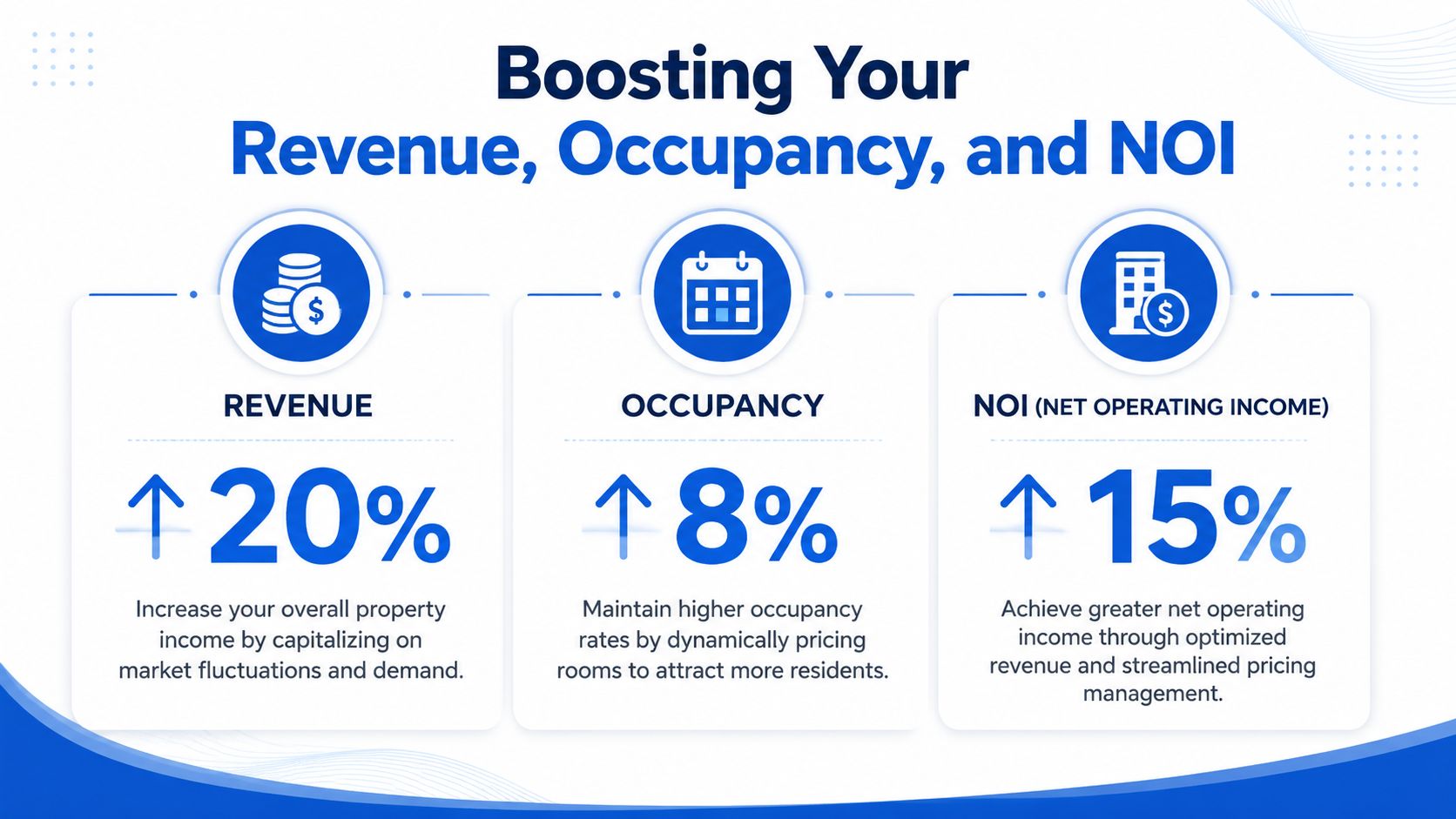
At some point, software has to earn its keep. For co-living operators, that comes down to three outcomes: more revenue per room, steadier occupancy, and stronger NOI.
Where the gains show up first
Organizations using pricing intelligence software often recover 2% to 5% of gross margin in the first quarter by fixing underpriced inventory, according to Tierly's guide to pricing intelligence software ROI. For room-by-room rentals, that often looks like catching rooms that have been priced too conservatively because staff relied on old comps or rushed turnover decisions.
The same guide says organizations that regularly optimize pricing achieve 30% higher growth rates than companies using static pricing models. That's a broad business finding, but the logic fits co-living well. Static room pricing doesn't adapt when local supply changes, when demand tightens around a transit corridor, or when your own vacancy picture shifts week to week.
How this affects occupancy and NOI
Revenue and occupancy often pull in opposite directions. Push rates too high and rooms may sit. Discount too aggressively and you fill beds while hurting property income.
Pricing intelligence software helps operators manage that tension more deliberately.
- For revenue: It can identify rooms that deserve stronger pricing because the market supports it.
- For occupancy: It can flag listings that likely need a faster adjustment before a vacancy drags on.
- For NOI: It reduces avoidable revenue leakage and cuts some of the manual labor tied to repetitive pricing checks.
Better pricing doesn't mean charging the maximum every time. It means choosing the rate that best fits your leasing goal for that specific room, at that specific moment.
A co-living example
Say you manage two similar houses. One has strong occupancy and only one premium room available. The other has several vacancies opening at once. A static pricing model might treat both houses similarly. Pricing intelligence software gives you a reason to behave differently.
For the tight house, you may hold rate and protect margin. For the softer house, you may price one room more aggressively to improve leasing velocity and stabilize the property faster.
That's how the software supports NOI in practice. It helps you stop treating every vacancy as the same problem.
Choosing Software and Avoiding Common Pitfalls
A co-living operator can lose money with the "smartest" pricing tool in the room if the software misunderstands the room itself.
That problem shows up fast in room-by-room rentals. One house may have a furnished basement suite with private entry. Another may have a small interior room that shares a bath with two housemates. If the system treats those rooms as close substitutes, its recommendation starts from the wrong baseline.
Airlines do not price every seat the same way, and Uber does not price every ride the same way. Good pricing software for co-living works with that same logic. It needs to understand that your inventory is not a stack of identical units. It is a set of distinct rooms, each with its own features, tradeoffs, and demand pattern.
Ask hard questions about room matching and data freshness
According to an analysis by Pricer24 on choosing pricing intelligence software, pricing mistakes often start with bad matching. That point matters even more in co-living, where small room differences can change renter demand and perceived value.
For a PadSplit host, matching is the foundation. If a "corner room with balcony" gets compared to a darker room with no natural light and a shared bath, the suggested rate can be misleading from the start. If market data updates too slowly, the software may keep pointing you toward last week's answer while your submarket has already shifted.
That is why operators should look closely at tools built around pricing rooms in co-living operations. Room-level logic matters more here than broad apartment averages.
A short buyer checklist
Use these questions in demos and vendor calls:
How does the platform match non-standard rooms?
Ask the vendor to show a real example using furnished rooms, private baths, shared baths, and premium layouts.How often is market data refreshed?
"Real time" can mean many things. Ask how often nearby listings are checked and how quickly new supply appears in the system.Can your team see why a price was recommended?
If the software acts like a black box, staff will hesitate to trust it. You want clear factors, not mystery math.Does it fit daily leasing work?
A strong model still falls short if your team has to copy numbers by hand across systems or hunt for the next action.
Common traps to avoid
Some mistakes come up again and again with co-living operators:
| Pitfall | Why it causes trouble |
|---|---|
| Buying on subscription price alone | A cheaper tool can cost more if bad room matches lead to weak pricing decisions |
| Looking only at competitor rent | Room differences, lead flow, and vacancy timing also shape the right rate |
| Treating all rooms in one home as interchangeable | Co-living revenue depends on pricing each room for its actual value |
| Assuming setup solves everything | Teams still need review habits, feedback loops, and adoption across leasing operations |
One more caution. Do not ask software to replace operator judgment. Ask it to sharpen it.
The right platform should understand your inventory the way an experienced leasing manager does, then help your team make faster, more consistent decisions with less spreadsheet work and fewer avoidable pricing misses.
Take the First Step to Smarter Pricing Today
Most co-living operators don't need more data. They need a better way to turn market signals into room-rate decisions they can trust.
That's what makes pricing intelligence software useful. It replaces repetitive comp checks, reduces avoidable pricing mistakes, and gives operators a cleaner way to balance occupancy and revenue room by room. For portfolios with unique inventory, that shift can be the difference between reactive leasing and intentional NOI management.
If you're still pricing mostly by instinct, spreadsheets, and scattered listing checks, you don't need to overhaul everything overnight. Start by tightening one part of the process. Look at how your team compares rooms, how often prices are reviewed, and where stale assumptions tend to creep in.
The operators who get the most value from this category usually do one thing well. They stop asking, “What are others charging?” and start asking, “What should this specific room rent for right now, given our goals and the market around us?”
That's a better question. It leads to better pricing.
PadPulse is building an all-in-one platform for PadSplit hosts and co-living operators, with planned features including dynamic room pricing, messaging workflows, smart-home integrations, portfolio analytics, and market intelligence. If you want an early look before the planned Winter 2026 launch, join the PadPulse early access interest list. There's no cost or commitment. You'll get updates, limited beta access opportunities, and a head start on a tool designed specifically for room-by-room rental operations.