Operational Bottlenecks in Room Rentals and How to Fix Them
September 21, 2026
A room goes vacant on Tuesday. The cleaner finished on time, the photos are ready, and demand is there. But the painter didn't get the updated scope after inspection, the leasing inbox sat too long, and the key handoff depends on one person who is off that day. By Friday, nothing is wrong with the room itself. The delay lives in the gaps between steps.
That's how operational bottlenecks usually show up in pad-by-room rentals. Not as one dramatic failure, but as a string of small handoff misses that hold back revenue. One slow response, one unclear work order, one access issue, and the whole turn stretches out.
In room-by-room operations, speed matters twice. It matters when a prospect is deciding where to book, and it matters again when a vacant room is waiting to come back online. If you run shared housing, co-living, or PadSplit-style inventory, the bottleneck usually isn't “we need more people.” It's “work is sitting between people.”
Why Operational Bottlenecks Hit Pad by Room Rentals Hard
A room rental business runs on short chains with tight dependencies. Inquiry comes in. Follow-up happens. Showing gets booked. Applicant gets screened. Turnover gets scoped. Vendors get scheduled. Access gets assigned. Miss one handoff and the downstream steps don't just slow down. They stop.
The easiest mistake is blaming the visible task. Operators often say the bottleneck is cleaning, maintenance, or leasing. Sometimes it is. Often it isn't. The room may be ready for the next step, but the next person doesn't have what they need to move.
One slow step suppresses the whole portfolio
Manufacturing has a clean example of what bottlenecks do to a larger system. During the 2020 to 2021 supply-chain disruption, the Federal Reserve estimated that bottlenecks held down manufacturing production growth by about 0.2 percentage point per month in the first half of 2021, and for manufacturing excluding transportation equipment, the effect was about 2.5 days of lost output in the average month since December 2020. By September 2021, manufacturing growth was still about 0.6 percentage point below what it would have been without those constraints, according to this Federal Reserve bottleneck analysis summary.
That matters here for a simple reason. A bottleneck at one point can suppress output across the full system, even when the rest of the system is capable of moving faster.
In room rentals, that same logic shows up every day:
- Leasing delay: A prospect asks about a room, but no one replies fast enough.
- Turnover delay: The inspector closes the visit, but the vendor scope isn't clear.
- Access delay: The room is leased, but key pickup or code assignment drags.
None of those issues sound huge in isolation. Together, they stretch vacancy and create avoidable friction.
Practical rule: If a room is “almost ready” for more than a day, the bottleneck is usually a handoff problem, not a labor problem.
Why pad-by-room operations feel this pain faster
Single-family leasing can sometimes absorb delay because the workflow is less frequent. Room-by-room rentals don't have that luxury. You're handling more inquiries, more turns, more lock changes, more resident coordination, and more exceptions per property.
That's why delayed follow-up is so costly. One industry summary says 82% of prospective tenants expect a response within 4 hours of their initial inquiry, while 37% of companies in a widely cited audit replied within an hour and 24% took more than 24 hours, according to these leasing response time statistics. If your process lets inquiries sit, the bottleneck isn't marketing. It's response flow.
The same thing happens on the expense side. A property-management leasing summary reports 34.4 average vacant days for stabilized units at the end of 2024, and says RealPage estimated each vacant unit adds about $275 in extra expense and turnover cost, based on this vacancy cost summary. In practice, that means a “small” procedural delay shows up in NOI very quickly.
How to Find the Constraint in Your Workflow
A room turns on Monday. Cleaning finishes by noon. Maintenance handles two small repairs the same day. By Tuesday afternoon, the room is still not listed, the next prospect has gone quiet, and move-in slips again because no one assigned access. On paper, everyone did their part. In practice, the handoffs failed.
That is usually where the constraint sits in pad-by-room operations. Not in effort. Not in software. In the gaps between one completed step and the next owned step.
Start by tracing one room, one lead, or one move-in from start to finish. Use whatever records you already have. Your PM tool, inbox, text threads, lock logs, cleaning board, or a spreadsheet all work. The goal is to see where work waits after someone is done with it.
Start with age, not opinions
Sort active work by how long each item has been sitting in its current status.
That simple sort exposes more than a team debate ever will. If the oldest items collect in "inspection done," "waiting for photos," "pending approval," or "access setup," you have found the queue that is slowing everything behind it.
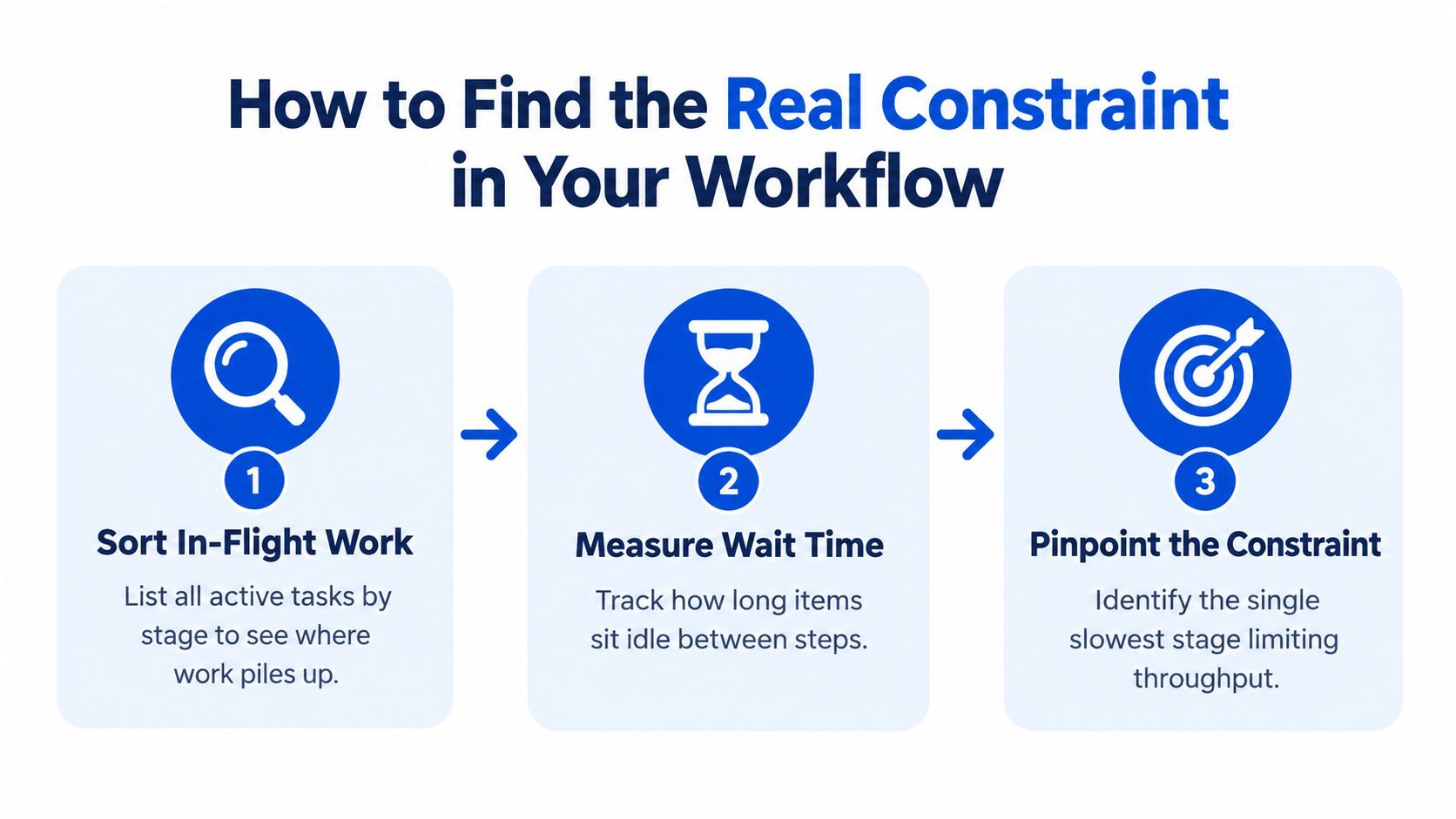
A practical workflow bottleneck guide suggests reviewing work this way: sort in-flight items by age, compare active work time against total elapsed time, and look for the points where follow-up messages pile up. That matches what I see on room turns. The oldest item is rarely waiting because the job itself is hard. It is waiting because the next handoff is unclear, unowned, or triggered too late.
In room-rental terms, the pattern usually looks like this:
- Leads age in the inbox: response coverage or assignment is weak.
- Rooms stall after inspection: scope approval, vendor scheduling, or turn sequencing is weak.
- Move-ins wait at the finish line: access creation, code assignment, or resident confirmation is weak.
Compare touch time to waiting time
Next, separate working time from waiting time.
A cleaner may spend an hour in the room. A tech may spend thirty minutes fixing a lock. If the turnover still takes three days, labor speed is not the first issue to fix. The lost time sits between steps, usually in approval, scheduling, listing prep, or access control.
This is the mistake operators make when they throw people at the problem. More cleaners do not help if cleaned rooms are waiting on photos. Faster leasing replies do not help if qualified prospects cannot self-tour because codes are not issued until someone manually reviews a text thread.
The constraint is the stage where completed work goes idle.
Count the chasing
Open the messages tied to delayed turns and delayed move-ins. Count every "Is this ready?" "Did maintenance finish?" "Can we send the code?" and "Who is handling this one?"
Chasing is a cost. It also points straight at the broken procedure.
If one coordinator has to keep checking whether a room is photo-ready, the issue is not communication style. The issue is that no step automatically changes ownership from turn completion to listing prep. If leasing keeps asking for access details on move-in day, the issue is not urgency. The issue is that access setup happens too late in the sequence.
A simple audit works well:
- Pull a recent batch: turns, inquiries, and move-ins from the last few weeks.
- Mark each waiting point: response assignment, inspection signoff, repair approval, cleaning completion, photography, listing publish, lock setup.
- Write down the trigger and owner for the next step: if either is fuzzy, that is where time is leaking.
- Note every manual follow-up: repeated status checks usually sit right beside the constraint.
For operators tightening this kind of process, this guide to workflow optimization for property operations is a useful companion to your own map.
What to avoid during diagnosis
Do not start with a software demo. Do not average the whole workflow into one cycle-time number. Do not accept "the team needs to communicate better" as an answer.
Map the current sequence exactly as it happens, including the messy parts. Who closes inspection. Who approves make-ready scope. Who schedules cleaning. Who publishes the room. Who assigns the code. Who confirms access worked.
Then ask three direct questions:
- Where are items aging the longest
- Where is waiting much longer than active work
- Where does the team keep chasing status
In room-by-room rentals, that process usually points to a failed handoff or a missing procedure before it points to headcount. That is the constraint worth fixing first.
KPIs That Reveal Where Time and Money Leak
At 4:10 p.m., the cleaner finishes a room. By 7:30 p.m., the listing still is not live because inspection photos never got uploaded, maintenance never closed a minor repair, and nobody assigned the new door code. The room is technically ready. It is still not rentable.
That is why KPI tracking in pad-by-room operations needs to measure handoffs, not just labor output. If the scorecard only shows that cleaning finished or maintenance closed tickets, it misses the waiting time between those steps. That is usually where the money goes.
Start with timestamps you already have
Pull 8 to 12 weeks of records from the systems your team uses. Leasing inbox, inspection forms, work orders, cleaner check-out, listing publish time, and access-code setup all matter. Use one time zone and one event sequence for every room, or the review turns into a debate about who remembers what.
For room-by-room rentals, the basic event chain usually looks like this:
- inquiry received
- first response sent
- showing scheduled
- application approved
- move-out confirmed
- inspection completed
- make-ready scope approved
- cleaning completed
- maintenance completed
- photos uploaded
- listing published
- access issued
- move-in completed
You do not need a perfect BI stack to get value from this. A shared sheet with clean timestamps is enough to expose where rooms sit untouched between owners.
The room-rental KPIs that matter
A short KPI set works better than a crowded dashboard because each metric should point to a specific handoff failure or procedure gap.
| Metric | Healthy Target | What It Signals |
|---|---|---|
| Lead response time | Fast enough to keep prospects engaged | Whether inquiry assignment is immediate or sitting unowned |
| Time from inspection to make-ready approval | Short, with little variation | Whether turn scope is getting approved promptly or waiting on review |
| Time from cleaning complete to listing live | Short and consistent | Whether photos, signoff, and publishing are sequenced properly |
| Vacancy days per room | As low as your operation can sustain without rushed errors | Whether turnover flow is protecting revenue |
| Turnover cycle time | Consistent across similar room types | Whether scheduling and signoffs are controlled |
| Work in progress by stage | Capped at a manageable level | Whether the team is starting too many turns at once |
| Access setup completion before move-in | Near 100% before arrival | Whether lock codes, app invites, and entry instructions are handled on time |
| Rework rate | Low and trending down | Whether poor inspection, unclear scope, or bad handoffs are sending work backward |
Two of these deserve extra attention in co-living.
First, time from inquiry to first response. Teams often blame weak leasing volume when issue is that inbound leads sit in a shared inbox until someone claims them. Second, time from room-ready to access-ready. I have seen plenty of rooms turned on schedule and still lose a same-day move-in because the code was never created or the wrong room was assigned.
Tie the delay to cost
Vacancy days matter because they translate process mistakes into lost rent. Rework matters because every return visit burns margin twice. Late access setup creates a different cost. Staff time goes into calls, apologies, manual unlocks, and after-hours fixes that should never exist in a stable process.
A useful scorecard pairs time metrics with failure counts. Count how many rooms missed listing within 24 hours of turn completion. Count how many approved applicants waited for access instructions. Count how many turns required a second clean or a second maintenance visit. Those counts show whether the process is reliable, not just busy.
For operators building that reporting cadence, this guide to operational efficiency metrics gives a solid structure for the scorecard.
What these KPIs usually expose
Certain patterns come up repeatedly.
- Fast field work, slow total cycle time: the room is waiting on approvals, publishing, or access setup.
- Long gap between inspection and repair start: scope is unclear or nobody owns approval.
- Cleaning done, listing delayed: photos, final signoff, or pricing entry is stuck in a handoff.
- High work in progress: supervisors opened too many turns, so each one waits longer between touches.
- Frequent access failures on move-in day: lock setup is treated as an afterthought instead of a required pre-move step.
The point is simple. In pad-by-room operations, time and money rarely leak because one person works too slowly. They leak because the next step is undefined, unassigned, or triggered too late.
Prioritizing Fixes That Actually Move Throughput
A room can be clean by noon, maintenance can close its last item by 2 p.m., and leasing can still lose the next two days because nobody published the listing, approved the rate, or queued the lock code. That is the pattern to fix first. In pad-by-room rentals, the slowdown usually sits between steps.
I have seen operators throw money at the visible task because it feels actionable. Faster cleaning. More vendor pressure. Another coordinator. The room still sits because the process has a gap in ownership or timing. In shared housing, that gap is often small on paper and expensive in practice.
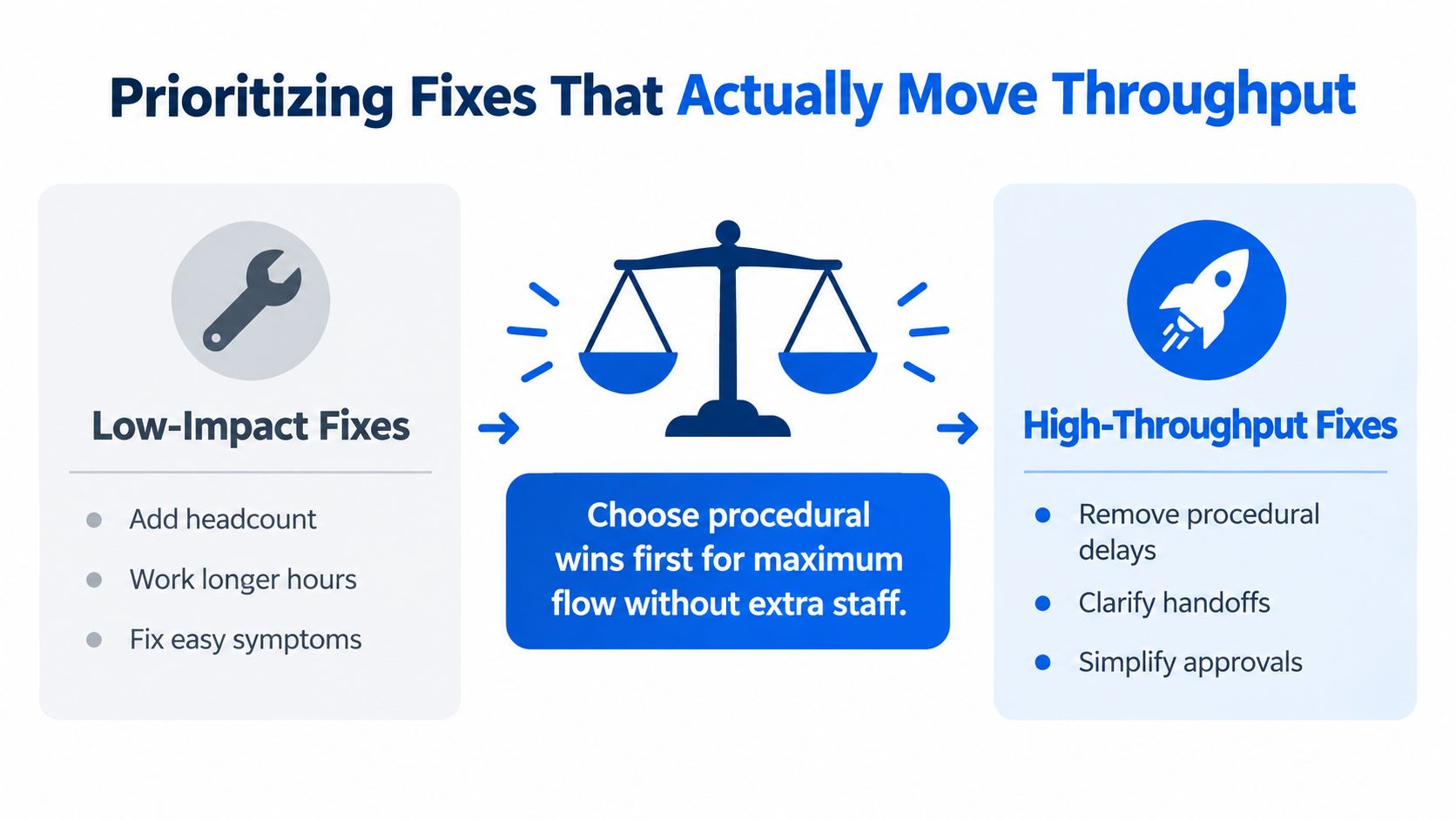
That split shows up in outside research too. A quantitative study found procedural constraints made up 44.4% of identified bottlenecks with 55 out of 124, while human-related constraints accounted for 29.0% with 36 of 124 and technological constraints 26.6% with 33 of 124, based on this bottleneck category study. For operators, the takeaway is straightforward. Process design and handoffs usually deserve attention before a software swap or extra headcount.
Compare fixes by throughput, not effort alone
The best fix is the one that removes waiting from the constrained path. It is rarely the one that looks busiest.
| Fix type | Usually helps when | Common downside |
|---|---|---|
| Add headcount | The constrained step is truly capacity-bound for most of the week | More people can create more internal passing if ownership is still fuzzy |
| Buy or switch software | Information is split across inboxes, spreadsheets, and vendor chats | A new tool does not fix weak triggers or missing accountability |
| Clarify ownership | Tasks bounce between leasing, ops, and vendors | Managers have to enforce the rule after the SOP is written |
| Remove approvals | Work sits in queues waiting for signoff | You need clear dollar limits and exception rules |
| Standardize scope | Vendors get inconsistent turn instructions room to room | Edge cases need a separate path so the standard does not break |
| Pre-schedule downstream work | Rooms wait between inspection, repair, cleaning, photos, and listing | The calendar has to be maintained daily |
A simple filter helps. Ask which change removes delay from the room's full path from notice to ready-to-rent. If a fix only makes one task faster while the room still waits on the next handoff, throughput barely changes.
That is why small procedural changes often beat larger purchases. A preset turnover scope, a same-day publish rule, or an auto-created access task can move more rooms than a new platform nobody uses consistently.
Use handoff friction as the decision filter
A lot of operating drag comes from coordination failures that people describe as staffing problems. The cleaner finished, but maintenance never saw the photo set. Leasing approved the applicant, but nobody assigned access setup. The field team assumed the room was blocked for one more day because pricing had not cleared.
PwC reporting summarized in one operational bottleneck article says 47% of operations leaders cite integration complexity as a reason technology investments haven't fully delivered, and 41% say limited collaboration across operational and supply-chain functions is a top-three barrier, as cited in this handoff and integration summary.
That lens fits room rentals well. Before approving a fix, ask:
- Does the delay happen inside one task, or while the work is waiting for the next owner
- Is the next step assigned by rule, or left to memory
- Does the receiving person get the exact information needed to act
- Will this change cut queue time, or only speed up labor inside the task
The best fixes reduce waiting and reduce interpretation.
A simple ranking method
I rank changes on two axes:
- How much waiting time they remove from the room path
- How much coordination they remove or add
That pushes the right work to the top. In practice, high-priority fixes usually include auto-assigned inquiry response, standard scopes for turn types, pre-booked vendor windows, and approval thresholds that let routine work move without supervisor review. Medium-priority fixes include better exception tagging, tighter templates, and cleaner reporting. Lower on the list, at least early, are staffing adds, tool migrations, and broad process redesigns.
There is a trade-off here. Standardization makes the day run faster, but if you force every room through the same path, unusual cases clog the line. The answer is not more flexibility everywhere. The answer is one default path for normal turns and a clearly defined exception path for damaged rooms, compliance issues, or roommate conflicts.
Fix the handoff that holds the room. Then measure again. If cleaning speeds up but listing still waits for pricing entry or lock setup, the bottleneck moved to the next desk.
Redesigning Leasing Turnover and Access to Remove Delays
Once you've found the friction and chosen the right kind of fix, the work becomes concrete. In room rentals, three workflows usually deserve attention first: inquiry to showing, turnover to ready-to-rent, and access control.
Each one tends to fail at the handoff, not the headline task.

Make leasing response immediate and structured
Leads don't wait for internal coordination. If your inbox, call handling, and showing calendar aren't connected, prospects feel the delay even when demand is strong.
One industry summary says 82% of prospective tenants expect a response within 4 hours of first inquiry, based on the earlier linked leasing response source. That makes response flow a real operating system issue, not just a customer service preference.
A better pattern looks like this:
- Route the first message instantly: one owner, one queue, one fallback.
- Use templates for the first reply: pricing, next steps, showing options, qualification basics.
- Trigger escalation if no contact is made: don't rely on memory.
- Keep the conversation in one thread: scattered texts and emails create hidden delays.
Before, the lead waits while someone checks availability manually. After, the prospect gets a fast reply, the showing options are clear, and exceptions get routed only when needed.
Standardize turnover scope before the first vendor arrives
Turnovers drag when every room becomes a custom project. The inspector sees damage, writes loose notes, and the next vendor shows up without a precise scope. That creates idle time, return visits, and status chasing.
A property-management turnover guide says 45% of studied companies completed unit turns in under 9 days, with the biggest cluster in the 5 to 7 day range, while 49% took 9 days or longer. The same source says idle time often comes from gaps between tasks, such as when the next vendor has not been scheduled or the scope was not clear after the last inspection, according to this apartment turnover guide.
Use a tighter turnover design:
- Create a fixed inspection checklist: walls, locks, flooring, bath, HVAC, smoke devices, furniture, photos.
- Write scopes in task-ready language: not “touch up wall,” but “paint north wall by closet, patch two anchor holes.”
- Schedule the next trade before the current one finishes: especially for common recurring work.
- Close each step with proof: photo, invoice, or checklist signoff.
That doesn't eliminate exceptions. It eliminates preventable ambiguity.
For a visual walkthrough of how operators are using connected device workflows in rental housing, this short video is worth a look.
Remove key handoffs where possible
Physical keys create some of the most annoying delays in pad-by-room operations. Someone has to pick them up, drop them off, copy them, recover them, or remember where they went. That's a fragile process when rooms turn often.
Smart access changes the handoff itself. It removes the need for a physical exchange and gives the operator a cleaner sequence for showings, vendor entry, move-in, and lock changes. If you're evaluating that path, these smart lock features for rental operations are the ones that matter most operationally.
A simple before-and-after example:
- Before: Leasing confirms move-in, maintenance still has the key, the resident arrives, and everyone starts calling.
- After: Move-in is confirmed, access is assigned by workflow, and the resident gets the right entry instructions without a separate coordination loop.
The best access process is the one that doesn't require a last-minute phone call.
If you want fewer vacancy days, fewer missed showings, and fewer “who has the key” moments, these are the workflows to tighten first.
Sustaining Gains and Preventing the Next Bottleneck
Monday at 9:10 a.m., the room is cleaned, the lead is approved, and the move-in is paid. By 11:30, the resident is still waiting outside because access was never reassigned after maintenance finished the turn. On paper, the bottleneck looked fixed last week. In practice, the handoff still breaks under normal volume.
That is the test. A fix counts only when it holds during staff absences, stacked turnovers, and oddball exceptions like a late vendor, a room change, or a same-day move-in.
The operators who keep gains usually do three things well. They write the new procedure down, they review work at the handoff level, and they catch drift before it becomes the new standard.
Put the new process in writing
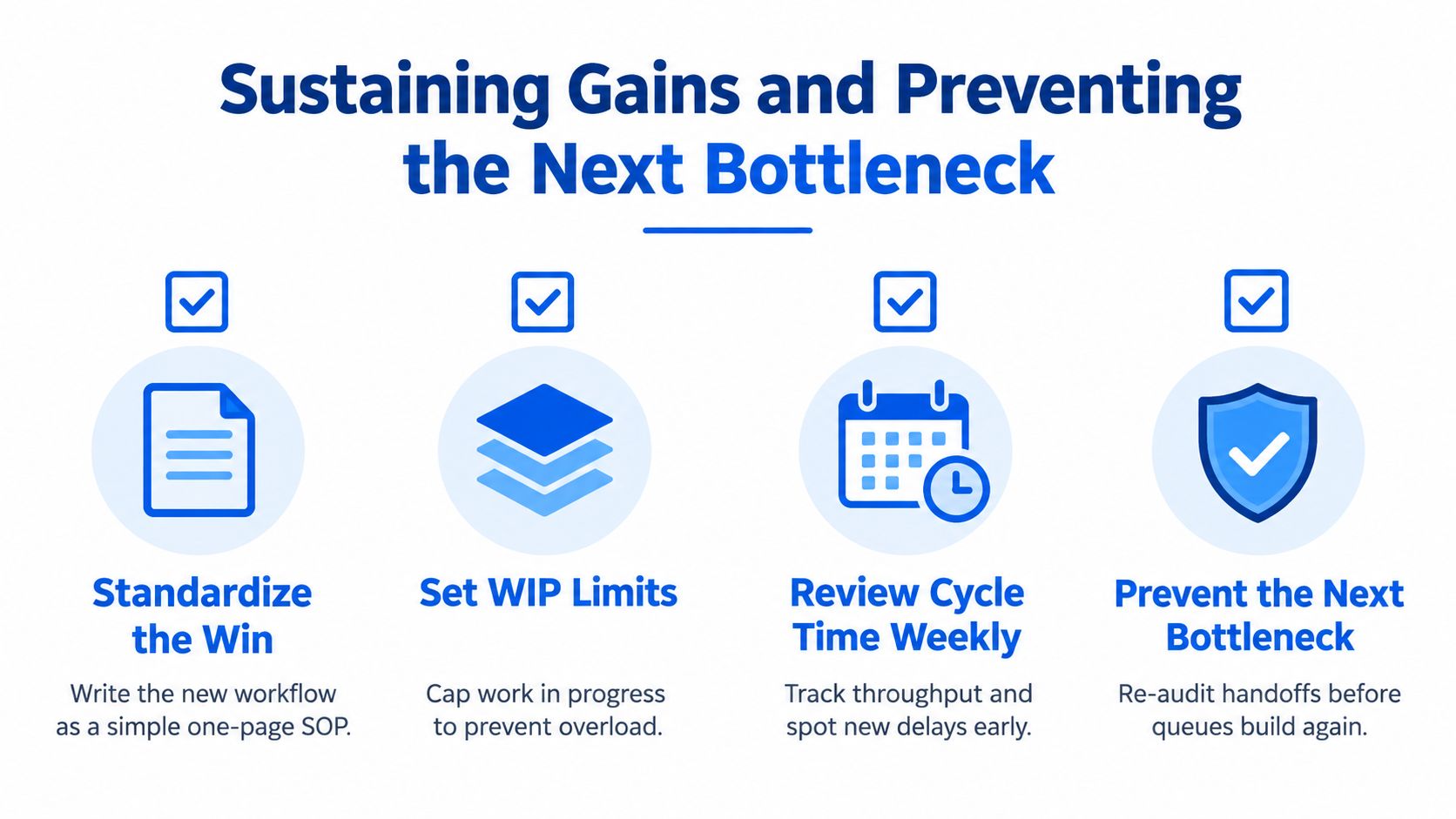
If a better workflow lives in one leasing coordinator's memory, it will disappear the first busy Friday. Write the change as a one-page SOP with a named owner, a clear trigger, the exact handoff requirement, and the backup path when the step stalls.
Keep it specific to the room-level work. “Turn unit” is too vague to manage. “Cleaner marks room complete by 2 p.m., photos uploaded, leasing notified, access code switched from vendor to showing mode” is clear enough to audit.
I have seen teams blame staffing for delays that were really missing end conditions. The cleaner thought the room was done. Leasing thought maintenance still had it. The resident got the delay.
Use a weekly review that stays close to the work
Skip the big presentation deck. Use one short review that shows where work is aging and where handoffs are failing.
Focus the review on questions like these:
- Which rooms, leads, or move-ins have been waiting the longest
- Which step is holding them there
- What information was missing at the last handoff
- Who owns the next action right now
- Did the latest change remove delay, or shift it to another step
This review should stay close to the pad, not drift into generic portfolio talk. Room-by-room rentals break on small misses. Inquiry response sits in one inbox. Turnover scheduling changes by text. Access is still assigned to the wrong person. Each issue looks minor by itself. Together they create dead time between ready, shown, approved, and occupied.
Outside dependencies belong in the review too. Vendor availability, supply delays, and utility scheduling can create the next queue before your internal team sees it. The point is not to track everything. The point is to spot which dependency is now controlling the pace.
A short sustainment checklist
- Define the handoff end state: every step ends with the exact info, status change, and owner the next person needs.
- Limit active work: starting five turns at once does not help if only two can get cleaned, checked, and released properly.
- Review aging weekly: older rooms, older leads, and older access requests usually expose the next failure first.
- Change one procedure at a time: that makes it easier to see what improved and what still breaks.
- Recheck permissions and escalation rules: recurring delays often come from nobody being able to reassign access or approve the next step quickly.
Bottlenecks do not disappear for good. They move to the next weak handoff.
That is normal in a live rental operation. Fix inquiry response, and turnover scheduling becomes the limiter. Fix turnover scheduling, and access control becomes the limiter. The job is not to chase perfection. The job is to keep tightening the procedure that is wasting the most time right now.
If you run room-by-room rentals, protect the gain by locking in the handoff, not by assuming the team will remember the new way next month.
PadPulse is being built for operators who want fewer handoff delays across pricing, messaging, access control, and reporting in one place. If you're trying to fill rooms faster and protect NOI without adding more admin overhead, visit PadPulse to see what's coming and join the early interest list.