How to Scale Rental Properties: Co-Living Roadmap 2026
July 17, 2026
Most advice on how to scale rental properties assumes every door behaves the same. It doesn't. A co-living house with six to twelve residents is not just a small multifamily asset with more leases. It's a shared living operation with room-level pricing, shared-space wear, staggered move-ins, and turnover that can hit one room at a time.
That's why the usual playbook breaks down fast. BRRRR, refinance timing, and market selection still matter, but co-living operators need tighter systems long before they need more properties. If you're filling individual rooms instead of whole homes, growth comes from repeatable operations, not hustle.
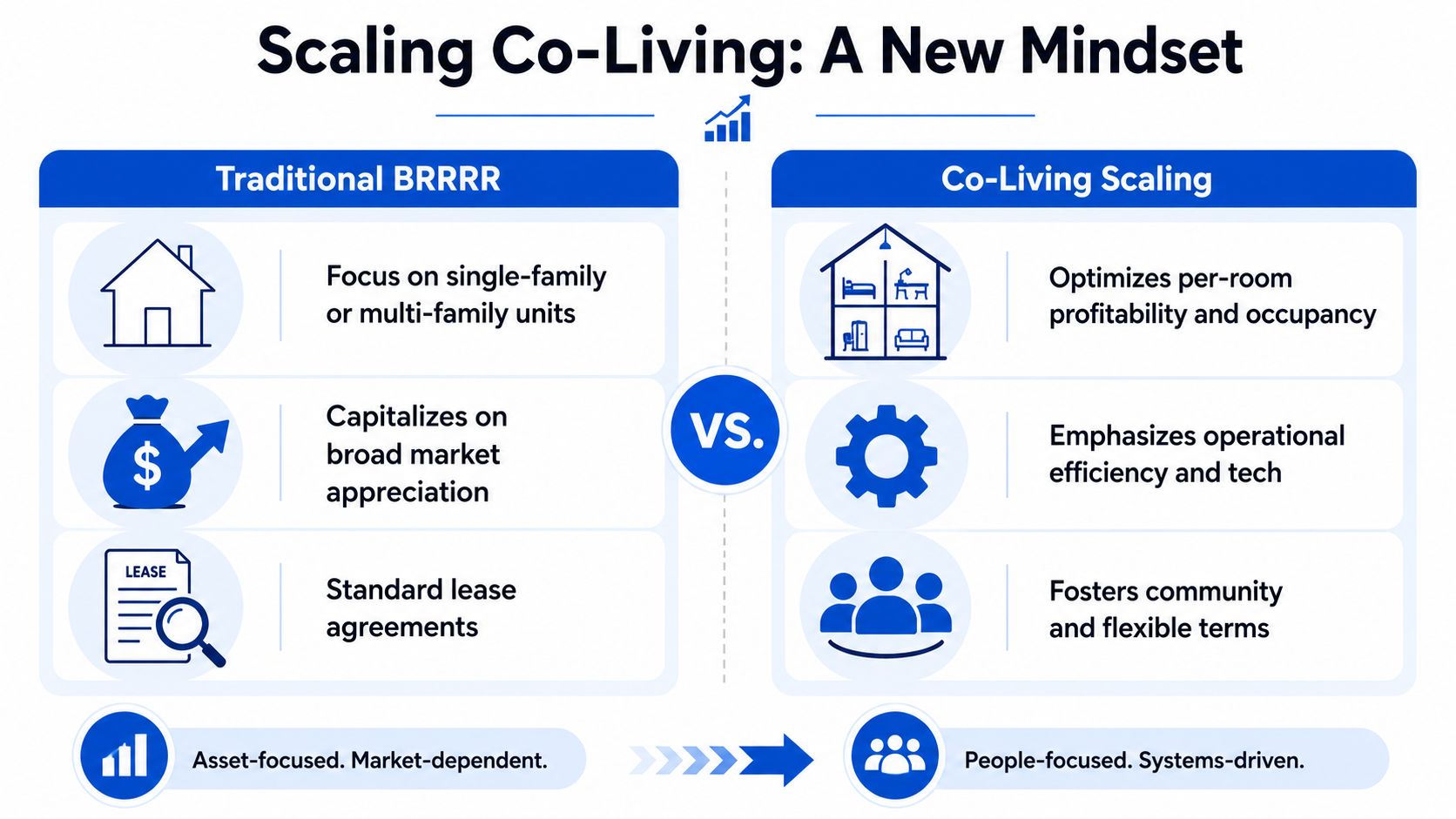
Beyond BRRRR The Mindset for Scaling Co-Living Rentals
Most scaling content still treats co-living like a variation of single-family investing. That misses the core issue. The income model is different, the vacancy pattern is different, and the operations are far more granular.
Data highlighted by Showdigs on scaling rental properties says co-living can generate 20–40% higher NOI per square foot, and that demand grew 18% in major U.S. markets in 2025, with room vacancies filling 2.3x faster than entire-home rentals when priced dynamically. Those numbers explain why so many operators are drawn to the model. They also explain why generic landlord advice leaves people unprepared.
Why room-by-room scaling feels harder
A traditional rental usually has one lease, one rent amount, and one turnover event. A co-living property has multiple income streams inside one house. That gives you more upside, but it also creates more moving parts.
A few examples show the difference:
- One vacancy doesn't empty the house: You're often solving for one room, not one property.
- Shared spaces affect retention: Kitchen cleanliness, bathroom scheduling, and noise complaints matter as much as rent.
- Pricing has to stay flexible: The front room with better light may lease differently than the smaller back room.
- Operations happen weekly, not just monthly: Leads, tours, room turns, inspections, and house messaging never really stop.
Co-living rewards operators who think in systems. It punishes operators who try to manage from memory.
The shift from landlord to operator
The operators who scale don't just buy more houses. They build a machine that can absorb more rooms without absorbing their life.
That shift starts early. The Rentrovio case study on landlord efficiency points to a major transition when moving from 2 to 20 properties, noting that this can happen in as little as 4 years if systems are built early and the mindset changes from landlord to business owner. It also argues that a property manager should be hired by 3 units rather than 5, and that operators need to track cash-on-cash return, occupancy rates, and maintenance ratios before adding more inventory.
In practice, co-living operators need that mindset even sooner. You're not just collecting rent. You're running leasing, hospitality, maintenance coordination, conflict management, and quality control at the same time.
What works and what doesn't
What works:
- Documented standards: Every room should have a known finish level, furnishing package, and move-in process.
- Centralized communication: One channel for maintenance, one for house notices, one for leasing.
- Portfolio thinking: Buy only after the current properties run cleanly.
What doesn't:
- Improvising every turn
- Pricing all rooms the same
- Waiting until you feel overwhelmed to add help
- Treating shared-space issues like minor annoyances
If you want to learn how to scale rental properties in co-living, stop asking how many houses you can personally handle. Ask how many rooms your systems can handle without quality slipping.
Finding and Funding Your Next Co-Living Property
The next house shouldn't just be available. It should fit your operating model. Beginners often underwrite co-living deals like standard rentals, then discover the layout fights them every day.
I care less about curb appeal than flow. Bedroom count matters. Bathroom access matters. Parking, transit, laundry placement, storage, and how residents move through common space matter. A house can look cheap on paper and still be expensive to operate if every turnover creates friction.

Underwrite by room, not just by house
The fastest mistake is using whole-home logic for a room-by-room business. In co-living, revenue depends on the leasing strength of each room and the friction of shared living.
When I review a property, I want clear answers to questions like:
- How many true bedrooms does it have: Not just legal count, but rooms a resident would choose.
- How do bathrooms distribute: A poor bedroom-to-bath setup creates recurring conflict.
- Can one room turn without disrupting the house: If the answer is no, your vacancy cost is higher than it looks.
- Does the location support room demand: Access to jobs, transit, and daily essentials usually matters more than school-district prestige in this model.
A practical way to narrow your search is to start with markets where room demand already makes sense. PadSplit-style hosts can review rental markets with strong operating potential and then filter for layouts that support smooth shared living.
Use BRRRR carefully in co-living
BRRRR still belongs in the conversation because it's one of the few proven ways to keep buying without depending only on fresh cash. The All Property Management breakdown of rental property investment strategy notes that BRRRR can recycle 80–100% of initial capital, but it also warns that 30–40% of scaling failures come from over-leveraging when reserves are thin and DSCR drops below 1.2x. The same source says a 6-month operating expense reserve prevents 65% of forced liquidations.
Those numbers matter even more in co-living because income can fluctuate room by room. Refinance proceeds are tempting. Using every dollar to chase the next acquisition is how operators end up with a larger portfolio and less breathing room.
Practical rule: Don't let a refinance create a growth story your reserves can't support.
What I look for before buying again
I don't add the next property until the current one proves it can run with limited intervention. The acquisition checklist is operational as much as financial.
A good buy usually passes these tests:
The layout supports separate room demand
Residents should feel like they're renting a real private space, not a carved-up leftover.The rehab provides a leasing advantage
Durable flooring, clean lighting, usable desks, and practical storage lease better than flashy finishes that break.The cash flow clears your floor
Greenmoov's roadmap for scaling from 1 to 10 rental properties recommends targeting at least $500 in monthly cash flow per unit, paired with validating returns through measures like a 5.18% cap rate, such as $20,700 in NOI on a $400,000 property.The pricing model is believable
Blueprint Title's overview of financing strategies notes that many investors use the 1% rule, charging monthly rent equal to 1% of the combined purchase and rehab cost during the rent phase. In co-living, I use that idea as a rough discipline check, then pressure-test each room individually.
Trade-offs beginners miss
The bigger house isn't always the better co-living deal. More bedrooms can mean more revenue, but they can also mean more conflict, more cleaning pressure, and more management load. Older houses may pencil well on acquisition, then drag once repairs and common-area wear show up.
Funding growth is about restraint as much as creativity. The best operators I know don't buy when they can. They buy when the house, the debt, and the management system all fit together.
Your Repeatable Unit Turn and Furnishing Playbook
A co-living operator can survive a bad acquisition longer than a bad turn process. Slow, messy room turns drain energy every week. They also leak revenue in ways that don't show up clearly until you're juggling multiple houses.
The hardest version of a turn is one empty room inside an occupied house. You're coordinating access, cleaning, patch work, photos, and a new move-in while the kitchen is still in use and the other residents are watching how you handle the house. That's where a playbook matters.
A real room-turn scenario
One resident moves out on a Tuesday. The room is mostly clean, but the wall behind the desk is scuffed, the mattress protector needs replacing, and the closet rod is loose. The rest of the house is occupied, and one bathroom is already scheduled for a vendor visit later that week.
If you treat that like a one-off project, you'll start texting vendors, searching purchase history, and debating furniture choices all over again. If you run a playbook, the process is boring in the best way.
My basic room-turn flow looks like this:
- Same-day inspection: Check walls, flooring, outlets, blinds, locks, smoke alarm, mattress, and closet hardware.
- Standard refresh decision: Decide whether the room gets a light clean, a paint touch-up, or a full refresh.
- Photo-ready reset: Make the bed, stage the desk, clear cables, and retake listing photos if the room changed.
- Re-list and pre-screen immediately: Don't wait for perfection if the room can be shown with a clear completion date.
Standardization removes bad decisions
The operators who burn out usually think customization is service. In reality, excessive variation creates waste. If every house has different paint, different lamp types, different desk sizes, and different lock procedures, every turn takes longer.
Use a brand standard for every room:
| Item | Standard choice | Why it helps |
|---|---|---|
| Paint | One wall color across the portfolio | Faster touch-ups and fewer mismatches |
| Flooring | One durable style by house type | Easier replacement and cleaner inventory |
| Bed setup | Same frame and mattress profile | Faster assembly and simpler ordering |
| Desk package | Same desk, chair, and lamp | Consistent photos and easier resident expectations |
| Soft goods | Same protector, curtains, and basic decor rules | Cleaner storage and quicker resets |
That standard should apply to hardware too. Lock model, smoke detector placement, Wi-Fi signage, house manual format, and move-in supplies should all repeat.
A room turn should feel like following a recipe, not solving a mystery.
Furnish for speed, not for Instagram
Beginners often over-furnish rooms because they're trying to make every listing stand out. That usually backfires. More pieces mean more assembly, more damage points, and more things to replace mid-turn.
A strong furnishing package is simple:
- Sleep well: Bed, mattress, protector, and a small bedside surface if space allows
- Work comfortably: Desk, chair, and task light
- Store basics: Dresser or closet system that fits the actual resident profile
- Light the room clearly: Bright, neutral lighting beats decorative fixtures
- Keep decor replaceable: Nothing that requires special ordering to maintain consistency
The hidden benefit of a turn playbook
A standardized turn process doesn't just fill vacancies faster. It changes how your team and vendors behave. Cleaners know the finish line. Handymen know the approved materials. Leasing knows when photos will be ready. Residents see that the house is actively managed.
That consistency lowers friction across the whole portfolio. In co-living, that matters as much as the room itself.
Mastering Dynamic Pricing and Tenant Acquisition
Static pricing is one of the fastest ways to stall a co-living portfolio. A room-by-room business needs room-by-room pricing logic. The corner room with extra privacy, the basement room with less natural light, and the room beside the laundry area should not all be priced as if they offer the same experience.
The Showdigs guide for small landlords makes two points that apply directly here. Operators should budget 5–10% of Gross Potential Rent for maintenance on newer properties and 20–25% on older ones, and using real-time data for dynamic pricing can minimize vacancy loss, with premium amenities supporting top-of-market rents while dated features call for pricing adjustments to improve leasing speed.
Price the room you have
Many operators get emotional. They remember what they want the house to earn, then force every room to support that target. Residents don't rent your spreadsheet. They rent a specific room.
A better approach is to price according to actual leasing strength:
- Premium rooms earn premium rent: Better light, private bath access, larger footprint, or quieter placement support stronger pricing.
- Average rooms should move predictably: These are the backbone of occupancy.
- Challenging rooms need help: If a room is dated or awkward, lower the rent or improve the offer. Don't let pride create vacancy.
If you're trying to sharpen this side of the business, a simple primer on dynamic pricing for rentals helps frame how demand, supply, and unit quality should shape rent decisions.
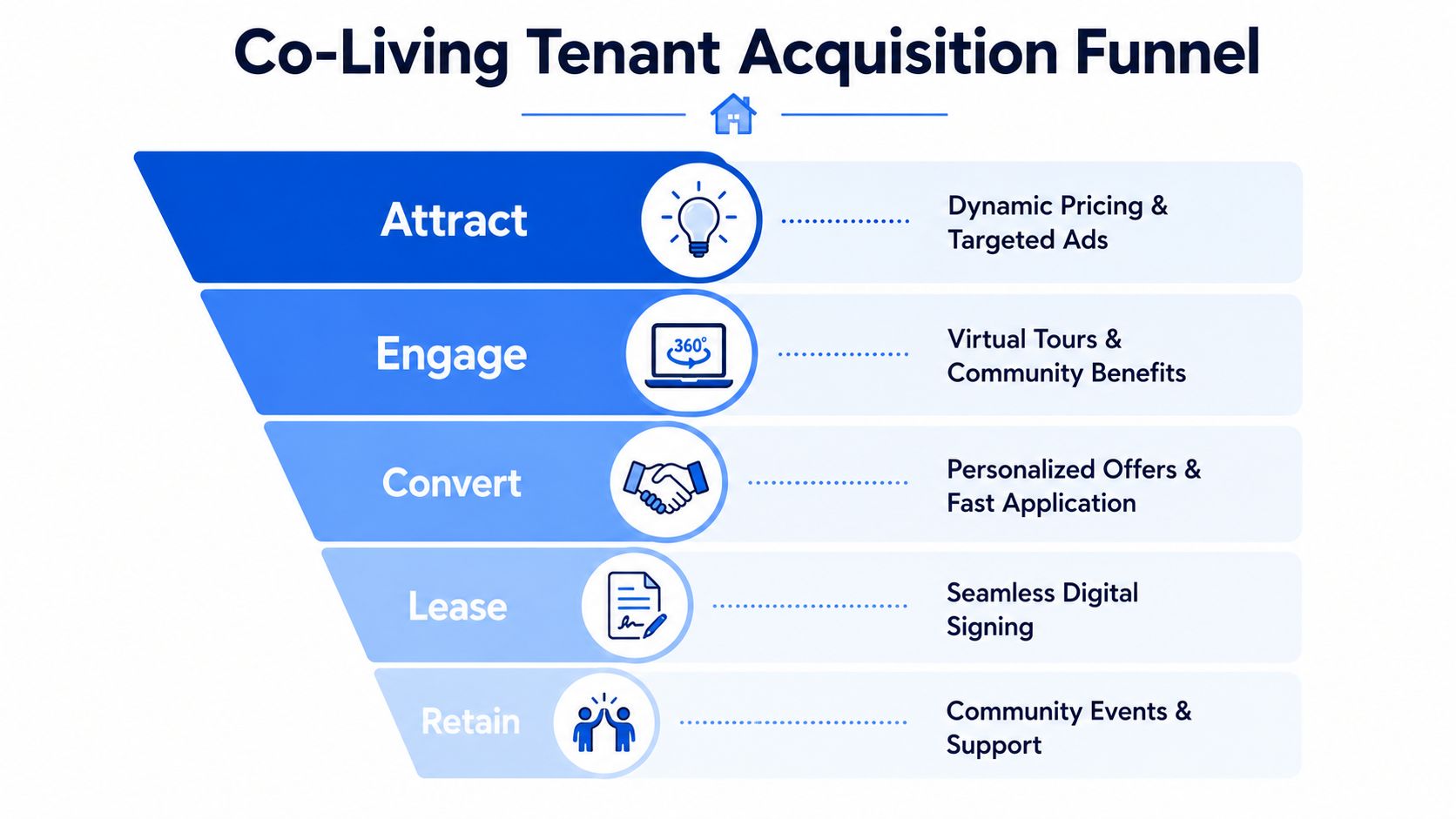
Build a leasing funnel, not a listing habit
A lot of beginners think tenant acquisition means posting a listing and answering messages. That's not a system. It's a reaction. Scalable leasing starts with a written pipeline that moves the lead from inquiry to move-in with as little delay as possible.
Here's the co-living version I like:
Inquiry comes in
Ask pre-screen questions early. Desired move-in date, income source, work schedule, and reason for moving matter.Qualified lead gets fast follow-up
Room renters compare options quickly. A slow response often loses the prospect before the tour.Tour or virtual walkthrough happens with context
Don't just show the room. Explain the house rules, shared-space expectations, and what kind of resident thrives there.Application moves immediately
Every extra hour between interest and application creates drop-off.Move-in prep starts before arrival
Lock access, house orientation, and utility expectations should be ready before day one.
The best leasing funnel doesn't just fill rooms. It filters out residents who aren't a fit for shared living.
Marketing a room is different from marketing a house
Your listing has to sell privacy and community at the same time. If you lean too hard on affordability, you attract people who only compare price. If you lean too hard on lifestyle, you can hide the practical details residents care about.
Strong room listings usually do three things well:
- Show the room clearly: Residents decide faster when photos are consistent and honest.
- Define the house experience: Clean kitchen, laundry access, quiet hours, and parking or transit details matter.
- Set expectations upfront: Shared bathroom, furnished setup, and application standards should be obvious.
The metrics that tell you leasing is healthy
At this stage, I care less about vanity metrics and more about flow. Are inquiries converting? Are tours showing up? Are applications coming from the right fit profile? Are certain room types sitting longer than others?
When those answers are tracked consistently, pricing gets smarter, listings improve, and the portfolio stops depending on guesswork.
Building Your Operational Engine with SOPs
Most operators don't need more motivation. They need fewer repeated decisions. If your leasing process lives in your head, your maintenance rules live in text threads, and your house standards depend on who showed up that week, scaling will feel chaotic no matter how good the deal is.
The Shuk Rentals guide on scaling from 4 to 40+ units is blunt about this. Operators need a written leasing pipeline and centralized maintenance intake, and failing to systematize before crossing the 10-unit threshold is a primary cause of burnout and cash flow degradation.
What a good SOP actually includes
A useful SOP isn't long. It's clear. Anyone following it should know the trigger, the sequence, the owner, and the finish line.
A simple SOP template should include:
| Process Area | Key Procedures to Document | Goal |
|---|---|---|
| Lead handling | Response timing, pre-screen questions, tour scheduling, application handoff | Faster leasing with consistent screening |
| Maintenance intake | Submission channel, urgency categories, vendor dispatch rules, resident updates | Less confusion and quicker repairs |
| Shared-space cleaning | Cleaning scope, frequency, inspection checklist, escalation for repeated issues | Cleaner houses and fewer resident complaints |
| Room inspections | Move-in photo set, mid-stay checks, move-out standards, damage reporting | Protect room quality and reduce disputes |
| Move-in communication | Welcome message, house rules, lock instructions, Wi-Fi details, contact paths | Smoother resident onboarding |
The first five SOPs to write
If you're early, don't try to document everything at once. Start with the processes that break most often and touch the most residents.
Leasing pipeline
Write down every step from inquiry to signed agreement. Include who responds, how quickly, what gets asked, and when an applicant is approved or declined. Co-living leasing gets messy fast when different people answer leads in different ways.
Maintenance triage
Every request should go through one intake path. Then classify it. Emergency, urgent, routine, cosmetic. Residents need to know where to report issues, and your team needs rules for what happens next.
Shared-house standards
This one is unique to co-living. Kitchens, bathrooms, trash, noise, and guest policies need repeatable procedures, not improvised warnings. A shared-space issue ignored today often becomes turnover next month.
Room-turn protocol
This SOP should mirror the playbook above. Inspection, supplies, photos, cleaning scope, repair scope, and relisting steps all belong in one place.
Resident communication rules
Document which messages go where. House-wide notices, payment reminders, maintenance updates, renewal outreach, and conflict resolution should not all happen through random personal texts.
Field note: If a task repeats twice in one month, it's a candidate for an SOP.
Why SOPs reduce burnout
People assume SOPs are about control. They're really about recovery time. When a cleaner calls out, a vendor misses an appointment, or two residents report the same issue differently, your team can reset faster if the process already exists.
That's the operational core of how to scale rental properties in co-living. You don't grow by getting better at remembering everything. You grow by making sure the business remembers for you.
Automating Growth with a Smart Tech Stack
At some point, manual management stops being disciplined and starts being expensive. In co-living, the volume of small tasks is what gets you. Inquiry follow-ups, room access, rent reminders, move-in instructions, maintenance routing, and renewal touchpoints don't look overwhelming one by one. Together, they consume the week.

The data behind automation is hard to ignore. Guestara's guide to scaling rental operations reports that 68% of co-living operators cite tenant churn as their top scaling barrier, but only 12% use automation. The same analysis says operators using AI-powered retention tools and smart locks cut average vacancy duration from 14 days to 4.2 days, preserving 9–14% of annual NOI.
Automation solves the exact problems co-living creates
Single-family landlords can sometimes get away with slower systems because there are fewer daily touchpoints. Co-living has more resident interactions and more time-sensitive moments.
The right stack helps in three areas first:
- Leasing communication: Automated replies can acknowledge inquiries immediately, answer common questions, and push qualified leads toward tours or applications.
- Access control: Smart locks remove key handoffs, reduce lockout friction, and make room turns easier to coordinate.
- Resident retention: Scheduled outreach, renewal timing, and move-out risk signals help you intervene before a room goes dark.
If you're comparing software categories, this overview of property management systems for growing operators is a useful starting point.
What to automate first
Don't automate everything at once. Start with the tasks that are repetitive, rule-based, and expensive to miss.
A strong order of operations looks like this:
Inquiry handling
Fast acknowledgment matters. Prospects usually contact multiple listings.Tour scheduling and reminders
This cuts no-shows and saves back-and-forth messaging.Move-in messaging
Residents need the same core instructions every time.Maintenance intake routing
Requests should land in one place and follow clear urgency rules.Renewal and retention touchpoints At renewal and retention touchpoints, many operators leave money on the table.
A quick demo makes this easier to picture:
The trade-off nobody mentions
Automation can create distance if you use it badly. Residents still need to feel that a real operator is responsible for the house. The solution isn't avoiding automation. It's automating the predictable parts and keeping human judgment for exceptions, complaints, and community issues.
That means:
- Use templates for common questions, but personalize approvals and denials.
- Use smart locks for access, but keep a documented backup process.
- Use scheduled resident messaging, but step in directly when house dynamics shift.
A smart stack should centralize, not scatter
The wrong setup gives you five separate apps and ten separate tabs. Then automation creates another management problem. The better setup ties pricing, messaging, access, and reporting together so you can see what's happening across rooms and houses without hunting for it.
That's when technology stops being a convenience and starts becoming operational infrastructure.
Monitoring KPIs for Scalable Portfolio Health
A beginner watches whether rent came in. A scaled operator watches whether the portfolio is healthy. Those aren't the same thing.
Once you move beyond one house, property-level anecdotes stop helping. One room leased fast. One resident complained. One cleaner did a great job. Those details matter, but they don't tell you whether the business is getting stronger or harder to carry.
Track the portfolio, not just the story
In co-living, I want a weekly operational view and a monthly portfolio view. The weekly view catches friction. The monthly view tells me whether the model is scaling.
The same Shuk Rentals framework referenced earlier notes that operators scaling from 4 to 40+ units should track five monthly KPIs: occupancy, average days vacant, maintenance spend per unit, rent collected by the 5th, and renewal rate. It also says that as portfolios grow, operators should pay more attention to total monthly net cash flow, portfolio-wide DSCR, and year-over-year equity growth than to isolated property stories.
That shift is critical in co-living because individual rooms can distract you. One room underperforming doesn't always mean the house is broken. But a pattern across the portfolio usually does.
The KPI dashboard I'd build first
Keep it simple enough to review regularly.
| KPI | What it tells you | Why it matters in co-living |
|---|---|---|
| Occupancy | How full the portfolio is | Small gaps across many rooms add up fast |
| Average days vacant | How quickly rooms re-lease | Measures turn speed and pricing accuracy |
| Maintenance spend per unit | Ongoing operating pressure | Helps spot houses that drain time and cash |
| Rent collected by the 5th | Payment discipline | Early warning for resident instability |
| Renewal rate | Resident retention quality | Lower churn reduces turn workload |
| Total monthly net cash flow | Actual portfolio output | Shows whether growth is improving income |
| Portfolio-wide DSCR | Debt safety at scale | Protects against overextension |
| Year-over-year equity growth | Long-term balance sheet progress | Keeps short-term hustle tied to wealth creation |
What these numbers mean in real life
If occupancy is solid but average days vacant keep rising, pricing or turn quality may be slipping. If maintenance spend per unit jumps in one cluster of houses, the issue may be asset age, poor rehab choices, or weak vendor control. If renewal rate is low, don't just blame the market. Look at house standards, communication, and roommate fit.
Healthy portfolios don't depend on heroic effort. They depend on repeatable performance.
The owner mindset that actually scales
This is the part many resist. You have to stop thinking of yourself as the person who fixes every issue personally. The business needs to produce consistent outcomes even when you're not in the middle of every message, every lockout, and every room turn.
That's what people really mean when they talk about how to scale rental properties. In co-living, scaling isn't just adding doors. It's building a portfolio that can handle churn, maintenance, pricing shifts, and resident needs without dragging you into constant firefighting.
A strong co-living business looks ordinary from the inside. Leads move through a pipeline. Rooms turn the same way. Pricing adjusts without drama. Maintenance follows triage. Residents know how the house works. You review the dashboard, spot problems early, and make decisions before chaos spreads.
That's the roadmap. Systems first. Properties second.
PadSplit hosts and co-living operators who want a simpler way to manage pricing, messaging, smart-lock access, and portfolio reporting can join the interest list for PadPulse. It's being built for room-by-room operations, with limited beta access and updates available ahead of launch.