How to Handle Complaints: A Step-by-Step Playbook
August 4, 2026
It's 9 PM on a Tuesday, and your phone lights up with a message from one resident about another resident's music, then a second text about trash in the kitchen, and then a third note about someone leaving the bathroom in a mess again. In co-living, that's not a bad night, it's a normal one. The operators who handle it well don't rely on good intentions, they run a complaint process that turns friction into action.
That matters because shared housing creates a complaint profile that generic customer service playbooks don't cover. Thin walls, shared kitchens, shared bathrooms, and people who barely know each other mean small issues can become house-wide tension fast. A complaint isn't just a message to answer, it's a signal that something in the property needs attention, and the way you log, route, and close that signal determines whether the same issue comes back tomorrow.
What Complaint Handling Really Looks Like in Co-Living
A co-living complaint usually starts small. One resident texts that the music next door is too loud, another says the sink is full again, and someone else asks why a roommate keeps coming into their space without knocking. None of those are “customer service” in the retail sense, they're house operations, and they sit right at the point where comfort, boundaries, and trust meet.
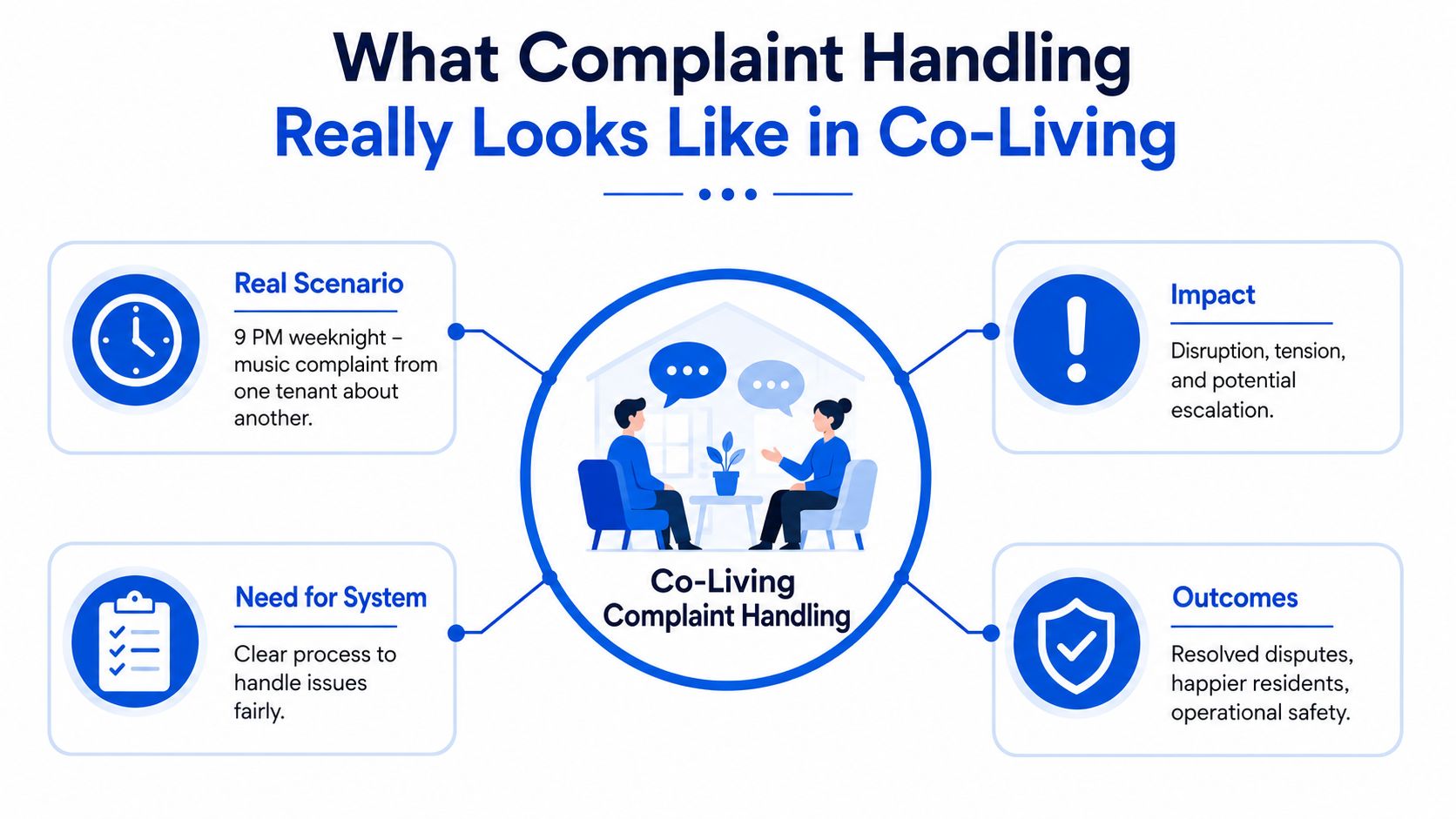
Reactive handling versus system handling
Reactive handling is what many small operators start with. A tenant complains, you reply when you can, you tell someone to turn the music down, and you hope the issue disappears. System handling works differently, it uses structured fields, a unique identifier, and a clear path from intake to closure so you can see whether the same room, the same appliance, or the same person keeps creating friction.
Public-sector complaint standards make the same point in a more formal way. The UK Ombudsman says complaint programs should track the number of complaints received, the number found to involve something going wrong, the number referred onward, average resolution time, and the percentage completed within the promised timescale, then review that data at least quarterly to identify themes and systemic issues (UK Ombudsman complaint learning guidance). The Australian Ombudsman guide also recommends public reporting of total complaints, benchmark performance, high-level trends, and the top complaint issues, causes, and outcomes (Australian Ombudsman complaint handling guide).
Practical rule: if you can't tell whether a complaint is about noise, cleanliness, or a recurring roommate pattern, you don't have a complaint system yet, you have an inbox.
In co-living, the three complaint categories that show up constantly are noise, cleanliness, and interpersonal conflict. Noise is usually the first to escalate because everyone can hear it. Cleanliness builds resentment slowly until someone snaps. Interpersonal conflict is the hardest, because once residents start feeling disrespected, the problem stops being about the original event and starts being about personal boundaries.
A Reliable Eight-Step Complaint Workflow
A complaint from a resident sharing walls, kitchens, and bathrooms can turn messy fast. One person hears noise, another sees a dirty benchtop, and a third is already frustrated about a broken boundary from last week. The workflow has to handle that reality without turning every issue into a debate.
The NSW Ombudsman's workflow works because it starts with intake, moves through triage, then resolution, and finishes with analysis, while keeping every complaint traceable from start to finish (NSW Ombudsman effective complaint management guide). That is the difference between a house rule and a management system, and it is also what keeps shared-house issues from being handled differently depending on who is on shift.
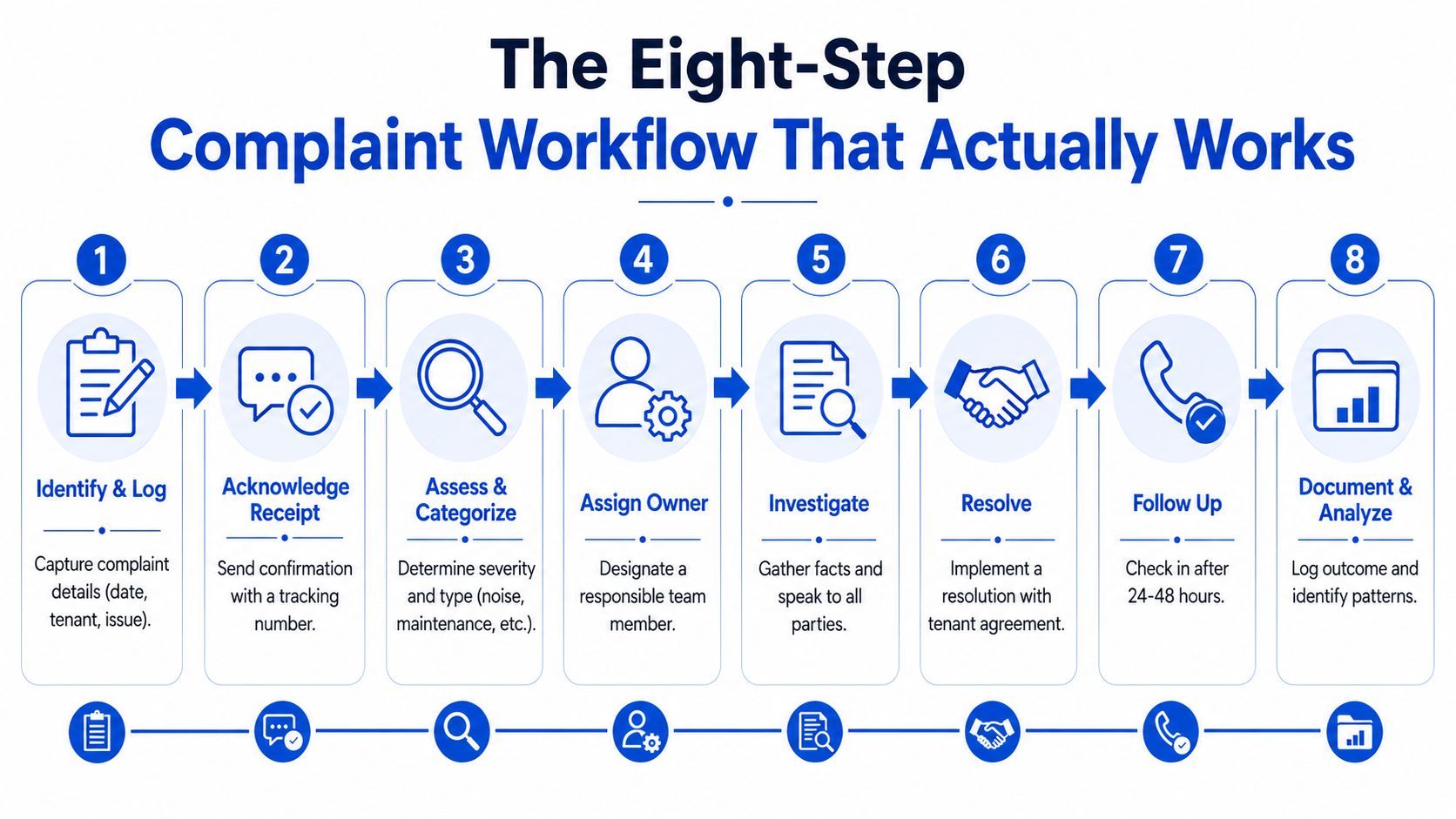
A useful workflow has eight steps:
- Identify and log the complaint. Capture the issue, who's involved, when it happened, and the house location.
- Acknowledge receipt. Send a confirmation with a tracking number or case reference.
- Assess and categorize. Decide whether it's noise, cleanliness, maintenance, boundary conflict, or something urgent.
- Assign an owner. One person owns the next move, even if others help.
- Investigate. Ask clarifying questions, review messages, and check the house record.
- Resolve early or continue the investigation. Some issues can be fixed immediately, others need more work.
- Communicate the outcome. Say what was done, what was found, and what happens next.
- Document and analyze. Close the file only after the record is complete enough to spot patterns later.
A fast reply changes how a resident experiences the problem. A text within the first 15 minutes can calm someone down even if the fix takes longer, because they know the issue has been seen and assigned. Silence for a few days does the opposite, especially in co-living where people are already sensitive to noise, cleanliness, and personal space.
The goal is to show that the issue is owned and moving, even if the answer isn't ready yet.
The common failure points are predictable. Vague intake leaves you guessing, skipped triage sends the wrong person to the wrong issue, and poor documentation makes repeat problems hard to prove. If a resident says the same upstairs neighbor has been loud for three weekends in a row, the file should show that pattern without making anyone dig through scattered texts or old notes.
If you want a model for the wording side of this process, the PadPulse guide on responding to tenant inquiries is useful for keeping tone steady while still sounding human.
Response Templates You Can Copy and Customize
Most operators lose time writing from scratch when they should be responding consistently. A strong complaint reply follows the same sequence every time, listen, acknowledge, apologize, solution, thank them, but the wording should fit the channel and the situation. A text to a resident about late-night noise should sound human, not corporate.
For a noise complaint, try this:
Hi [Name], thanks for flagging this. I'm sorry you were kept up, I'm checking it now and I'll follow up with the next step shortly. If there's anything else you noticed, send it over so I can work from the full picture.
For a shared-space cleanliness complaint:
Hi [Name], I hear you. The kitchen condition isn't acceptable, and I'm looking into who used the space most recently so I can address it directly. I'll update you once I've taken the next step.
For HVAC or thermostat disputes, keep the tone calm and specific:
- Acknowledge the comfort issue: “I know the temperature in the house affects everyone's day.”
- Avoid overpromising: Don't say it'll be fixed tonight unless you've confirmed that.
- Set the next checkpoint: “I'll verify the settings and tell you what I can change.”
For maintenance delays:
Thanks for the nudge. I'm sorry this is still open, and I'm checking the status now so I can tell you exactly where it stands. If the repair needs a contractor, I'll send the next update as soon as I have a confirmed time.
For roommate conflict, don't take sides too fast:
I hear that this has become personal, and I'm going to handle it carefully. I'll review the reports I have, then I'll come back with the next step so we can address the behavior without making the situation worse.
The sentence that should almost always appear in your acknowledgment is the one that sets expectations clearly, such as, “I'm checking this now and I'll update you by [time or next business window].” That one line reduces back-and-forth because residents know when to expect movement. For broader phrasing support, see practical tenant inquiry response guidance.
Triage and Escalation Paths That Save You Time
Not every complaint needs the same response speed or authority level. A showerhead that needs replacing and a resident reporting a safety threat are both complaints, but they don't belong in the same queue. Good triage sorts them quickly so you don't waste time over-managing the easy ones or under-reacting to the serious ones.
| Severity | Examples | Response Time | Owner | Authority Limit |
|---|---|---|---|---|
| Low | House rule clarification, minor cleanliness issue, broken showerhead | Same day | On-duty operator | Can resolve directly |
| Medium | Recurring noise, repeated shared-space disputes, suspected lease violation | Same day or next business window | Property manager | Can investigate and propose remedy |
| High | Safety threat, aggressive behavior, property damage, legal exposure | Immediate | Senior operator or escalation lead | Must escalate and document |
Quick-fix complaints should stay with the first responder. If a resident just needs a rule clarified, the operator can answer it without routing the message through three people. Standard investigations need context and follow-up, especially when one resident keeps reporting the same loud roommate. Emergency cases need immediate escalation, and they should never wait in a regular queue.
The biggest routing mistake is mixing internal escalation with external escalation. Forwarding a complaint to your property manager is not the same thing as calling law enforcement, contacting counsel, or notifying insurance.
In practice, authority limits should be written down before you need them. A frontline team member might be allowed to approve a house rule reminder or dispatch a contractor, but not issue open-ended refunds or admit liability. If your team uses a complaints workflow inside an operations platform, PadPulse is one option that can route inbound messages into defined workflows and help keep the ownership chain clear, which matters when the complaint is moving fast.
Documentation Practices That Protect You Legally
A complaint file only protects you later if it can stand up under review. The Queensland Ombudsman says complaint records should clearly capture time and date, place, the individuals or groups involved, and the number of incidents or duration if the problem keeps repeating (Queensland Ombudsman complaint-management guidance). If you cannot show what happened, when it happened, and who was affected, the file is weak no matter how confident the conversation felt at the time.
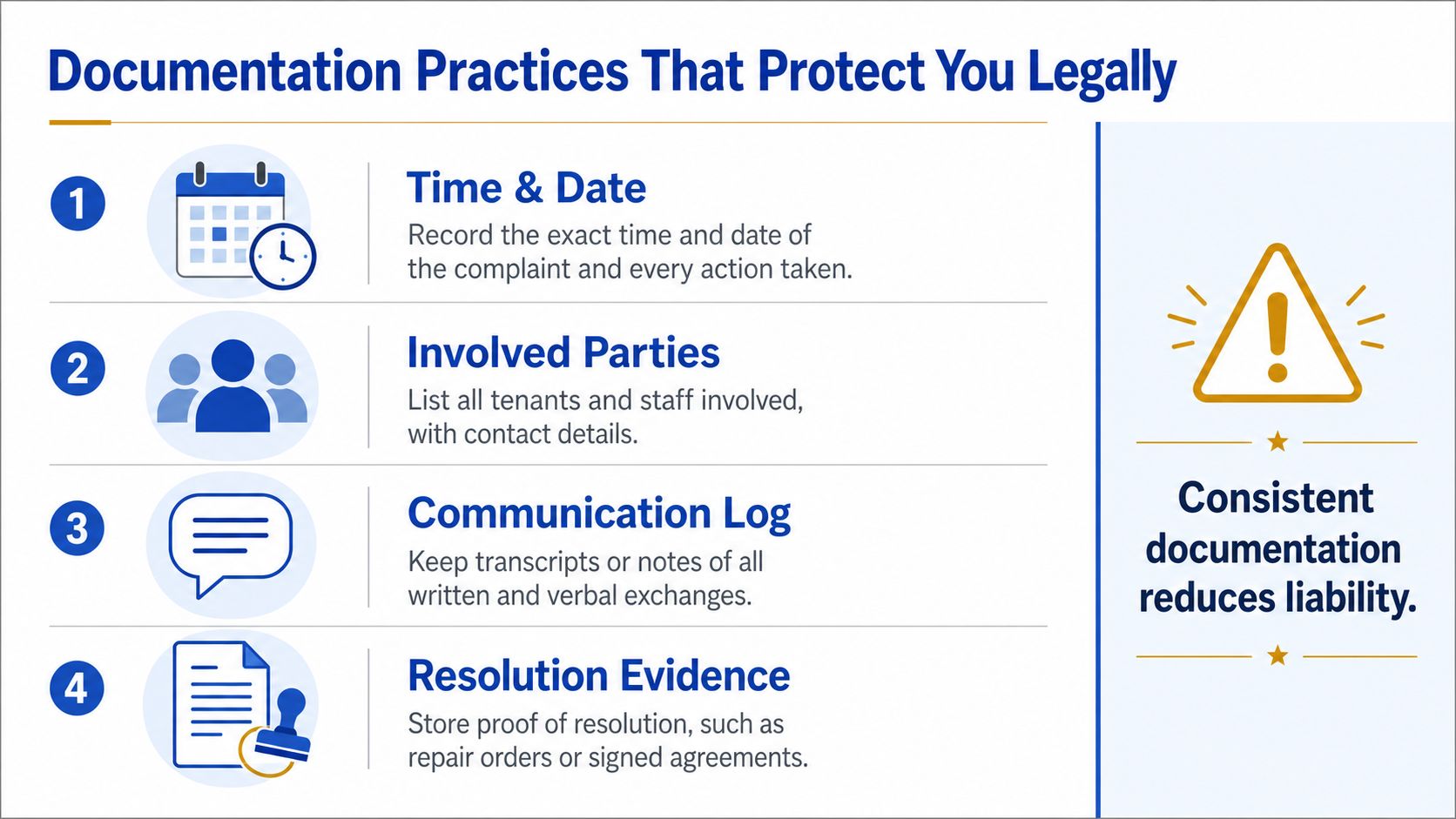
What a complete file should contain
A complete complaint file usually includes the intake message, your acknowledgment, investigation notes, photos, witness details, the resolution message, and confirmation that the matter is closed. The Community Tool Box guidance also points to supporting proof such as documents, first-hand testimony, witness details, and documented conversations, which turns a basic note into evidence if the dispute escalates (Community Tool Box complaint documentation guidance).
A good case note does not need to be long, it needs to be searchable. Use the same labels every time for issue type, property, date, outcome, and follow-up needed. Keep the language factual, not emotional, because the file should show what happened, not how irritated everyone felt.
Practical rule: write each record as if someone outside your team may read it later, because they often do.
Retention should match your own risk profile, legal advice, and software setup, then stay consistent across the portfolio. Privacy matters too, so record enough to support the action without stuffing unnecessary personal details into every note. The best complaint records are short, specific, and easy to find when another resident raises the same issue six months later.
See also how photo documentation fits into property operations.
Handling Hard Cases Without Burning Out
The complaints that drain operators aren't always the loud ones. They're the resident who's partly wrong but still furious, the roommate conflict that's turned personal, the caller who won't stop repeating the same accusation, and the one who starts crossing into abuse. Good complaint handling includes boundaries, because endless back-and-forth is not resolution.
A useful test is whether the conversation is still productive. If the resident keeps restating the same demand after you've acknowledged it, explained the next step, and set a clear timeline, you may already be in a loop. If the issue is no longer about the original complaint and has become a fight over tone, fairness, or attention, the next move should be a final response, not another round of negotiation.
The clearest boundary-setting language is plain:
I want to help, but I can't continue this conversation if it stays abusive. If you want to keep going, I need us to keep it respectful.
That approach matters because staff safety is part of operations, not a side issue. The complaint guide from the Enterprise Owners' network notes that if a customer is verbally abusive or threatening, you should politely state that the behavior isn't justified and end the call if it continues (EO Network complaint handling guidance). In housing, that same idea applies when a resident turns a complaint into harassment toward your team.
If you have to end the exchange, end it cleanly. Send one written summary, note the behavior boundary, and document what will happen next, or that no further conversation will happen until the resident communicates appropriately. For true threats, follow your safety protocol immediately and involve the right authorities or legal support without debating the complaint itself.
Turning Complaint Data Into Prevention and Better Operations
The value of complaint handling shows up after the ticket is closed. If you review complaints quarterly, you'll start seeing which houses have repeat noise issues, which units trigger the most maintenance confusion, and which house rules keep getting misunderstood. That's operational intelligence, not just customer service.
The metrics that matter are the ones tied to repeat problems and response discipline. Look at repeat-issue rate, time to resolution, complaint volume by occupied room, and root-cause category, then use them to decide where to fix the property or rewrite the process. If you want a broader operations lens, PadPulse's operational metrics guidance is a useful reference point for thinking about complaints as part of portfolio performance.
What complaint trends can tell you
- Repeat noise in one house: That can point to layout, flooring, or house rule enforcement.
- Recurring cleanliness complaints: That usually means the standard is unclear or nobody owns the shared space.
- Multiple comments about the same thermostat: That's often a process issue, not a people issue.
- Repeated confusion about the same rule: Your onboarding or resident guide needs work.
Complaint data should also sit alongside retention, vacancy, and the day-to-day cost of fixing avoidable problems. The point isn't to chase vanity numbers, it's to prevent the same issue from eating time every week. If one property keeps generating complaints over the same condition, you're better off solving the source than running the same response script forever.
Automation can help here too. Messaging workflows can route a complaint to the right owner, smart-lock logs can confirm access patterns, and thermostat integrations can reduce the number of comfort disputes before they reach your phone. The future-looking version of complaint handling isn't just faster replies, it's fewer preventable complaints in the first place.
If you're building a real complaint workflow for co-living, PadPulse is designed to help with resident messaging, rule-based automation, and operational visibility in one place. Visit PadPulse to see how a complaints process can connect to the rest of your room-by-room rental operations, from intake to follow-up to portfolio-level learning.