Short Term Rental: A Complete Guide for Investors
July 1, 2026
You bought a property, cleaned it out, and now you're standing in an empty living room doing the same math every investor does. Should you furnish it and chase nightly bookings. Should you place a long-term tenant and keep life simple. Or should you split the house into a room-by-room setup and aim for steadier cash flow?
That decision shapes almost everything that follows. It affects how often your phone rings, how much staffing you need, how exposed you are to seasonality, and how quickly small operational mistakes turn into expensive ones.
A short term rental can absolutely outperform a standard lease in the right market. I've seen it work best when the property has a strong reason for guests to choose it and when the operator treats it like hospitality, not passive income. I've also seen investors cling to the STR model long after the numbers stopped justifying the stress. That's usually the point where co-living starts to look a lot smarter.
What Is a Short Term Rental and Is It Right for You
A short term rental is a furnished property rented for brief stays, often to travelers, remote workers, families, or business guests. In practice, that usually means guests book for days or weeks instead of signing a standard annual lease.
The appeal is obvious. A vacant house can become a branded hospitality product instead of a plain rental. You add furniture, stock the kitchen, set up smart entry, write a strong listing, and try to turn one property into higher revenue than a conventional lease would produce.
The three paths most owners consider
Most new investors look at only two choices.
| Model | How it works | What owners usually want |
|---|---|---|
| Short term rental | Entire home or unit rented for short stays | Higher upside and flexibility |
| Long-term rental | One tenant signs a lease for an extended period | Simplicity and predictability |
| Co-living | Individual rooms rented with shared common areas | Stable income with better room-level yield |
The third option matters more than many people realize. Co-living, or room-by-room rental, sits in a useful middle ground. It doesn't give you the same peak-night upside as a great STR weekend, but it often removes the constant churn that burns operators out.
A beginner often starts with the wrong question. They ask, "Which model makes the most money?" The better question is, "Which model still works after the extra labor, vacancy risk, cleaning coordination, repairs, and compliance headaches are accounted for?"
Practical rule: If the property only works as an STR when everything goes right, it probably isn't a strong STR buy.
When an STR makes sense
A short term rental is usually a better fit when the property has one or more of these traits:
- Strong travel demand: Guests already come to the area for work, events, hospitals, universities, outdoor recreation, or tourism.
- Clear guest appeal: The home has something memorable, such as a view, walkable location, pool, hot tub, design appeal, or large-group layout.
- Hands-on ownership: You're willing to manage a hospitality operation or build systems for cleaners, messaging, maintenance, and pricing.
- Regulatory clarity: Local rules allow the use and you understand the tax and permitting requirements.
If you're still figuring out what kind of owner you are, this guide to different types of real estate investors is a useful reality check. Strategy should fit your operating style, not just your spreadsheet.
Understanding the STR Market Landscape
The short term rental market is broad, crowded, and fast-moving. Two listings in the same zip code can perform very differently because they attract different guests, face different competition, and promise different experiences.

Who actually books short term rentals
Not every guest shops the same way.
A family booking a weekend getaway cares about sleeping arrangements, parking, kitchen function, safety, and whether the place feels easy. A business traveler wants reliable Wi-Fi, clean design, quiet sleep, and a smooth check-in. A digital nomad may care more about workspace, laundry, and staying longer without feeling boxed into a hotel-like setup.
That matters because operators often overbuild the wrong features. They spend money on flashy decor but ignore practical friction points such as blackout curtains, mattress quality, water pressure, or simple instructions for parking and entry. Guests notice utility before they praise style.
Why high nightly rates can fool investors
A lot of beginners see a strong nightly rate and assume the property will outperform a long-term lease. That shortcut causes bad acquisitions.
Annual profit depends on more than rate. It depends on occupancy consistency, cleaning turns, platform fees, supply purchases, repair frequency, guest messaging load, and whether you need paid help to keep the place running. A listing can look impressive on a revenue snapshot and still disappoint once all the moving parts are included.
A short term rental isn't a lease business with shorter dates. It's a hospitality business built on real estate.
Competition has changed the game
Platforms like Airbnb and Vrbo made access easier for hosts and guests. They also made the marketplace tougher. Guests compare dozens of options in minutes, and they judge every listing against the best experiences they've had elsewhere.
That shift punishes average properties. A generic house in an average area often ends up competing on price. Unique homes, well-located units, and expertly operated listings stand out more easily.
Before buying in a new city, I like to study comparable listings the way a hotel operator would. I look for who the guest is, why they would book this neighborhood, and what would make them choose one listing over another. Broad market guides can help narrow that search, and this roundup of the best rental markets in the USA is a practical starting point.
Market forces that matter most
- Seasonality: Some markets boom for part of the year and cool off hard outside peak demand.
- Supply pressure: New STR inventory can dilute results for average listings quickly.
- Guest expectations: Cleanliness, fast responses, and easy entry aren't perks anymore. They're baseline.
- Review momentum: Strong reviews help conversion. Weak reviews drag down future bookings.
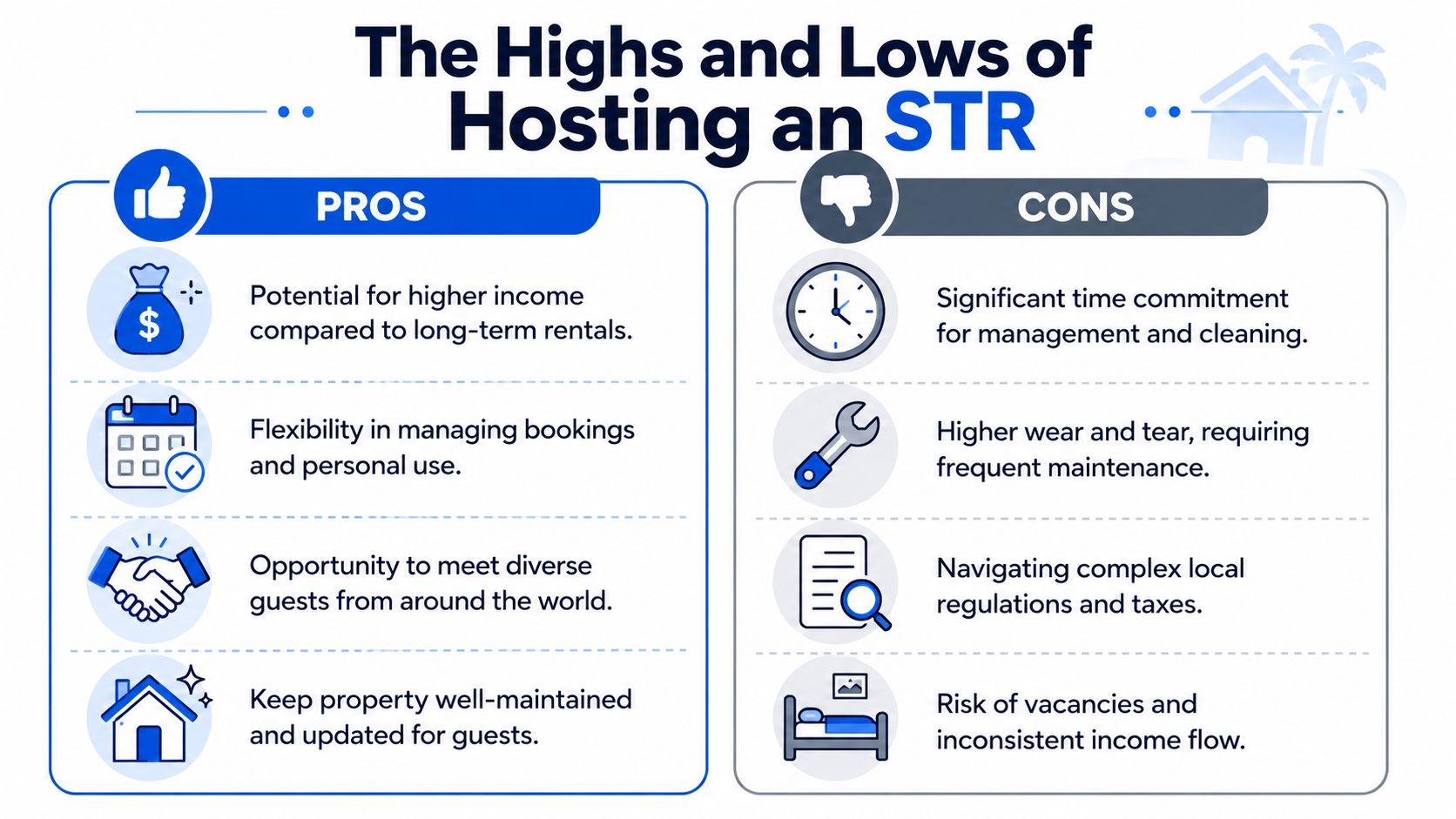
The Highs and Lows of Hosting an STR
The biggest mistake new hosts make is treating upside as guaranteed and hassle as occasional. In reality, the upside is conditional and the hassle is built into the model.
Early in an STR's life, the business feels exciting. You launch a listing, bookings come in, guests leave good reviews, and the nightly revenue looks better than a standard lease. That's the high.
The low arrives when those bookings have to be supported every single week.
What works in your favor
There are good reasons investors stay in the short term rental business.
- Revenue upside: A well-positioned property can produce more gross income than a conventional lease.
- Calendar flexibility: Owners can block dates for personal use, renovations, or market repositioning.
- Faster feedback loops: Frequent guest turns force regular inspections and make it easier to catch maintenance issues early.
- Brand potential: A standout listing can become a repeat-stay property instead of a commodity rental.
I've found that the best STR assets usually have a clear identity. They aren't just furnished houses. They're the place guests remember, recommend, and rebook.
Where operators get worn down
Now the trade-offs.
| Potential upside | Operational cost attached to it |
|---|---|
| Higher nightly revenue | More vacancies between stays |
| More control over calendar | Constant repricing and forecasting |
| Frequent property checks | Frequent cleaning and restocking |
| Hospitality experience | Guest messaging at all hours |
The busiest work often comes from issues that don't look serious on paper. A late check-in call. A cleaner who found damage. A guest who can't operate the lock. Missing towels. A neighbor complaint. An internet outage that becomes an urgent problem because the guest works remotely.
Those aren't rare exceptions. That's the operating environment.
Operator note: If you hate interruptions, you probably won't enjoy managing a short term rental yourself.
A lot of STR owners eventually realize they didn't buy passive income. They bought a customer service business attached to a house.
The financial reality most spreadsheets miss
Management costs change the picture fast. The break-even point often arrives sooner than expected once you layer in outsourced cleaning coordination, messaging support, maintenance response, and property management fees.
Many average STRs start to wobble. This does not apply to standout cabins, destination properties, or homes with a clear guest magnet. It concerns the ordinary houses. These only look great when self-managed by an owner who absorbs all the labor personally.
A helpful reality check on that operator mindset appears in BiggerPockets' opinion piece, Short-Term Rentals Have a Murky Outlook, But They're Still the Biggest Opportunity For Cash Flow When Done Right. The core takeaway is one I agree with. STRs can work, but only when the owner treats them like a real operating business.
A practical walkthrough on the hospitality side helps too:
Core Operations for a Successful Short Term Rental
Most struggling STRs don't fail because the furniture looked bad or the logo was weak. They fail because the operator loses control of three core systems: pricing, communication, and access.
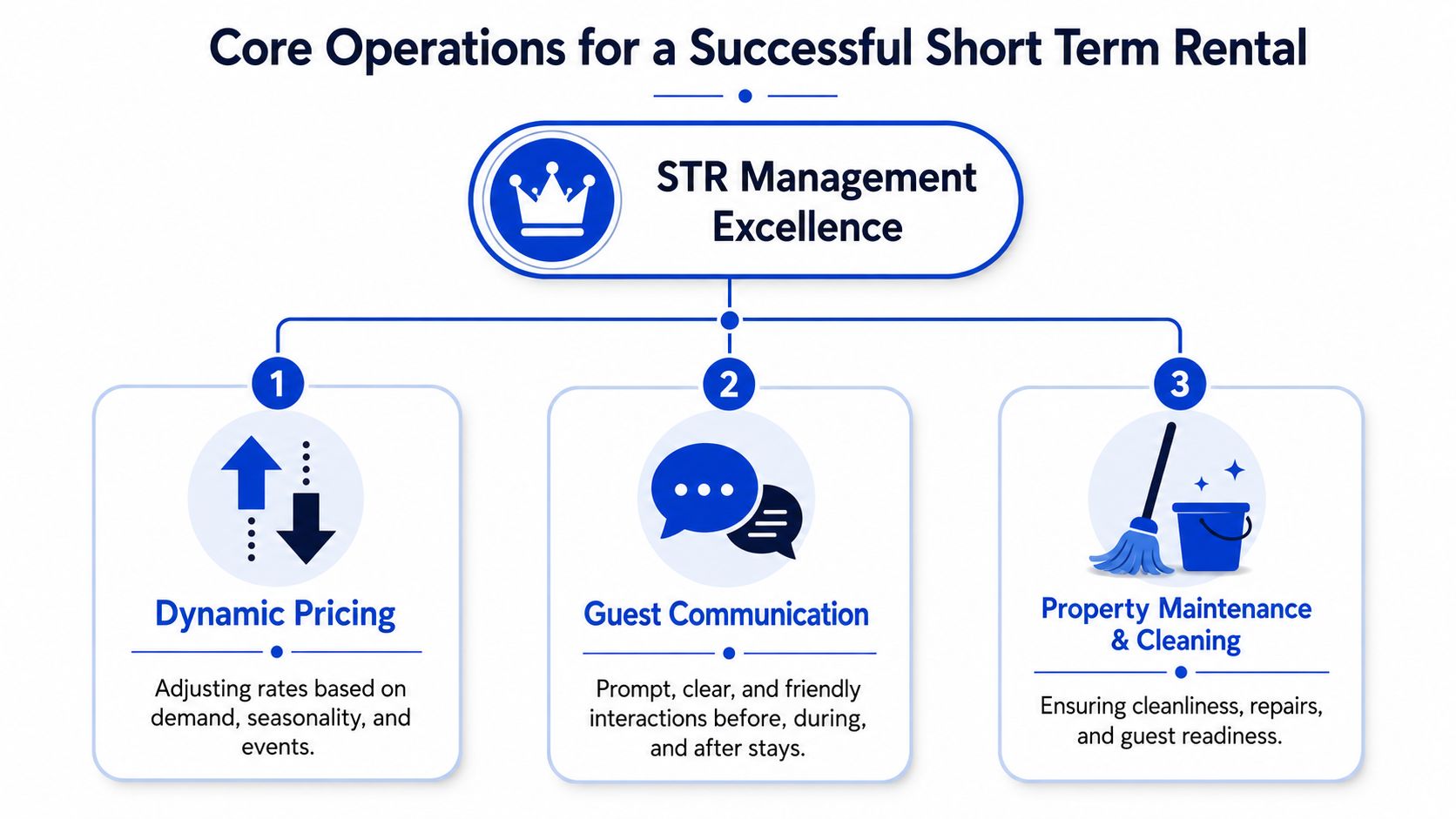
Dynamic pricing is not optional
Static pricing leaves money on the table during busy periods and kills conversions during softer demand.
Good pricing responds to local events, day-of-week patterns, seasonality, booking window shifts, competitor inventory, and stay length. That doesn't mean you chase every market move. It means you review the market often enough to avoid stale pricing.
I prefer a simple pricing workflow:
- Set a floor: Know the lowest rate that still makes operational sense.
- Set premium dates intentionally: Holidays, event weekends, and high-demand stretches need manual review.
- Watch booking pace: If dates are filling too early, rates may be too low. If good dates sit empty, rates may be too ambitious.
- Use tools, but check them: Automation helps, but blind trust creates pricing mistakes.
If you're comparing software options, this review of short-term rental pricing tools gives a practical overview of what to look for.
Guest communication wins bookings and reviews
Many operators underweight communication because it doesn't feel like revenue work. It is.
Fast, clear responses help convert inquiries before guests book elsewhere. Clean pre-arrival instructions reduce check-in problems. Calm mid-stay support keeps minor issues from turning into bad reviews. Post-stay follow-up helps you learn where friction still exists.
A strong messaging setup usually includes:
- Pre-booking replies: Answer questions quickly and set expectations clearly.
- Arrival instructions: Send simple, skimmable directions with parking, entry, Wi-Fi, and house rules.
- Mid-stay support: Have a plan for maintenance, lockouts, noise concerns, and supply issues.
- Review requests: Ask for feedback in a way that feels professional, not needy.
Access control saves time and prevents chaos
Physical keys create avoidable problems. Lockboxes are better, but still clunky. Smart locks are where most serious operators land because they simplify turnover and reduce the odds of a guest access issue spiraling into a late-night emergency.
What matters isn't just the device. It's the process around it.
- Code timing: Set codes to activate close to check-in and expire after checkout.
- Cleaner access: Make sure vendors can enter without using guest credentials.
- Backup plan: Keep a manual entry option for internet outages or hardware failure.
- Guest instructions: Write them for someone who has never used a smart lock before.
Clean operations beat clever marketing. A decent property with smooth systems often outperforms a better-looking property with sloppy execution.
Navigating Short Term Rental Regulations and Taxes
Compliance is where many new STR owners get blindsided. They focus on furnishing, photos, and pricing, then discover local law is the gatekeeper.
The rules usually fall into three buckets
The first bucket is zoning. Some municipalities allow short term rentals broadly. Others restrict them by neighborhood, building type, or occupancy setup. An area can look attractive on a map and still be a poor STR target if zoning rules are hostile or unclear.
The second bucket is licensing and permits. Cities and counties may require registration, business licenses, inspections, local contacts, or renewals. Some places are light-touch. Others expect active compliance and enforce aggressively.
The third bucket is taxes. Owners typically need to think about income tax on earnings and lodging-related taxes charged to guests. These are separate issues, and confusing them causes filing mistakes.
What local due diligence should look like
Before you buy or convert a property, verify these points directly with the city, county, or a qualified local professional:
- Use permissions: Is short term rental use allowed for that address and property type?
- Permit requirements: Do you need a license, registration, inspection, or local representative?
- Operational restrictions: Are there rules on occupancy, parking, noise, signage, or minimum stay length?
- Tax collection: Which taxes are marketplace-collected and which still remain your responsibility?
One state-level example shows how layered this can get. In Florida, Avalara's overview of Florida short-term rental rules notes that rentals for six months or less fall under transient rental accommodations rules, that vacation rentals must generally be licensed through the DBPR, and that hosts may also have separate local tax and registration obligations depending on where the property sits.
That last point matters. Even when Airbnb or Vrbo collects some taxes, they may not collect every local obligation tied to your listing.
Common mistakes that create expensive problems
I see the same errors repeatedly:
- Assuming platform collection covers everything: It might not.
- Buying before checking zoning: This can trap an investor in the wrong exit strategy.
- Ignoring neighborhood enforcement risk: Active enforcement changes the risk profile even when rules appear manageable.
- Treating tax setup as an afterthought: Filing confusion compounds quickly.
If you can't explain your local STR rules in plain English before launch, you aren't ready to launch.
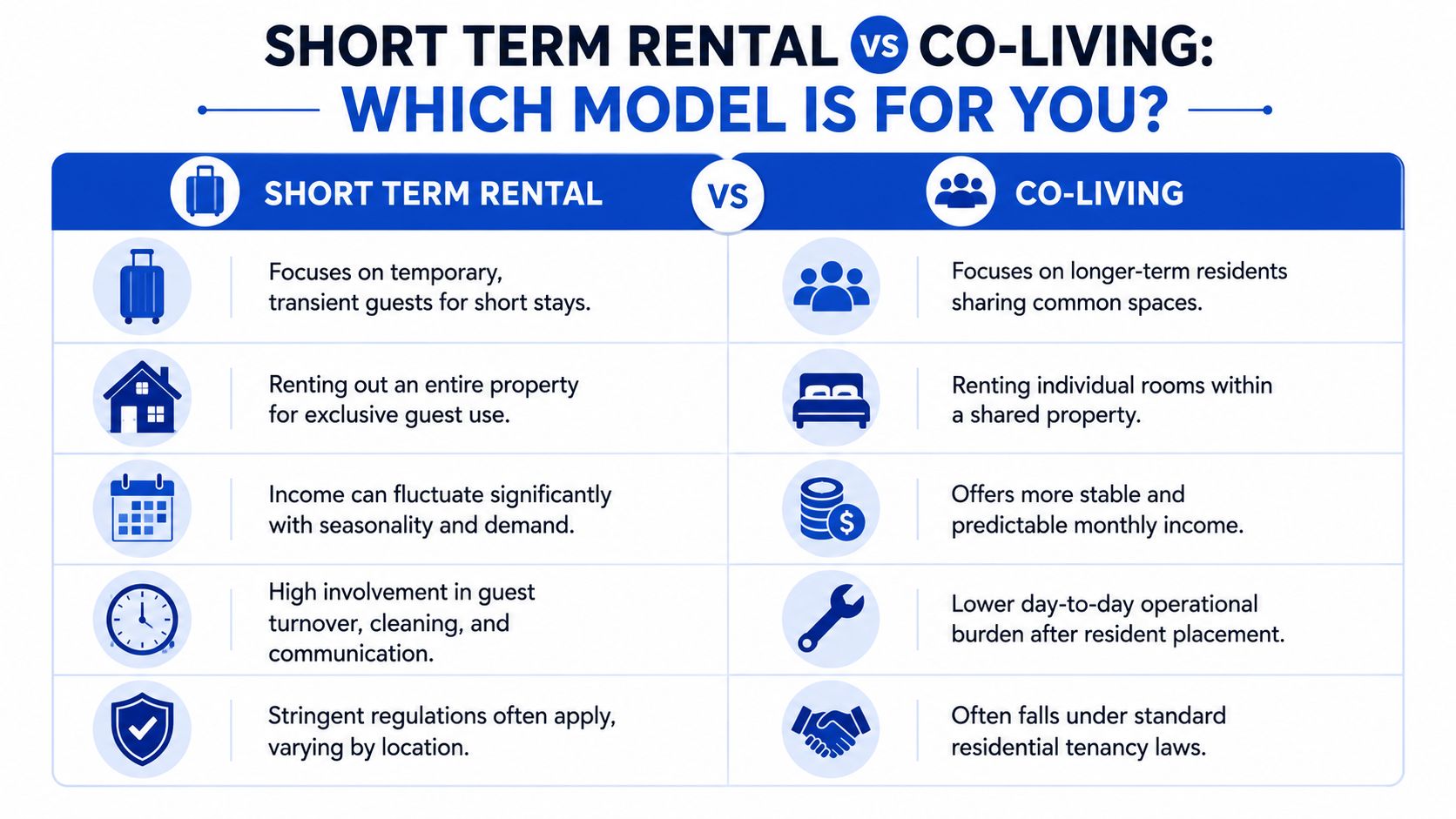
Short Term Rental vs Co-living Which Model Is for You
This is the decision that matters most for investors who care about break-even risk.
A short term rental behaves like a day-trading strategy. You pursue stronger peaks, but you accept more volatility, more attention, and more exposure to mistakes. A co-living property behaves more like a dividend strategy. You trade some upside for steadier monthly performance and simpler operations after the rooms are filled with the right residents.
Where the STR model shines
If your property sits in a true destination market, has a strong guest hook, and can command consistent demand, STR can still be the better play. This is especially true for homes that are hard to replicate. Think large gathering spaces, special amenities, or a location guests actively seek.
The STR model is often stronger when:
- The home is unique: Guests can find many places to sleep. They book memorable places to stay.
- The owner likes operations: Hospitality systems, vendor coordination, and pricing decisions don't feel like a burden.
- The market supports turnover: There is real demand from travelers, not just hopeful host optimism.
- You want flexibility: Personal use and rapid repositioning still matter.
Where co-living often wins
Co-living works best when the property's strength is layout, affordability, and practical demand from residents who need housing, not a vacation experience.
A good room-by-room house doesn't need weekend tourism to work. It needs durable resident demand, workable common areas, strong house rules, reliable screening, and efficient rent collection. Once the right members are placed, the operating rhythm is usually calmer than an STR.
Here's the practical comparison:
| Factor | Short term rental | Co-living |
|---|---|---|
| Revenue pattern | More variable | More stable |
| Turnover pace | Frequent | Less frequent |
| Communication load | High-touch guest support | More routine resident communication |
| Cleaning cadence | Constant reset standard | Shared-space maintenance schedule |
| Scalability | Harder without systems and staff | Often easier to standardize by room |
The break-even pivot point
This is the angle most STR guides skip.
A property should pivot away from the STR model when management intensity and inconsistency start eating the spread that made STR attractive in the first place. I don't wait for a property to become a total failure. I look for warning signs that the business is becoming fragile.
Watch for these signals:
- You are the margin: The deal only works because you're personally handling guest messaging, vendor issues, and pricing.
- The home is becoming generic: It lacks a clear reason for guests to choose it over nearby alternatives.
- Seasonality is too sharp: Peak periods look great, but the slower months erase progress.
- Turnover pain is constant: Cleaning coordination and maintenance interruptions dominate your week.
- Co-living demand is stronger than travel demand: The area supports workforce housing, students, medical staff, relocations, or residents who need flexible room rentals.
When those signs stack up, room-by-room co-living can preserve income and reduce stress. You shift from chasing booking velocity to building dependable occupancy. You stop underwriting the property like a mini hotel and start operating it as shared housing with better unit economics than a single lease.
The best investors don't fall in love with a model. They pivot when the property tells them to.
Which owner profile fits each model
Choose STR if you want a more active business, your property stands out, and you can support a hospitality-grade operation.
Choose co-living if you care more about monthly consistency, cleaner forecasting, and a portfolio that can scale without needing every house to act like a boutique stay.
Choosing the Right Path for Your Property
There isn't one best strategy. There is only the strategy that fits the property, the market, and the way you want to operate.
If your house sits in a location with clear travel demand, has features guests will pay for, and you don't mind running a hospitality business, a short term rental can still be a strong model. But be honest about the break-even point. If the deal depends on your unpaid labor, constant responsiveness, and near-perfect execution, the margin is thinner than it looks.
If you prefer steadier performance, less day-to-day chaos, and a model that gets easier to standardize across multiple houses, co-living deserves serious attention. For many ordinary homes in ordinary neighborhoods, room-by-room rental is the more durable path. It may not produce the same peak excitement, but it often delivers a better operating life and a more dependable income stream.
The smartest move is to evaluate the property as it exists, not as you hope it will perform. Underwrite the workload. Underwrite the vacancy pattern. Underwrite who the end user really is.
When the answer points to stability over spikes, co-living is often the better business.
If you're building or converting room-by-room rentals, PadPulse is worth watching. It's being built for PadSplit hosts and co-living operators who need one place to manage pricing, messaging, smart access, and portfolio visibility without stitching together a dozen separate tools. If that fits the direction you're heading, join the interest list and keep an eye on the beta.