Optimize Apartment Gate Codes: Co-living Access 2026
June 5, 2026
A resident moves in at 8:30 p.m. The leasing note says they have the gate code, but the code in the welcome text is old. A food delivery driver is waiting at the entrance. Someone else tails through the gate because a current resident shared the code with a former roommate weeks ago.
That kind of access chaos isn't a technology problem first. It's an operations problem.
In co-living, apartment gate codes touch everything at once: resident experience, safety, staff workload, vendor coordination, and move-out control. Traditional apartment advice usually assumes one lease, one household, and lower turnover. Room-by-room housing doesn't work like that. You have multiple unrelated adults, frequent guest requests, more handoffs, and more chances for a code to spread beyond the people who should have it.
The fix is a playbook. Not a random list of code tips. A real operating system for who gets access, when they get it, how it expires, and what your team does when something goes wrong.
Why Your Apartment Gate Code Strategy Matters
A gate code problem usually shows up as a small support ticket. In co-living, it turns into a building-wide operations issue fast.
One resident shares the code with a guest. Another moves out and still has it. A vendor keeps using yesterday's instructions because nobody closed the loop. By the time the team notices, staff are fielding access texts, residents are asking whether the property is secure, and nobody has a clean record of who came through the gate.
That pattern is common in co-living for one reason. The access model is more complicated than standard multifamily. You are not managing one household behind one lease. You are managing multiple unrelated residents, staggered move-ins, roommate changes, recurring vendors, and guest access requests that do not follow office hours.
Gate codes sit at the front of all of that. They shape first impressions for new residents, determine how much time staff spend answering entry questions, and affect how quickly you can respond after a move-out or incident.
What goes wrong when access is handled loosely
Loose code management creates the same operational failures again and again:
- Security gaps because one shared code spreads beyond the people who should have it
- Higher support load because residents, guests, and vendors keep asking which code still works
- Poor incident response because the team cannot tie entry activity to one resident, guest, or contractor
In co-living, those failures show up faster. Turnover is higher. Guest volume is higher. There are more edge cases, and edge cases become your daily workload if the process is weak.
A simple test helps. If your on-call team gets a late-night message about gate access, can they confirm who should have entry, revoke the wrong credential, and issue the right one without calling three people or checking old text threads? If not, the strategy needs work.
What good operators optimize for
Good gate code strategy is not about making entry harder. It is about making entry predictable for authorized people and easy to shut off for everyone else.
The target state looks like this:
| Operational need | Weak approach | Better approach |
|---|---|---|
| Resident access | One shared property code | One credential per resident |
| Guest entry | Text the house code | Time-limited guest access |
| Move-out handling | Change it later | Revoke on the same day |
| Incident review | Ask around in group chat | Check logs and permissions |
The trade-off is real. Shared codes are simple on day one. They become expensive on day thirty. Your team loses time answering exceptions, and your property loses control over who still has access.
In co-living, the best systems reduce both friction and ambiguity. Residents get in without confusion. Staff know who has access right now. Former residents, off-schedule vendors, and old guests do not keep a working credential by accident.
Building Your Core Gate Code Policy
Most properties don't have a gate code problem. They have a policy problem that's showing up at the gate.
Before anyone creates or changes a code, decide the rules. Write them down. Put them in your team SOPs, resident welcome materials, and offboarding checklist. If the policy only lives in one manager's head, it won't survive turnover.
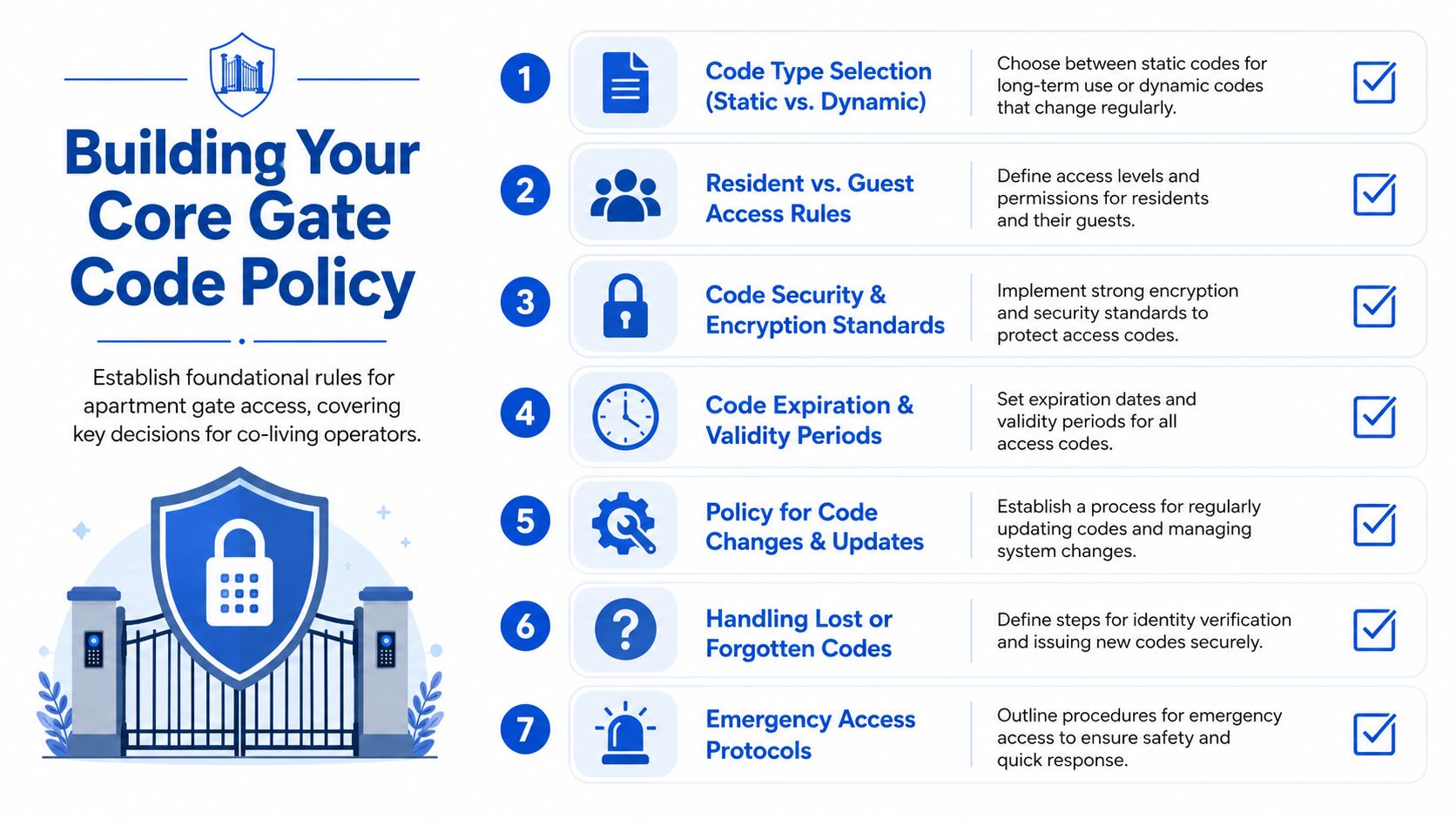
Start with one non-negotiable rule
Use unique, per-user PINs whenever your system allows it. Industry guidance is clear that shared static codes are the main failure mode because they get passed around and become difficult to attribute after an incident. The recommended workflow is to issue an individual code, set an expiration date for move-outs or temporary guests, and keep audit logs that show who entered and when. Cloud dashboards are used to update permissions, revoke credentials remotely, and review logs without reprogramming on site (Swiftlane on residential gate access control).
That single decision fixes a surprising amount of operational mess.
The policy decisions you need to make
Don't write a long legal document. Write a short operating policy that your team can follow under pressure.
Include these points:
Resident access rules
Residents get their own credential. They don't share it with housemates, guests, vendors, or former residents.Guest access rules
Guests should use a temporary method tied to the host resident, not the resident's permanent credential.Vendor access rules
Cleaners, maintenance techs, inspectors, and contractors need separate permissions with a clear validity window.Move-out timing
Revoke resident access as part of offboarding, not "when someone remembers."Who can issue codes
Limit this to named staff roles. Too many admins create code sprawl fast.Where codes are delivered
Never through public channels like house group chats or whiteboards in common areas.What happens after an incident
Define who reviews logs, who changes credentials, and how residents are notified.
A simple policy template you can adapt
Use something like this in your house rules or operations manual:
Residents receive an individual access credential for gate entry. Credentials are personal and may not be shared. Guest and vendor access must be issued through approved temporary methods. Resident access is revoked at move-out or upon lease termination. Staff may issue or modify credentials only through approved management channels. Access events may be reviewed for security and operational purposes.
Co-living policy choices that save headaches later
Regarding this, co-living operators need to be stricter than conventional apartment teams.
Treat each bedroom occupant as a separate user
Don't assign one code to "the house." That's how former residents keep access.Separate social access from operational access
A romantic partner, dog walker, cleaner, and pest vendor don't belong in the same permission bucket.Build around exceptions
The policy has to work on weekends, after-hours, and during turnovers, not just during office time.
The best gate code policy is boring. Staff know exactly what to do, residents know what to expect, and exceptions don't require improvising at the entrance.
Generating and Provisioning Access Codes
Once the policy is set, the actual work starts. Operators then either create order or create permanent cleanup.
Most properties begin with the old model because it's easy: one code for everyone, sent in a text thread, added to a PDF welcome guide, maybe posted in a team note. That setup feels efficient for about a week. Then a resident leaves, a guest keeps returning, or a vendor still has access long after the job is done.
Shared code versus assigned code
Here's the operational difference.
| Method | Why teams use it | What breaks |
|---|---|---|
| Shared static code | Fast to hand out | No accountability, hard to revoke cleanly |
| Unique resident code | Better tracking and cleaner offboarding | Requires process discipline |
| Temporary guest or vendor code | Useful for short-term access | Must be tied to clear start and end times |
Apartment gate systems often rely on numeric keypad credentials, and these codes are typically 4 to 8 digits long. In practice, some property teams assign a unique 4-digit code to each tenant rather than reusing one code across the property. The problem with shared credentials is simple: they can be copied, shared, or posted online, and once several people use the same code, individual accountability falls apart (IS3 Technologies on apartment gate code usage).
A low-tech workflow that still works
If you're using a basic keypad and don't yet have a full smart access stack, you can still run this well.
Use a controlled spreadsheet or property ops database with these fields:
- Resident name
- Room or unit
- Credential issued
- Issue date
- Expiration or move-out date
- Status such as active, pending revoke, revoked
- Notes for special permissions
Then create a standard provisioning sequence:
- Approve the resident for move-in.
- Generate a unique code that isn't already assigned.
- Record it in your access log immediately.
- Deliver it through a one-to-one channel, not a resident group thread.
- Confirm the resident tested it successfully.
- Schedule revocation based on the resident's end date.
The exact code format matters less than consistency and tracking. What you don't want is staff making up codes ad hoc with no record of who has what.
Secure delivery matters more than people think
A lot of code leakage happens during provisioning, not after.
Bad delivery methods include:
- House group chats because old members may still be in them
- Printed sheets in common areas because anyone can photograph them
- Forwarded emails because credentials get buried and reshared
- Verbal handoffs through current residents because accountability disappears
Use direct resident communications and keep one source of truth. If you already run connected entry systems, pairing that with a documented smart lock setup workflow for rental operations helps keep access assignment and physical entry aligned.
What better systems change operationally
The best access tools don't just generate a code. They reduce admin drag.
A stronger setup lets your team:
- Assign one resident at a time without affecting everyone else
- Set end dates for temporary access at the moment of creation
- Revoke remotely without a site visit
- Check logs quickly when a resident reports an issue
If a code must be copied from one note into three different systems, your process is already too fragile.
In co-living, provisioning is part of onboarding. Residents shouldn't arrive guessing which code is current, and staff shouldn't have to search old texts to find it.
Managing Rotation and Emergency Access
A gate code system doesn't fail because the original setup was bad. It fails because nobody maintained it after move-ins started piling up.
In co-living, rotation and exception handling need to be routine. Turnover is part of the model, not an unusual event. If your process treats every move-out, lockout, or vendor visit like a surprise, the entrance becomes a daily support queue.
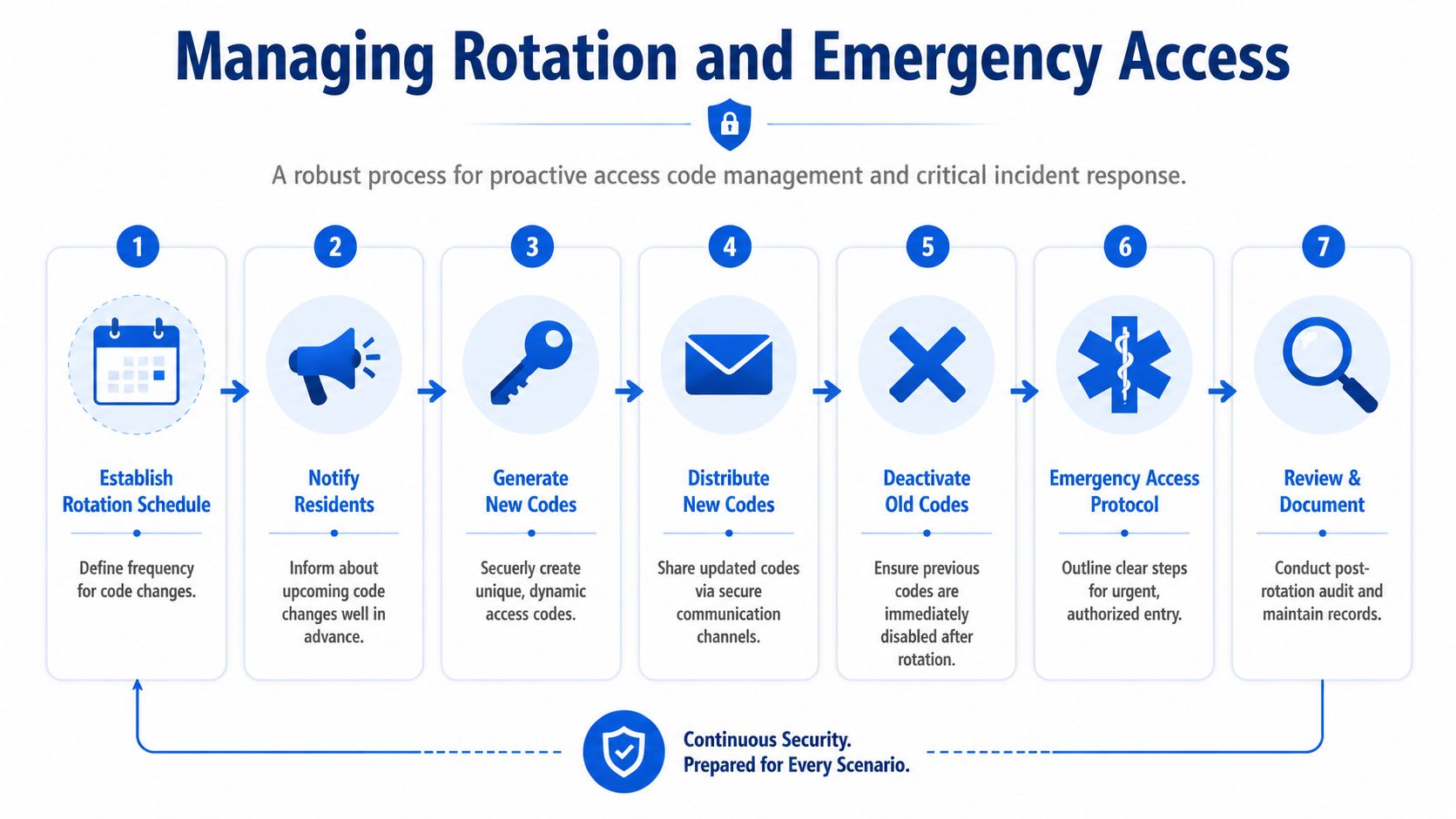
Handle move-outs the same day
Former residents keeping access is one of the most preventable problems in shared housing.
Use this turnover sequence every time:
- Confirm departure as part of your offboarding checklist
- Revoke resident credentials on move-out day
- Remove any linked guest permissions tied to that resident
- Test access states so current residents aren't accidentally locked out
- Document completion in your property record
For a house with multiple unrelated residents, same-day revocation isn't optional. A "we'll update it Monday" habit is how stale credentials stay active.
Build a clean lockout workflow
Residents forget codes. Phones die. People type the wrong sequence after a late shift. Those events don't require blowing up the whole access system.
Use a support workflow like this:
- Verify the resident's identity through your normal resident record.
- Confirm whether the credential is active or expired.
- If active, resend instructions or reset the resident-specific credential.
- If expired or compromised, issue a replacement and retire the old one.
- Log what happened so repeated issues are visible.
Don't solve lockouts by sending the shared property code "just for now." Temporary shortcuts have a way of becoming permanent.
Emergency and non-resident access needs their own lane
The hardest gate problems aren't usually residents. They're exceptions. Delivery drivers, process servers, emergency responders, on-call maintenance, and guest arrivals all create pressure to use whatever code opens the gate fastest.
That's where operators get into trouble.
A better approach is to separate urgent access from normal resident access. Industry guidance highlights this as a core issue for residential gates: the challenge isn't whether a code exists, but how to grant access without creating a long-term security leak. Newer systems are moving away from generic codes and toward mobile credentials, call-box integrations, license-plate recognition, and other per-user tools because once a generic code is exposed, it's difficult to contain (Gatewise on apartment gate operations).
If you're reviewing options, it's worth looking at how modern smart lock and access integrations for property operations support temporary permissions and cleaner revocation.
A vendor should never need the same access method as a resident. If they do, your exception process is leaking into your core security model.
Auditing, Legalities, and Smart Technology
Once a property grows beyond a handful of residents, gate access becomes a records problem as much as a hardware problem.
If someone reports unauthorized entry, disputes a guest visit, or says a former resident still has access, you need more than staff memory. You need logs, a documented policy, and a system that shows what happened without guesswork.
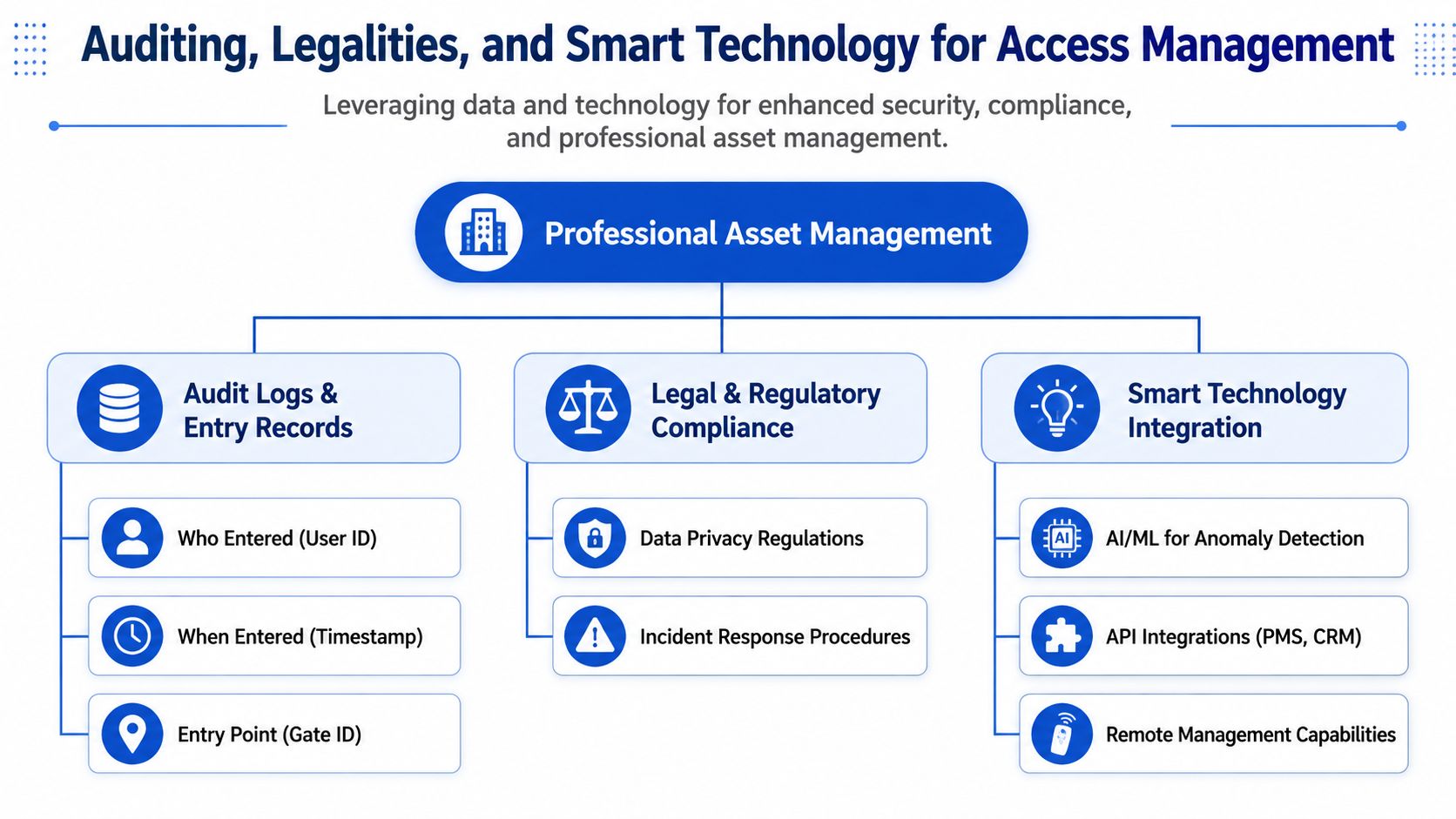
Audit logs turn access into something manageable
For operators, auditability is the dividing line between old gate setups and professional access control.
The broader market has been moving away from shared keypad systems toward trackable entry methods. One practical reason is cost history. Full commercial gate systems can range from $2,500 to more than $100,000, with physical gate hardware and motors often ranging from $3,000 to $13,000, which helps explain why many properties started with simple codes and upgraded later as budgets allowed. At the same time, gated communities experience 33% fewer break-ins than non-gated communities, which is why access control became a serious operating priority rather than just an amenity (Proptia on gate access code systems).
Those numbers matter, but the daily takeaway is operational: if the system can't tie access to a person and a time, it becomes hard to investigate incidents or defend your process.
What to document and what to disclose
Operators don't need to become lawyers to run this well, but they do need basic discipline.
Keep a record of:
- Who received access
- What type of access they received
- When it started
- When it ended or was revoked
- Who approved the change
- What happened after any reported incident
Then make sure your resident-facing documents say, in plain language, that the property manages access credentials and may review access records for security and operational reasons.
That's good practice for two reasons. First, residents deserve clarity. Second, staff need a consistent standard for handling entry data. Loose handling of access records causes the same kind of confusion as loose handling of codes.
Smart technology is useful when it removes manual work
Not every property needs a full replacement of its gate hardware right away. But once you're managing enough rooms, manual credential tracking starts to break.
Look for systems that make these tasks easier:
| Need | Manual approach | Smarter approach |
|---|---|---|
| Resident onboarding | Staff sends code by hand | Credential issued through a controlled system |
| Move-out | Team remembers to remove access | Revocation tied to offboarding |
| Incident review | Search texts and notes | Searchable access log |
| Hardware coordination | Separate tools for each lock or gate | Connected platform and integrations |
If your property uses supported lock ecosystems, TTLock and Sifely integration workflows show how connected tools can centralize assignment, revocation, and visibility across entrances.
Smart access tech isn't valuable because it's new. It's valuable because it cuts down the number of manual steps where people forget, delay, or improvise.
Your Actionable Gate Code Checklist
If your current setup depends on memory, group texts, and one code that everybody knows, fix that first.
Use this checklist to tighten your process:
- Write one access policy that separates residents, guests, vendors, and emergencies
- Assign individual credentials instead of relying on a shared building code
- Deliver credentials securely through direct resident communication, not public or reused channels
- Log every issuance and revocation in one system your team can maintain
- Tie access to dates so move-outs and temporary visits have a clear end point
- Remove credentials on move-out day as part of offboarding
- Create an exception process for cleaners, contractors, deliveries, and urgent access
- Review logs after incidents instead of trying to reconstruct events from memory
- Update resident documents so expectations around access and recordkeeping are clear
- Upgrade tools when manual work starts breaking because scale exposes weak workflows fast
For co-living operators, the goal isn't to make the property feel locked down. It's to make entry smooth for the right people and easy to control when occupancy changes. That's what cuts support tickets, avoids awkward resident disputes, and keeps former occupants from lingering in your system.
A clean gate code process feels invisible to residents. That's the mark of a good one.
PadPulse is building an all-in-one platform for PadSplit hosts and co-living operators who want tighter operations without adding more admin work. If you want a simpler way to manage pricing, communications, and connected access from one place, join the PadPulse interest list.