Short Term Rental Management Software: A Beginner's Guide
July 26, 2026
Are you drowning in a sea of spreadsheets, juggling messages across half-dozen apps, and manually tweaking your prices every day? If that sounds familiar, you know it's the fastest path to burnout. For most hosts, this is a frustrating reality that not only kills your time but also puts a hard ceiling on how much your business can grow.
This is where short term rental management software comes in. Think of it as a central command center for your entire operation, turning that mountain of chaotic tasks into a well-oiled, profitable business. This guide will walk you through what this software does, why it's essential, and how to choose the right one for you.
Why Manual Rental Management No Longer Works
If you're managing co-living spaces or renting out individual rooms, you know the daily grind all too well. It’s answering the same question for the fifth time, manually changing nightly rates on every single listing, and trying to figure out who paid what and when. This isn't just inefficient; it’s completely unsustainable.
Trying to manage your properties manually is like being an air traffic controller for a busy airport with nothing but a notepad and a telephone. You might handle one or two planes just fine, but the moment things get busy, the whole system collapses. Each new property or guest is another plane in the sky, and another chance for a missed message, a double-booking, or a costly mistake.
The Shift to Automated Operations
The entire industry is moving away from these patchwork methods. In today's market, especially for unique models like PadSplit and co-living, technology isn't just a nice-to-have—it's what separates the businesses that thrive from those that barely survive.
The data speaks for itself. By 2025, a massive 61% of short-term rental (STR) operators had already adopted AI-powered tools. That’s a huge leap in just a few years, and it shows that automation is now a fundamental part of staying competitive. You can see more on this trend in the 2026 Short-Term Rental Report by Hostaway.
This is precisely the gap that short term rental management software fills. It's not just another app to add to your phone; it's the central nervous system that connects every moving part of your business.
Instead of constantly reacting to problems and putting out fires, a proper software platform lets you become a proactive business owner. It hands the repetitive, time-sucking tasks over to automation so you can finally focus on what really matters: growth.
Before we dive into the specific features, let's put the difference in stark contrast. Managing a rental portfolio is a series of repetitive tasks. Here’s a quick look at how software changes the game entirely.
Manual Chaos vs. Automated Control
| Task | The Old Manual Way | The New Automated Way |
|---|---|---|
| Pricing | Manually checking comps and updating rates across listings. Takes hours, often inaccurate. | Dynamic pricing tools automatically adjust rates based on demand, seasonality, and local events. |
| Guest Messaging | Copy-pasting answers to common questions, 24/7. Slow responses and inconsistent info. | Automated messages for check-in, check-out, and FAQs. Instant, consistent communication. |
| Bookings | Manually updating calendars on different platforms to avoid double-bookings. High risk of error. | A channel manager syncs calendars in real-time across all booking sites. |
| Team Tasks | Texting cleaners, tracking maintenance requests in a notebook. Things fall through the cracks. | Automated task assignments, notifications, and progress tracking for your entire team. |
| Reporting | Spending days in spreadsheets trying to calculate occupancy, revenue, and profit. | Instant, detailed reports on key metrics with the click of a button. |
Looking at this comparison, the value becomes crystal clear. It's not just about saving a few minutes here and there; it's about reclaiming entire days and preventing costly errors that eat into your profits.
The Cost of Doing Nothing
Sticking with spreadsheets and manual workflows doesn't just cost you time—it hits your wallet directly. Without automated systems in place, you’re almost certainly facing:
- Lost Revenue: Every time you fail to adjust your prices for a local concert or a holiday weekend, you're leaving money on the table.
- Operational Inefficiency: Every hour you spend on mind-numbing data entry is an hour you could have spent finding your next property or improving your guest experience.
- A Poor Guest Experience: Slow response times and disorganized communication lead to bad reviews, which means fewer bookings down the line.
The bottom line is simple. As the rental market gets more crowded and guest expectations continue to rise, relying on manual processes is a recipe for falling behind. Adopting a modern software solution is the single most powerful step you can take to protect your time, boost your income, and build a rental business that can actually scale.
Exploring the Core Features of Modern Platforms
Jumping into short term rental management software can feel overwhelming, with all its talk of APIs and algorithms. But once you look past the buzzwords, you’ll find these platforms are built to solve the real-world headaches you deal with every single day. The best way to think about this software is not as one giant, complicated program, but as a team of digital assistants, each an expert in one part of your business.
These platforms essentially become your command center. They take the messy, manual chaos of running a rental business and bring it all under control.
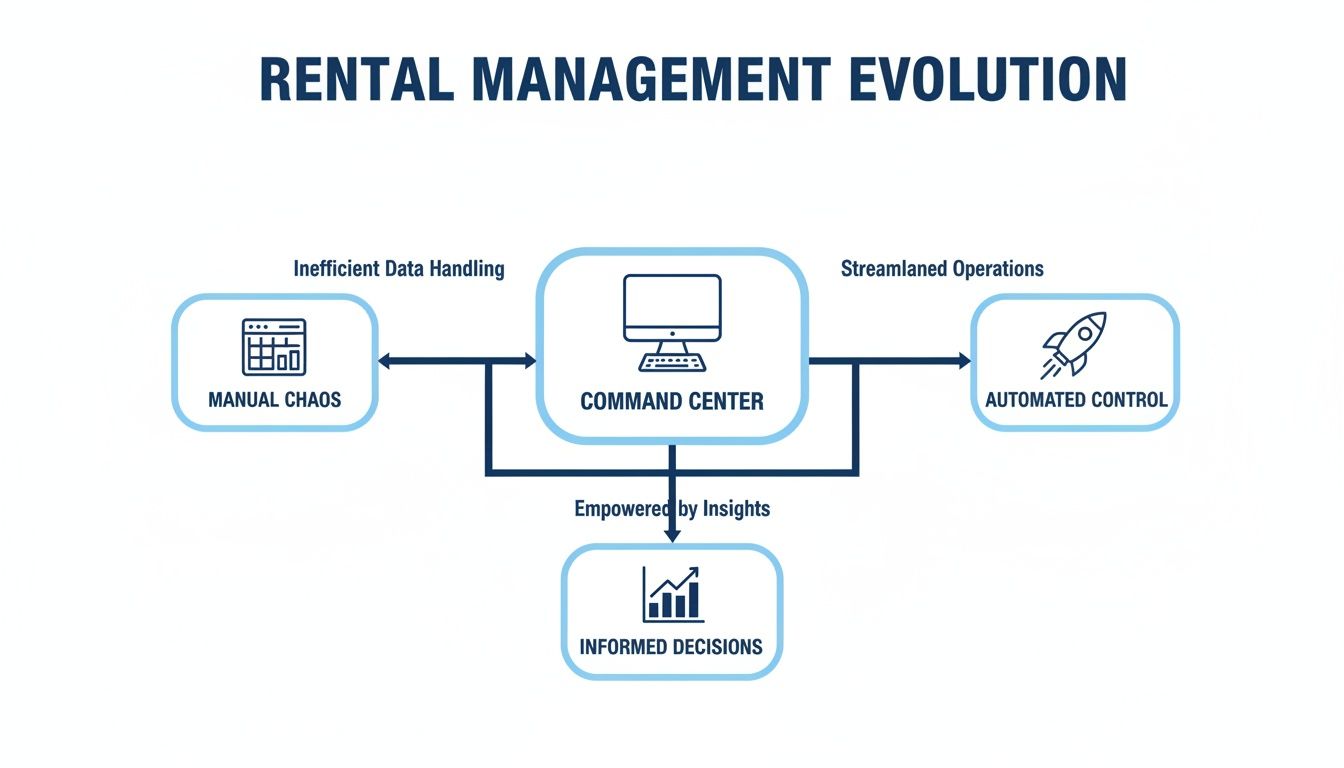
The image above really tells the story. Trying to juggle disconnected spreadsheets, calendars, and messaging apps is a recipe for mistakes and missed opportunities. A unified system, on the other hand, gives you the automation and clear oversight you need to actually grow.
Let's break down the core features that make this happen.
Dynamic Pricing: Your Personal Revenue Manager
Setting room rates manually is often just a shot in the dark. Are you leaving money on the table during a big holiday weekend? Or are your prices too high for a slow Tuesday in February? Dynamic pricing takes the guesswork out of the equation.
Think of it as having a personal stockbroker for your room rates. This feature constantly scans the market, looking at local events, flight data, competitor pricing, and seasonality. It then automatically adjusts your rates to find the perfect balance between occupancy and profit.
Here’s a practical example:
- When demand surges: For a big local concert, it smartly increases prices to maximize your revenue.
- During slow spells: For a random weekday, it strategically lowers rates just enough to fill rooms that would have otherwise sat empty, keeping your cash flow positive.
This is a game-changer for co-living operators. Instead of a one-size-fits-all rate for the whole property, you can optimize the price for every single room, ensuring you’re capturing its true market value.
AI Guest Messaging: Your 24/7 Digital Concierge
How much of your day is spent answering the same questions? "What's the Wi-Fi password?" "Where should I park?" "What time is check-out?" It’s a massive time sink. AI-powered guest messaging hands this entire task over to a bot.
This tool acts like a digital front-desk clerk who never sleeps. It provides instant answers to common questions, sends scheduled messages with check-in details, and can even trigger tasks for your cleaning crew once a guest departs. To see how this syncs across different booking sites, check out our guide on what a channel manager is and how it all connects.
For you, this means no more waking up to a 3 AM text from a guest who can’t find the lockbox. For your guests, it means getting quick, professional answers every time, which is a direct path to glowing reviews.
For a co-living business, that consistent and reliable communication is the bedrock of a great community. When routine messages are automated, you're free to focus on the human interactions that truly matter.
Smart Home and Access Control: Your Digital Locksmith
Let’s be honest: physical keys are a security nightmare. They get lost, copied, and create endless logistical challenges, especially when you're managing remotely. Smart home and access control integrations make this whole problem disappear.
By installing smart locks, you can generate a unique digital code for every single guest or member. That code only becomes active at their check-in time and automatically expires the moment they check out. This gives you:
- Serious Security: No more wondering who might have a spare key floating around.
- Effortless Operations: Forget coordinating in-person key handoffs.
- Total Oversight: You get a digital log of every entry, so you always know who is coming and going.
This technology goes beyond just locks. You can also integrate smart thermostats to automatically adjust the temperature between stays, chipping away at your utility bills without you lifting a finger.
Centralized Reporting: Your Financial Dashboard
Do you really know how healthy your rental business is? Trying to stitch together the financial picture from a bunch of spreadsheets is like trying to diagnose an illness without any medical equipment—it's slow, inaccurate, and you’re bound to miss something important.
Centralized reporting tools are like a financial dashboard for your portfolio. In just a few clicks, you can get a deep, accurate view of your business's performance, whether you want to look at a single room, an entire property, or your whole portfolio. It tracks all the crucial metrics:
- Revenue and occupancy rates
- True profit and loss (P&L) statements
- Booking trends and average nightly rates
For co-living hosts, this data-driven clarity is transformative. It helps you instantly spot which rooms are underperforming, understand your real net operating income, and make smart, confident decisions to drive profitable growth.
Calculating the Real ROI of Your Software
Whenever you look at a new tool for your business, the first question is always the same: "What's the ROI?" But with short term rental management software, thinking only about saving a few hours a week completely misses the point. A good platform isn't just another monthly expense; it's an engine that can seriously boost your bottom line.
Forget just automating a few tasks. Let's dig into the real, tangible ways this tech actually puts more money in your pocket. It’s all about turning operational efficiencies into cold, hard cash flow.

You don't have to take our word for it—just look at the market. The global Short-Term Rental Management Software space is exploding and projected to hit $2,350 million by the end of 2025. It's growing at a blistering 14.5% compound annual growth rate (CAGR) through 2033, according to a comprehensive market analysis from Data Insights Market. Why? Because as more travelers demand authentic, home-like stays, operators like us need professional tools just to keep up.
More Revenue Through Smarter Pricing
The clearest way to see a return is with dynamic pricing. If you're still setting rates by hand, you're almost certainly leaving money on the table. Think of a dynamic pricing tool as a dedicated revenue manager who works for you 24/7, never takes a vacation, and is obsessed with your occupancy.
But its real magic isn't just jacking up prices on holidays. It's about intelligently filling those awkward gaps in your calendar. By constantly scanning market data, it can pinpoint the perfect price to snag a last-minute booking for a random Tuesday night, turning a zero-revenue day into a win. For a PadSplit or co-living operator, this means creating a much more stable and predictable income stream.
Practical Example: Let's say you have one room that sits empty for four extra nights a month. If dynamic pricing helps you fill just those four nights at a conservative $60/night, that's an extra $240 in revenue per month. From a single room. Now, do that math across your entire portfolio.
Fewer Costs Through Smart Operations
On the other side of the ROI coin, the software actively cuts your operating costs. The savings show up in a lot of places you might not even think about.
- Lower Utility Bills: Integrated smart thermostats let you set rules so the AC isn't blasting in an empty room between guests. That wasted energy adds up fast.
- No More Key-Related Headaches: Physical keys are a pain. They get lost, guests lock themselves out, and locksmiths are expensive. Smart locks completely eliminate this cost and the hassle of coordinating key handoffs.
- Less Income Lost to Vacancy: Automated messaging and instant booking mean the time between an inquiry and a confirmed reservation shrinks dramatically. A faster response time means fewer potential guests get tired of waiting and book somewhere else.
By taking care of these small but crucial details, the software plugs the little financial leaks that drain your profits. Every dollar saved drops directly to your net operating income.
Cashing in on Your Most Valuable Asset: Time
Finally, let's put a price on your own time. What’s an hour of your day worth? If automated messaging saves you five hours a week, that’s 20 hours a month handed back to you.
What could you do with that time instead of answering "What's the Wi-Fi password?" for the tenth time? You could be:
- Scouting and analyzing two new potential properties.
- Optimizing your listings to rank higher in search results.
- Building relationships with local handymen to get better rates on maintenance.
These are the high-value activities that actually grow your business. When software handles the daily grind, you’re free to be the CEO of your portfolio, not just its busiest employee. The real ROI isn't just in the money you make or save—it's in the new opportunities you finally have time to chase. For a deeper dive on what to track, our guide on leveraging short-term rental analytics is a great place to start.
How to Choose the Right Software for Your Properties
Picking the right short term rental management software can feel like a make-or-break decision for your business. And honestly, it is. The platform you choose becomes the very backbone of your day-to-day operations. But here's the most critical thing to grasp: not all software is built the same, especially when you're renting rooms instead of entire houses.
Most platforms on the market were designed for the traditional vacation rental model—think a single family renting a beach house. They're fantastic for managing one booking calendar for one property. For a co-living or PadSplit operator, that model just falls apart. Your needs are fundamentally different, and forcing a traditional tool to work for you is like trying to hammer in a screw.
You're running a complex, multi-tenant business within a single property. That's a completely different ballgame, and it demands a specialized tool built for the job.
The Right Questions to Ask
To avoid sinking time and money into a platform that creates more problems than it solves, you have to vet potential software through a co-living-specific lens. Generic feature lists won't tell you what you really need to know. You have to dig deeper.
During any demo or trial, start with these questions:
- Does it support room-specific pricing? Can you actually set and dynamically adjust rates for each individual room, or are you stuck with one flat price for the whole property?
- How does it handle individual room reporting? Can you pull a quick profit and loss (P&L) statement for "Bedroom 3" to see if it's pulling its weight?
- What smart home integrations are available? Does it seamlessly connect with the smart locks and thermostats that are non-negotiable for secure and efficient co-living management?
- Is the system built for scalability? Will it perform just as well when you grow from 10 rooms to 100, or will you be dealing with constant lags and crashes?
These questions get right to the heart of what makes room-by-room management so unique. If a company can't give you confident, clear answers, it's a major red flag that their software isn't the right fit.
The goal isn't to find software with the most features; it's to find the software with the right features. A simple tool designed for co-living will always outperform a complex one built for something else.
Your Co-Living Software Evaluation Checklist
Choosing your short term rental management software is all about making an informed decision that truly matches how you operate. This checklist is designed to help you ask the right questions and ensure any platform you consider is actually equipped for the unique challenges of co-living. Getting this right is the difference between finding a true partner and just buying another subscription.
| Feature Category | Key Question to Ask | Why It Matters for Co-Living |
|---|---|---|
| Granular Management | Can I manage pricing, availability, and reporting for each room individually? | This is the absolute deal-breaker. Without room-level control, you're flying blind on revenue optimization and profitability. |
| Ease of Use | Is the interface intuitive for a non-technical host to learn and use daily? | Your software should be a time-saver, not a part-time job. A clunky system will become a bottleneck to your growth. |
| Customer Support | Is the support team responsive and knowledgeable about co-living challenges? | When an issue pops up, you need quick, expert help from people who actually understand your business model, not just vacation rentals. |
| Pricing Model | Does the pricing scale fairly with the number of rooms, or is it based on whole properties? | A pricing model built for whole homes will become incredibly expensive and inefficient as you scale your room count. |
| Integrations | Does it connect with essential tools like smart locks, accounting software, and key booking channels? | A well-integrated platform becomes your command center, cutting out hours of manual data entry between different apps. |
| Future Development | What is the company's roadmap? Are they focused on building more tools for co-living? | You're not just buying a tool for today; you're investing in a partner for tomorrow. As you can see from the rise of AI in property management, you need a forward-thinking partner. |
At the end of the day, the best short term rental management software will feel like it was built by someone who lives and breathes your daily operational hurdles. It should solve your unique problems, empower your growth, and give you the freedom to focus on what matters most: expanding your portfolio. Take your time, ask the tough questions, and choose a partner that’s as invested in your success as you are.
A Step-By-Step Guide to Implementing Your New System
Making the switch to a new short-term rental management software can feel like a huge project, but a smooth changeover is much more achievable than you might think. The right software partner won't just sell you a product; they'll guide you through the transition, making it feel manageable, not monumental. The goal here is simple: get you from your old, disjointed methods to a new, automated system without dropping any balls.
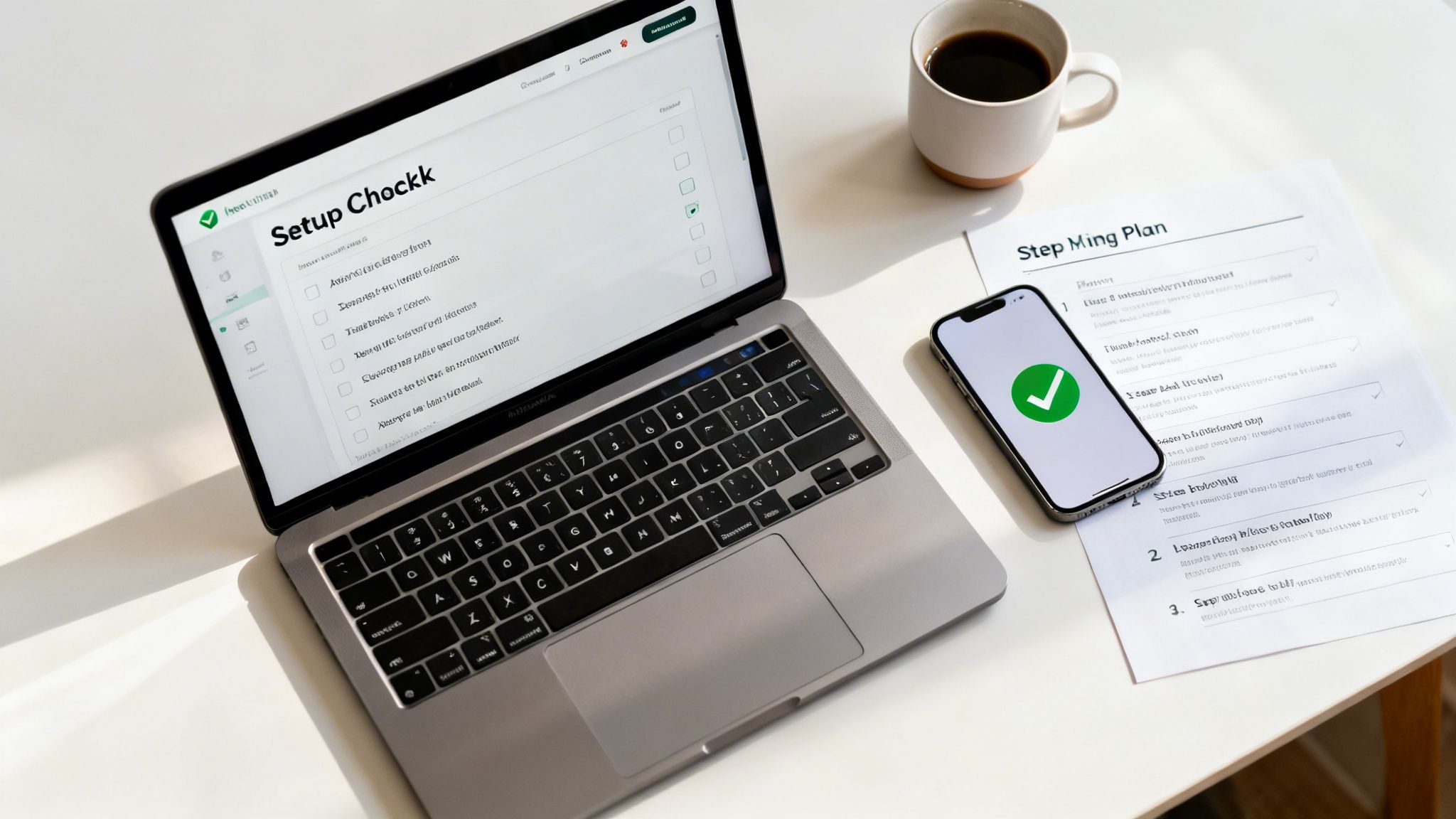
Let’s walk through what this process actually looks like, from getting your data ready to confidently launching your new setup. We'll break down each stage and give you some practical tips to make sure it all goes off without a hitch.
Phase 1: Prepare Your Data for Migration
For many operators, this is the step that causes the most stress: moving your data. It's easy to imagine losing critical booking information or messing up guest details. But with a bit of prep work, this part is surprisingly painless.
Think of it like packing up a house. You wouldn't just toss everything into random boxes. You'd label them—"Kitchen," "Bedrooms," "Office"—so unpacking on the other side is simple. Data migration is the same. Start by getting all your essential information organized and ready to move.
- Property Details: Gather the basics for every unit, like addresses, room names or numbers, and a list of key amenities.
- Booking Information: Pull all your existing and future reservations from your current system, whether that's a calendar, a spreadsheet, or another platform.
- Guest Data: Consolidate your contact lists and any important notes you have on current guests.
Most modern software includes import tools designed to handle this. Often, it's as simple as uploading a well-organized spreadsheet. A little tidying up beforehand ensures nothing gets lost in the move.
Phase 2: Configure Your Properties and Automations
With your data loaded into the new system, you get to the exciting part—setting up your properties and flipping the switch on automation. This is where you’ll immediately feel the power of a true short-term rental management software.
First, you'll connect your accounts with booking channels like Airbnb and Vrbo. The platform will walk you through it, instantly syncing your calendars across all channels and finally putting an end to the dreaded double-booking.
Next, it’s time to set up your first few automations. You don’t need to do everything at once. Start with the basics that will have the biggest impact:
- Welcome Messages: Create a message that automatically goes out right after someone books, confirming the details and making a great first impression.
- Check-in Instructions: Schedule a message to send 24 hours before arrival containing the address, smart lock code, and Wi-Fi password.
- Pricing Rules: Activate a basic dynamic pricing strategy. This is absolutely critical, especially as booking windows shrink. With 27% of all reservations now made 0-7 days before check-in (up from 21% in 2021), your pricing has to be agile. You can read more about these booking window trends to see why real-time adjustments are no longer optional.
A successful rollout isn't about tackling every single feature on day one. It's about building momentum. Getting these first few automations live delivers immediate value and gives you the confidence to explore more advanced tools later.
Phase 3: Go Live and Monitor Performance
Once your properties are configured and your key automations are humming along, you’re ready to go live. This doesn’t mean you have to hit a big red button and just hope it all works.
A smart approach is to run your new software in parallel with your old method for a day or two. This gives you a safety net to confirm new bookings are flowing in correctly and your automated messages are firing exactly as planned.
Once you see that everything is working perfectly, you can officially retire those old spreadsheets and disconnected apps. The transition is complete! Now, you can focus on your new dashboard—watching your occupancy, checking your revenue, and enjoying all the time you've just bought back for yourself. This is the moment you begin to see the real return on your investment.
Key Takeaways for Your Business
We've covered a lot of ground, from the nuts and bolts of dynamic pricing to the sanity-saving power of automated messaging. It’s clear that simply having great properties isn't enough anymore. The real key to scaling a co-living portfolio is running it with precision and efficiency.
If you’re still wrestling with spreadsheets and a patchwork of different apps, it’s time to consider a better way. The first step isn't a massive, complicated leap; it's simply exploring tools designed for the way you actually work. Remember, generic short term rental management software just doesn't cut it, as it's built for whole-unit rentals, not the room-by-room model that defines co-living.
That’s exactly why we built PadPulse. As co-living hosts ourselves, we got tired of trying to force generic tools to work for our unique needs. We decided to build the platform we always wished we had—one that puts pricing, messaging, access, and reporting all under one roof, specifically for hosts like you.
By signing up for our interest list, you'll be first in line for our beta program. It's your chance to get an early look, share your feedback, and lock in special updates before anyone else. We believe the right software should pay for itself almost immediately, and we're excited to show you how.
Ready to finally ditch the spreadsheet chaos and build a more profitable, scalable operation? Join the PadPulse interest list and help us shape the future of co-living management.
Frequently Asked Questions
Thinking about bringing new software into your business is exciting, but it’s normal to have a few questions. This is especially true when you're running a co-living or PadSplit-style operation and need tools that truly fit your unique model.
We get these questions all the time from hosts just like you. Let's walk through the most common ones and get you some clear, straightforward answers.
How much technical skill do I need to use this software?
This is usually the first question people ask, and for good reason—you’re busy running a business, not an IT department. The simple answer? Very little. If you can manage your email or post on social media, you have all the technical skill you need.
Modern platforms are designed with hosts, not coders, in mind. The software guides you through every step, from adding your properties to setting up your first automated message. You won't be messing with code or servers; it’s all about clicking buttons and filling out simple forms.
Is it expensive to get started?
Most operators are pleasantly surprised by the cost. Getting started with short term rental management software is far more affordable than you might think, especially when you consider the time and money it saves you down the road.
Many platforms, including PadPulse, have flexible pricing tiers, so you aren't forced to pay for features you don't use.
- Free or Basic Tiers: Some companies offer free plans for essential tools, like a simple dynamic pricing engine.
- Per-Room Pricing: Unlike software built for vacation rentals, platforms designed for co-living often charge per room. This model is much more cost-effective and scales logically with your business.
It's helpful to see this software as an investment, not an expense. The extra income you'll generate from smarter pricing, combined with the hours you get back each week, means the platform often pays for itself within just a few months.
How long does it take to set up?
You can have the core of the system running in just a couple of hours. The initial setup is a one-time process where you'll add your property details and connect your booking channels, like Airbnb or Vrbo. Most platforms have a guided walkthrough to make it painless.
From there, you can start small. You don't need to automate everything on day one. A great approach is to set aside one afternoon for the basics, then maybe an hour or two each week to explore new features and add more automations as you get comfortable.
PadPulse is the all-in-one platform built by co-living hosts, for co-living hosts. Ready to see how a dedicated tool can transform your operations? Join our interest list for exclusive beta access and updates. Join the PadPulse Interest List